
The words of the anti-hate pledge recently signed by the selectmen are inspirational, if not quite factual. While we might all like to think that “Harvard has always shown that each individual should be treated with dignity and respect,” the town’s history tells a different story.
In his “History of Harvard 1732–1893,” Henry Nourse wrote, “The northeast corner of Harvard early proved to be a place apart from the rest of the town in all senses; its inhabitants from the first being peculiar in their spiritual condition and inclined to religious vagaries.” Over the years, the town responded to the various “peculiar” people living there with increasing intolerance.
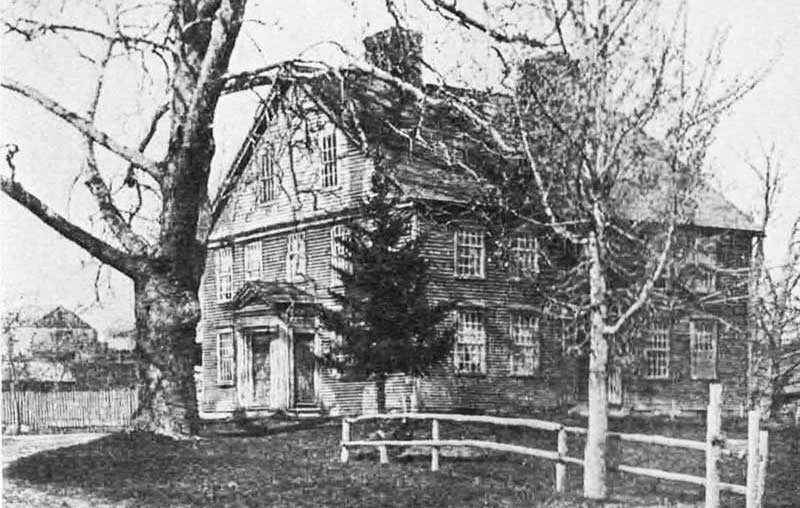
The so-called “Whipping Tree” at Thaddeus Pollard’s house (327 Still River Road), where a Shaker was tied and beaten. The historic tree still stands. (Courtesy photo))
The first to be brought to public disgrace for religious “vagaries” were three married couples residing in northeast Harvard. They were admonished by John Seccomb, the first minister of Harvard, in 1751, for violating both the “discipline and the doctrine” of the Congregational Church; however, Seccomb assured them that “out of charity and good will” the church would welcome them back if they gave up their deviant ways.
At least one of those “separatists,” Isaac Willard, persisted in his refusal to attend the church, and in 1777 he, Abidah Worster, and one other man were released from paying their shares of the minister’s salary on the grounds that they belonged to some other religious society. That “other” was a group of followers of Shadrach Ireland, a “New Light” itinerant preacher of the Great Awakening, who had come from Charlestown to Harvard around 1760 to find refuge from persecution for his blasphemy against the church. He probably chose the northeast corner of Harvard because he had heard of sympathetic believers there. Willard and others hid Ireland until they had gathered enough other believers to need a public gathering place. They built the so-called Square House, which remains in Shaker Village today. The building of the house was done in secrecy, and Ireland remained a recluse there until his death in 1780.
There seems to have been no documented effort to find and persecute Ireland, though the secrecy surrounding him suggests that intolerance was a real threat. His heresy was that he asserted he was immortal in body as well as soul. When he died, his followers waited as long as they could for him to prove his immortality. It seems that rather than being disillusioned, they were ready to bring their zeal to a new prophet.
Shakers arrive
Mother Ann Lee, a Shaker who had come from England with her brother, Elder William Lee, Elder James Whittaker, and three others, arrived in northeast Harvard in 1781, and, declaring that the place had been shown to her in a vision and readily winning over the followers of the late Ireland, settled into the Square House.
Understandably, many Harvard residents, successors of the grim and somber Puritans, found the Shakers’ form of worship disconcerting. According to one observer’s published account: ”When they meet together for worship, they fall a-groaning and trembling … muttering inarticulate sounds … some dancing, others laughing heartily, others agonizing as though they were in great pain … turning around swift for an hour.” They also were troubled by Mother Ann’s assertions that she was “the female Christ.” Further, there were rumors that the Shakers were really English spies with secreted stores of ammunition in the Square House.
‘Remove the people’
A special town meeting of 1781 voted “yes” to the following warrant article: “To hear and consider a petition of a number of inhabitants of Harvard and see if the Town will … consult and determine on some means to Remove the people called Shaking Quakers who are collected together in this town.” A committee was chosen to act in the matter, and its chairman warned the strangers to be gone by a certain date. Mother Ann and the elders left Harvard but returned to the Square House when they were persecuted elsewhere. Again they were warned away, and this time a militia company visited them, prepared to enforce the order. Not content with the actions of the militia, a mob later gathered at the Square House, but Mother Ann and the elders had been warned of its coming and had fled.
Five months later they returned, and the town responded by setting a date in July for their expulsion, posting notices for people to gather on the Common for the purpose. It’s disturbing to note that on the day, “two barrels of cider were furnished the assemblage.” As it happened, a group of ministers was meeting the same day in Harvard. The clergymen urged the people to go home and to let a group of ministers visit the Shakers and ascertain if they had weapons stored. Satisfied that the Shakers were not up to nefarious deeds, the group of ministers convinced the mob assembled on the Common to disperse.
A week or so later, in what sounds like a modern-day protest gathering, scores of Shaker believers from as far away as 100 miles gathered at the Square House and demonstrated their support “with singing, dancing, leaping, shouting, clapping of hands, and such other exercises as they were led into by the Spirit,” according to annalists.
In response to this, a mob of close to 400 townspeople assembled the next morning at the Square House and announced its intention to drive the nonresident believers out of town. The visitors were given an hour for breakfast and preparations, and then, with the mob at the front and rear, they were marched toward the town boundary at Lancaster. Many Harvard brethren persisted in accompanying them.
An account of the 10-mile march from the Square House to the Lancaster border was signed by Abijah Worster and two others and published by Clara Sears in “Gleanings from Old Shaker Journals.” The account says that the mob was armed with whips and cudgels, which they used freely, even “to hasten the pace of the aged and infirm. If anyone attempted to admonish them for their cruelty, he would be threatened with the lash or cudgel above his head.”
About 3 miles into the journey, the mob indulged in the “diversion” of whipping an Englishman, James Shepherd, seemingly venting its anger at not having taken Mother Ann herself into custody. She and a few others had fled the previous week. The rest of the trek was “one continued scene of cruelty and abuse, with whippings with horsewhips, pounding, beating, bruising with clubs, collaring and pushing from bridges into the water and mud, and every kind of abuse they could invent without taking lives.”
At the boundary, the out-of-towners were dismissed with warnings never to appear in Harvard again. The mob turned back, guarding the Harvard Shakers who had insisted on accompanying their brethren. At Captain Pollard’s home, the first house after returning back into Harvard (on what is now Still River Road), “a ring was formed,” and in what was perhaps a longstanding vendetta, Abijah Worster was stripped, tied to a tree, and whipped for the crime of “going about and breaking up churches and families.” The punishment of 20 lashes was interrupted by a prominent resident, James Haskell, who happened to be passing by. He stripped off his coat, offering to take the remaining blows. The mob released Worster.
But the persecution wasn’t over. While some townspeople opposed the cruelty shown to the Shakers, the feeling against the group was so strong that in 1783 a town meeting voted to instruct the selectmen to “warn and carry out of town all the Foreigners called Shaking Quakers.” A crowd of Harvard men surrounded a house in Shirley where Mother Ann and her elders were then conducting worship. Although they did not find Mother Ann, some of the mob scourged the two elders, leaving their bodies bruised and bleeding.
Mother Ann left the Harvard area in July 1783. The town gradually accepted the next generation of Shakers, which was deemed less extreme in demeanor and no longer feared as dangerous to society.
Reviewing history can help to guide us in the present and future. Acknowledging that Harvard has, at times, been brutally intolerant of “outsiders” can only enforce the selectmen’s current commitment to show “that we are a caring and supportive community for all.”