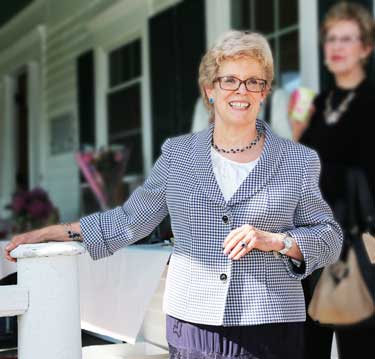
Gretchen Henry addresses the crowd at her retirement party, June 3. (Photo by Lisa Aciukewicz)
Having spent 11 years teaching in Chelmsford and Harvard elementary schools, Gretchen Henry was on her “mom break” when Harvard’s new elementary school building was finished in 1989. The new building, attractive as it was, lacked one important feature. It had no playground, and there was no money left to build one.
So Henry began a community effort to make a playground. After months of planning and fundraising, volunteers gathered on a spring weekend and installed a colorful set of swings, slides, and climbing structures.
From volunteer to administrator
Members of the Harvard Parent Teacher Organization knew a good organizer when they saw one and quickly recruited Henry as PTO president.
Soon afterward, then-Superintendent Lois Haslam suggested that Harvard consider a before- and after-school program for elementary students. When a survey of PTO members showed strong support for the idea, Henry—still a volunteer—presented a complete plan for the program to the School Committee. The committee approved the idea; Bridges was born.
Bridges needed a director, and Henry successfully applied for the position, moving from volunteer to administrator. The Bridges program was combined with Spectrum, which featured after-school classes. In 1993, adult community education and a summer program for students were added, creating a wide range of classes that served many interests and ages.
‘It takes mentors’
Henry has worked closely with Harvard’s school superintendents over the years and credits Haslam and her successors for mentoring her. Superintendent Mihran Keoseian encouraged Henry to get her principal’s certification, which she did in 2001. She also chaired a committee on the organization of the middle school, became curriculum coordinator for math and science, and headed the first technology committee for the elementary school. Superintendent Thomas Jefferson promoted her to associate principal, first as an interim position and then a permanent one.
“It takes mentors,” Henry says. And Henry herself has become a mentor to other school administrators through the Massachusetts Elementary School Principals Association, because, she says, “It was time to pay back.” In one-to-one relationships, she has guided new principals in several towns through the state certification program.
Henry began teaching in the 1970s, and she recalls a number of landmark changes in education as she looks back over her career. She remembers the first year Harvard schools found a way to accommodate a child who used a wheelchair. A fourth-grade class moved from the old Brown Building into the K-wing, which was the only accessible part of the school at the time.
“Funding has always been a problem,” Henry says. She remembers the year (1990) when an override failed by 50 votes. In response, some Harvard residents organized a get-out-the-vote campaign for the next override that succeeded. That group eventually evolved into the Harvard Schools Trust, which provides grants for many educational projects.
Henry also remembers hiring the first learning assistant for the elementary school. It was Suzanne Mahoney, who became a longtime second-grade teacher in Harvard and then a principal in another system. Mahoney then returned to Hildreth Elementary as interim principal several years ago.
iPads and Common Core
Among the most recent changes, Henry is very happy with the use of iPads in fifth grade, soon to be extended to sixth grade. Her stint on the first technology committee, she says, was about 23 years ago, when her now-adult son was nine. “We got some Macs for a lab that year,” she said, shaking her head at how primitive that equipment seems now.
Initially Henry had concerns about how well the statewide assessment program, MCAS, was going to work. But she now serves on the state MCAS committee for third-grade math, and she is impressed with how well the test writers respond to input from teachers. “They really listen to you if you say [a question] is too hard or too easy,” she says. “The process is really good.”
Henry calls herself a strong supporter of the Common Core, a set of educational standards for math and literacy that has been adopted by about 40 states since 2010. Henry considers it important to have a consistent, statewide baseline for curriculum. “I like that equity,” she says, but adds that schools can still create programs above and beyond the basic requirements.
The playground that first drew Henry out of her mom break and into volunteer work for the schools was recently replaced after many years of service. But the volunteer ethic it represents remains strong in the Harvard schools. And when Gretchen Henry retires this June, her influence on the school system will continue in many areas, from the math and science curriculum to the successful integration of new technology, the extended-day program, and more.