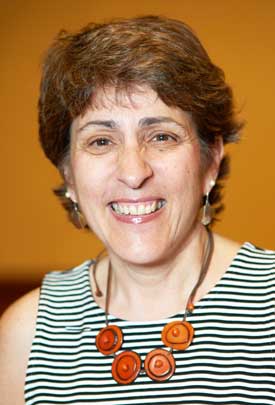
Arlene Sullivan. (Photo by Kathryn Costello)
“I’m really a proponent of the arts,” says retiring teacher Arlene Sullivan, who has taught third-graders in Harvard for 16 years. And her emphasis on the arts is clear in the classroom, from the guitar leaning against a stand at the front of the room to the drawings on every table and desk.
Sullivan says the arts are a great way to reach kids and involve them in learning. Back when the current seventh-graders were in third grade, they wrote the lyrics for the Hildreth Elementary School song, while Sullivan, who has a degree in music, wrote the melody.
It’s important, Sullivan says, to set up an environment in which the kids will not feel self-conscious about singing. The key, she says, is choosing the right songs, often ones that are slightly silly, so that children will take the risk of performing .
“Kids in Harvard are wildly creative,” Sullivan says, and she feels fortunate that both parents in the community and her colleagues at Hildreth Elementary School have strongly supported the arts in the curriculum.
A recent field trip to Boston, which included a duck boat ride, gave third-graders an opportunity to use the visual arts to interpret their experience. In the hall outside Sullivan’s classroom is a mural of Boston, showing the Charles River and the roads along it. Scattered over classroom desks are student drawings of major Boston landmarks: Old North Church, the Pru, Fenway Park. Each will be added to the mural in its (more or less) correct place, while many, many duck boats will bedeck the river.
Much of the trip focused on topics the students were covering in history, such as the Pilgrims and the Puritans, Sullivan says. But doing the art project afterward allowed students to talk about the trip and process what they had learned.
Sullivan also has a special unit that she teaches not just to her own class, but to all four sections of third grade. A colorful box of rocks and minerals sits on her desk, filled with geodes, quartz crystals, a chunk of obsidian, a lump of something greenish and granular. Kids this age love rocks, she says, and want to learn about them. Even a couple of years later, students come back to visit Sullivan’s room and bring her interesting rocks to add to the box.
A year of ‘firsts’
Third grade is a year of many “firsts.” For one thing, it is the year that children begin to learn cursive writing, as indicated by the row of cards high on the wall, each with a neatly formed capital and lowercase letter in cursive. Although some schools have stopped teaching cursive, teachers at HES decided to continue, Sullivan says. And the kids are very excited to learn this grown-up way of writing, she adds.

From left: Dan Page reads from his recent book to his grandson’s class in Arlene Sullivan’s room. Third-graders Gerry Cohen, Wyatt Neville, and Ethan Alfieri listen. (Photo by Lisa Aciukewicz)
Third grade is also the first year in which students take the MCAS, and Sullivan says the best way to reduce anxiety about the test is to make sure the kids are prepared. They need to learn the format of such tests as well as the subject matter, she explains. “Afterward, they mostly say it was easy,” she says, which will help them take future tests in stride.
Sullivan enjoys bringing parents or grandparents into the classroom as resources. A parent who is a geologist, for example, may come to class during that unit on minerals. This year, a grandfather who has written a children’s book is coming to read aloud to the class. So students will have a chance to think about what it means to be an author—not just to read a book but also possibly to write one of their own.
Like the mural of Boston, these special events give students a different way to think about what they are learning and absorb it. Time for processing learning is something that Sullivan both values and worries about. As the elementary school curriculum has become more intense, she says, there is less time for that processing, which often occurs during breaks or at recess. “It’s a tall order, what we are asking of kids now,” she says.