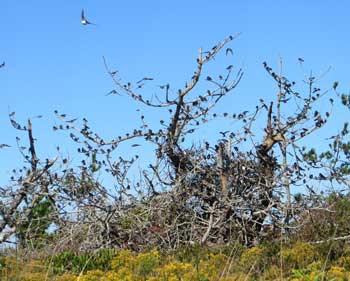
Hundreds of tree swallows congregate on a dead shrub. (Courtesy photo)
We were lucky to be offered a cottage on Nantucket for R&R for a week after my recent operation. The cottage was set in the heath lands with a view out to the dunes and ocean at Surfside. On our first afternoon we were surprised to see flocks of tree swallows winging by. I thought it was rather late for these birds to be migrating as we usually see them congregating on Plum Island to feed on bayberry in August or early September before migrating. Every day we saw thousands of these swallows coming from the east, and streaming by, some of them spiraling down en masse to feed on the bayberries not 30 feet from our deck.
One day we went looking for migrating waterfowl. We drove to the area around Miacomet Pond and were surprised to see tens of thousands of swallows swooping around, forming clouds, and every now and then funneling down to perch en masse on scrub oaks and then off again to feast on bayberries.
Tree swallows headed south
At first I thought some might be northern rough winged swallows because they lacked the blue iridescent sheen of tree swallows. On closer inspection I could clearly see the white throat and belly of tree swallows as distinguished from the dusky brown throat of the northern rough winged. It turns out that a high percentage of the swallows we were seeing were juveniles, which lack the blue iridescent sheen of mature birds.
A little research on the net revealed that the birds we were seeing on Nantucket were from the most northern populations and usually remain on Nantucket through October. Tree swallows summer as far north as Quebec and winter as far south as Central America. The Nantucket population of swallows may winter as far north as North Carolina, while the swallows that nest in Harvard may winter as far south as Central America. Although tree swallows eat mainly insects during the breeding season, they rely on bayberries and other berries to give them much needed fat for their migration south.
From the deck we were able to watch song sparrows scratching around on the ground or calling from the uppermost branches of scrub oaks. The first call I recognized when we arrived was the towhee, and we soon found him jumping around in the brush along with a couple of catbirds. The towhee was usually the first call we heard in the morning.
A favorite raptor
Having a 180-degree view of the heath lands between the ocean and us gave me ample opportunity to observe one of my favorite raptors, the northern harrier. The northern harrier is a large hawk that has a long narrow tail with a white patch at its base, which easily identifies it. This raptor floats over the heath lands, sometimes hovering, in its search for prey. Once it finds a small mammal or even a bird, it will suddenly dive into the scrub and grab it.
There were also catbirds, cardinals, chickadees, Carolina wrens, and blue jays around the cottage; and in the distance there were always cormorants and gulls flying over the dunes.
The week before we left, a pair of immature hooded mergansers visited our pond, and over the week an additional twelve joined them. These were immature first-year birds, their plain brown plumage being nothing like the dramatic breeding plumage that they will develop next spring. They were so drab, in fact, that it was really hard to see them floating on the water. The only thing giving them away were the ripples they caused when they dove for food. They were quite at home diving for tadpoles and shiners—I hope they left some for Jeff, who gathers them for ice fishing in the winter! By the time we got back from Nantucket, they had all departed for their winter home further south.
Hudson trip yields art, but few birds
A later trip to the Hudson Valley to visit Storm King, Dia Beacon, Stonecrop, and Manitoga gave us an overload of art, gardens, and architecture, but very few birds. I was hoping to see several migrants, but the only warblers we saw were dozens of palm warblers flitting around a stand of evergreens at one of the gardens. Other birds around were golden crowned kinglets, flickers, pileated woodpeckers, robins, chickadees, and the usual backyard species.
David Durrant lives with his wife, Pamela, on East Bare Hill Road at Micheldever Farm, where they watch birds—their own peacocks, chickens, and wild birds.