

As I had hoped, the bluebirds fledged a second set of chicks. One pair fledged two and another fledged three. Each day the parents would bring the young to the oak tree that overhangs their feeder. The young would line up on a low branch while the parents flew to and from the feeder bearing sunflower chips. The parents do a good job of feeding each of their young in turn. Once finished, they all fly off to the perch that I made on a post 30 feet off the ground down by the barn.
This same perch is favored by the barn swallows that line up chattering to themselves and then diving off to grab insects, which are their main source of food.
We have had several chipping sparrows hopping around at the base of the feeder, the parents picking up seed pieces and offering them to their young. The tufted titmouse and cardinals have also been bringing their young to the terrace.
Goldfinches are one of the last birds to nest. They nest later in the summer so that when their young are born, there are more plants with seed heads. Pam has planted several species of flowers that now have seeds, and between them and the grasses that naturally grow in the fields, we seem to have plenty to attract these canary-colored birds.
Sitting on the terrace one afternoon I noticed a great blue heron gliding across the fields. He glided about four feet over the lawn, scattering the chickens, who no doubt thought he was a predator, and settling down beside the pond. A while later I heard a great clacking noise coming from the other side of the pond and saw that another heron had joined the first. The two were jumping up and down and clacking their bills together, producing the noise I had heard. Whether this was a territorial display, courtship, or whatever, they were totally engrossed in each other. Later we saw one of the herons in Pam’s perennial garden, which seemed kind of odd, but I assume they can find food just about anywhere.
One of the more vocal birds lately has been the pair of Carolina wrens that we have around here. They are usually the most noticeable in the dawn chorus because of their loud call, which to my ear is reminiscent of tropical birdcalls. These birds are very inquisitive and seem to enjoy human interaction. We can often see them on the terrace, not two feet from the slider, hopping in and out of the terrace furniture looking for insects.
Birds are beginning their winter migrations to the south. Shorebirds are usually the first to leave, but being far from the coast we do not see any of them around the farm. You may pick up some at Great Meadows in Concord or Bolton Flats. One day I heard this great “swoosh,” and hundreds of grackles landed in the trees beyond the pond. They were there only a few minutes before I saw them scattered by an approaching Cooper’s hawk. The hawk was able to separate a bird and chase it right by the barn only feet from where Pam was standing, surprising not only her but my white homing pigeons, who instantly scattered. The hawk missed the grackle but circled around and settled in a Korean mountain ash, probably waiting for one of my chickens or pigeons to reappear. After a few minutes he gave up and flew off into the woods.
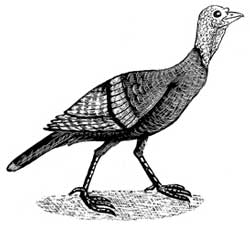
We had fenced our vegetable garden years ago to keep out rabbits and other varmints, but Pam was surprised to see that something had taken fairly large bites out of her tomatoes. The next day Pam surprised a hen turkey and three chicks, which explained who had been doing the munching. Our dog Tetley usually does a good job of scaring off unwanted visitors, but I suppose the turkeys felt safe inside the fence.
A few days later we were surprised to see that 20-plus wild turkeys had joined our hens feeding on the lawn. In our 30 years here, we have never seen more than a half dozen turkeys, and that has been an infrequent occurrence. Seeing so many proves how successful the reintroduction of these birds has been.
David Durrant lives with his wife, Pamela, on East Bare Hill Road at Micheldever Farm.