The powder house on Elm Street was damaged Saturday, Oct. 5, when a vehicle parked at the fire station rolled down the hill and struck it. (Photos by Lisa Aciukewicz)
On Saturday, Oct. 5, Harvard’s iconic 1812 powder house sustained significant damage.
The small brick building with a wooden door is located on a hillside at the west edge of the Elm Street parking for Town Hall. Allegedly, a parked car with unengaged parking brake rolled down the hill from the fire station, struck the building and dislodged it from its foundation. The damage is readily seen from the front of the structure and from the north side, where a large zigzag separates the bricks. Town Administrator Tim Bragan is handling the matter, working with the car owner’s insurance company. Ken Swanton, chairman of the Historical Commission, commented that because of the age of the building, with its double-thick brick walls and old mortar, repairing the building will have to be done by someone skilled in historical brick construction. Unlike what happened so often in the past, volunteers alone cannot rescue the powder house this time.
At some point in their history, almost all small New England towns had a powder house, where ammunition was stored for the militia’s use in protecting the town. Harvard is fortunate in that its powder house has been preserved as part of the historical fabric of the town. Over the years, different groups have contributed to the stewardship of the structure.
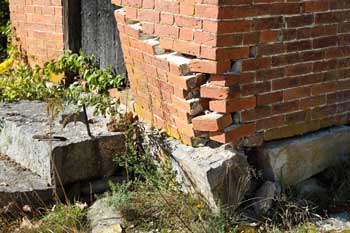
The damage involves both the structure and its foundation.
After its incorporation in 1732, the town kept its military stores in the loft of its meetinghouse. But by 1811, the uncertainty of war and the greatly increased bulk of ammunitions persuaded the town to approve the building of a powder house. The town passed the article and left it to the selectmen to “be a committee to see that said house is built.” The committee decided that the building was to be close to the meetinghouse, sited “on the rocky hill west of the horse sheds on the Common” and to be built to standard specifications for the time: small, square, hip-roofed, built of brick with a heavy oak door and no windows, set on a solid rock foundation. The February 1812 report of the selectmen shows payment of $87 to Philemon Preist.
Hidden by horse sheds and vegetation
For over a hundred years, the brick building stood hidden by horse sheds and overgrown vegetation. In April of 1914 a group of 35 citizens formed a society to be known as the Powder House Association of Harvard, Massachusetts, and declared that they “do hereby affix our signatures and pledge our interest in repairing and preserving the old Powder House.” The signers were prominent Harvard names such as Gale, Dickson, Whitney, Bigelow, and Pollard, each of whom pledged one dollar. Clara Endicott Sears was the single contributor who paid five.
The removal of a row of horse sheds to the west of Town Hall brought the small brick building to light. The original Powder House Association was joined by other citizens in 1932, and they replaced the old door with one designed by Bruce Elwell at the request of the Harvard Woman’s Club. The door, recycled from another building in town, was made to look even older by studding it with square head nails and using old heavy strap hinges. The door cost $40. In 1948 the building received a new roof. Over the years, efforts by the Garden Club of Harvard kept the landscape cleared and planted.
A tradition of citizen stewardship
Continuing in this tradition of citizen stewardship for the powder house, the Historical Commission sought funds in spring of 2006 to once again preserve the old building. The town approved $6,400 for a new roof. Thanks to the expertise and frugality of former resident and Historical Commission member Doug Coots, the roof cost considerably less than this amount. Coots removed the old asphalt shingle roof from the 1940s and installed new sheathing and new sawn western red cedar shingles, which will weather to a lighter color. Coots commented that modern methods of roofing are cost efficient, while giving an old look to historical buildings.
One hopes that “modern methods” of insurance coverage will work to let Harvard continue proper stewardship of this unique old structure.