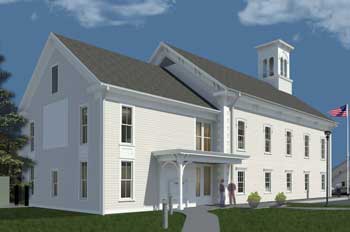
The most recent schematics of Town Hall with the approval of the Harvard Historical Commission. Thie drawing above is of the west side of the building.
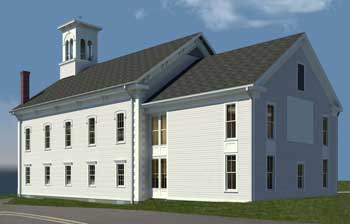
Ayer Road view of proposed Town Hall. (Drawings of courtesy of LLB Architects)
Call it double jeopardy. Efforts to renovate Town Hall are about to go on trial for the third time in as many years.
At Special Town Meeting next week, attendees will be asked to increase the budget for renovating the 1870s-era building by more than 25 percent. Then, at a special Town Election in November, residents will be asked to add the costs of borrowing that money to the town’s taxes for the duration of the loan. The failure of either measure would put the project on hold and leave the immediate future of Town Hall in question.
The request for additional money will be the first item considered when Special Town Meeting (STM) convenes in Cronin Auditorium at 7 p.m. on Wednesday, Oct. 16. The request, which appears as Article 1 in the STM warrant, asks for another $1.1 million dollars for the project so that construction contracts can be signed and the work begun. The money will be added to the $3.9 million budget already approved by Annual Town Meeting voters in 2012, bringing the total cost to $5 million.
Adding to excluded debt
Article 1 also asks that the money be borrowed as part of a 20-year municipal bond and added to the town’s excluded debt for the project. By law, Massachusetts towns can increase their property taxes by no more than two and one-half percent per year (plus new construction), unless voters agree to exceed that amount. By voting to treat Town Hall debt as so-called excluded debt, voters are agreeing to add the yearly payments of principal and interest to what they already pay in property taxes for services in the annual town budget. (See sidebar)
Passage of Article 1 requires a two-thirds vote of meeting attendees, a margin that was easily achieved in 2012. But once the article is approved, the town must agree—by majority vote in a special Town Election—to accept the 20-year costs of the borrowed money as excluded debt. In 2012, that question passed by a narrow margin of 39 (755 to 736) votes out of more than 1500 cast.
Taxpayer impact
The impact of the increase on taxpayers depends on the interest rates available for 20-year municipal bonds. During the recent recession, those rates have hovered at historic lows, near 2 percent or less. But within the past few months, those rates have begun to rise, approaching 4 percent for the first time in years. If the $5 million total can be borrowed at 2 percent, town officials have estimated the cost will add roughly $167 in its first year to the property taxes on a typical $500,000 Harvard home; by year 20, the amount will have declined to $122. At 4 percent, the first year amount is estimated to be $214, declining to $124 at the end of 20 years.
Members of the Town Hall Building Committee and their consultants were as surprised as anyone when they opened subcontractor and general contractor bids for the Town Hall project in September. In 2012, when voters gave their go-ahead, the team had estimated the total cost would be $3.9 million, of which $3 million was allocated for construction. As late as July, Daedelus—the firm hired to provide estimating services—was predicting the total amount had likely increased to $4.1 million. But once the bids were in, it was clear construction costs alone had soared to $4 million. Once all of the other costs were considered and the fund for contingencies was raised from 7 to 10 percent at the recommendation of the Selectmen and Town Administrator Tim Bragan, it was clear that a grand total of $5 million is needed to complete the project.
Various reasons have been given for the magnitude of the increase. Town Hall is a relatively small project as municipal projects go, and as the economy recovers, contractors are drawn to larger jobs available in the Boston area and MetroWest. Only two general contractors bid on the Harvard project. While there has not been a surge in materials costs, contractors who hunkered down during the lean years of the recession are making up for lost time by increasing their cost of labor. Still, the pace of the increase clearly caught project estimator Daedelus off-guard.
Delays faulted for increase costs
But perhaps the biggest reason for the cost increase lies in the delays that have bedeviled the project. Although voters approved a design and spending for Town Hall, the project was delayed for an additional 15 months as the building committee first sought and failed to receive a variance from town center zoning bylaws, and then worked its way through site plan approval by the Planning Board and design approval by the Historical Commission, both of which required some modification of the 2012 design. Only after the 2013 Town Meeting voted to exempt municipal buildings from zoning bylaws was the building team able to put the project out to bid. (See “Town Hall Renovation Timeline.”)
Of the town’s key committees, only the Finance Committee has so far voted to recommend the $1.1 million project and loan increase. Their vote was 3-1-1, as reported this week in our “From the Boards” coverage. The Capital Planning and Investment Committee (CPIC), which made no recommendation in 2012, was expected to vote this Thursday. The Board of Selectmen will make their recommendation at their next meeting on Tuesday, Oct. 15.
‘Doing nothing is not an option’
Proponents of the project argue that the plan represents the careful work of three successive building committees and promises a building that will last for 20 or more years, meet the standards of accessibility laws, provide more community and volunteer space as originally envisioned, use energy more efficiently, and restore a historic landmark that is central to Harvard town government.
“We’ve minimized the footprint. We’ve minimized the building program and compromised the project as far as we can while making essential improvements to safety, accessibility, and energy efficiency,” says building committee member Tim Clark.
“Reluctantly we need increased funding to move forward…simply because we have examined all the alternatives, and they all cost more. Doing nothing isn’t an option, and any intervention will cost a great deal and will not meet our goal for a renovated Town Hall that meets our needs for he next 50 years.”
At a Sept. 24 meeting of the Selectmen, Finance Committee and CPIC, BOS Chairwoman Marie Sobalvarro argued that going back to the drawing board would not save the town money. She said that a key goal has to be that of ensuring that work done on the building last as long as the 20-year bond taken out to pay for it, “but preferably for the next 50 years.”
Project too costly?
But opponents say the project is simply too expensive, given other looming capital expenses—for OPEB liabilities (other post-employment benefits), Hildreth House, Bromfield House, and other needs. If Article 1 or the ballot question fails, they say, the town will still have $3.9 million available to rehab what all agree is a failing structure.
Tear it down?
Some have suggested that if the building is simply torn down and rebuilt, the cost per square foot could be reduced. Their opposition is expected to be fierce.
In an email to the Press, Harvard Historical Commission Chairman Ken Swanton wrote, “The Historical Commission (HHC) needs to approve any demolition of historic buildings in an historic district,” while noting that HHC did agree this summer to the demolition of the old addition to Town Hall, as part of the plan to replace it with a new addition.
“In general,” said Swanton, “the HHC feels that the Town Hall is a very important contributing structure to the Harvard Town Common Historic District and should be preserved and preserved well. A contributing structure is one that adds a lot to the historic district, and of course our Town Common District is one of the most quintessential historic commons left in the Commonwealth.”