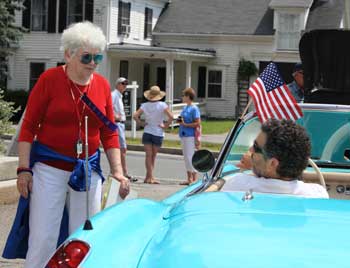
Arline Marteney speaks with classic car owner Dan D’Amore at last year’s July 4 parade. (Photo by Lisa Aciukewicz)
Harvard’s Fourth of July is often described as a quintessential, old-fashioned celebration. One can imagine it evolving from past traditions—Willards, Whitneys, and Wetherbees making pies and draping Town Hall; Harrods, Haskells, and Hildreths waving flags and decorating wagons or bicycles long ago.
Indeed, the current day celebration really is very like old-time Fourth of Julys—just like the ones Gene Marteney remembered from growing up in Ridley Park, Penn.
The Press recently spoke with this year’s Fourth of July Grand Marshal, Arline Marteney, who, with her late husband, Gene, inaugurated the Independence Day traditions treasured by Harvard today. She has vivid memories of those early days.
A sorry state
Arline, who moved to Harvard with Gene and their young family in 1961, recalled the sorry state of July 4 in town in 1967: “I think there was a color guard. A clown gave out ice cream on the Common, and only about 25 children showed up. Everyone else had left town.” American Legion Post 119 supplied the color guard. The clown was hired and the ice cream purchased with income from the $1,500 Walter K. Harrod Fund for July Fourth Entertainment.
The following year, Gene got into a conversation with Selectman Malcolm Henry at the Memorial Day commemoration. Gene recalled the Fourth of July festivities that entranced him as a boy in Ridley. He remembered a marching band and a big parade that all the kids joined on their decorated bikes. There were races and all types of field games, a pie-eating contest, ice cream, a fireman’s muster, and a concert. At night came the big event, the fireworks.
A summons
Not long after that conversation, the Marteneys were surprised when the constable arrived at their door with a formal paper. It was a summons to organize a field day on the Common for the July holiday just a few weeks away.
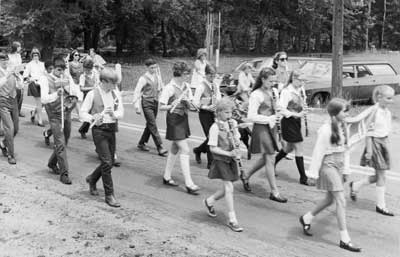
The Yankee Doodle Band marches in the July 4 parade in the mid-1970s. (Courtesy photo)
“We contacted Assistant Fire Chief Paul Johnston, because we knew the firemen had had a muster on the Common. I was involved in Girl Scouts and got the local scouts to agree to come along with the scouts at Camp Green Eyrie. The Boy Scouts didn’t think they could get enough people. Ann Marie Arnold asked if she could bring her Yankee Doodle Band. I asked Dr. Pittelli to be on hand for first aid. I was worried about the kids running down the hill. Nancy Brown at the beach said she’d do beach activities,” Arline said.
The Marteneys, Dorothy Wells, and Jane Petrie—the original Fourth of July Committee—described the resulting “Field Day” in the 1968 Town Report:
“The program started at ten in the morning with a blast from the fire whistle and a colorful parade followed the fire engines.
“A color guard was followed by a children’s marching band in colonial costumes playing spirited patriotic music. Behind these came a long procession of decorated doll carriages, tricycles, and bicycles, then the “horribles” in weird costumes, and the Girl Scouts from Camp Green Eyrie.
“The Girl Scouts conducted an impressive flag-raising ceremony, after which the judging of the decorated vehicles took place.
“Then followed games and races for different age groups and a very popular pie-eating contest. Winners received ribbon trophies and all participants in the activities were presented with American flags.
“An afternoon finale was a rousing concert by the St. Benedict band.”
200 barbecued chickens
Arline remembers the parade going around the Common two or three times. The organizers had promised a man who barbecued chickens in the parking lot that he would sell 200 dinners or they would buy and freeze the extras. A square dance by the Sixteen Footers capped the evening. Latecomers and the organizers missed dinner, because the chickens sold out. The Boy Scouts were the first to sign up to participate the next year.
The barbecue and square dance were traditions that continued through the ’70s. The 1970 Town Report shows that the pie-eating contest’s future was secure: “The highlight of the festivities was the pie-eating contest at which the blueberry pies were consumed by eager boys and girls. A few parents complained about the mess, but this had been intentional, with blueberry pies ordered specifically for this occasion.”
In a matter of weeks, the Marteneys had recreated Gene’s childhood memories from Ridley Park, except for a feature that would have to wait.
“Our one regret was the fire chief wouldn’t let us have fireworks. He thought it was too dangerous with all the woods around the pond,” Arline said.
The following year, Don Spinney, an acquaintance of Gene’s who belonged to an antique car club, brought in old cars and their owners. Spinney and his Model A Ford were in the parade last year, and Arline is hoping to see him again on Thursday.
In one of their early appointments, the Marteneys were charged with creating an event attractive to families. Few could doubt they succeeded.
The Marteneys served two three-year terms on the Fourth of July Committee, then three more years to help with Harvard’s 250-year anniversary celebration.
Interests beyond volunteering
Arline said she and Gene shared many interests besides volunteering. They loved to talk about archaeology, and Gene even taught himself to read hieroglyphs when a month of jury duty in Fitchburg meant a lot of waiting time. Gene, an electrical engineer, loved music and played the oboe in several regional orchestras. Arline has a talent for art and studied watercolor painting with Agnes Abbot. She taught an after-school art and cultural history class with Jean McCrosky.
On her wall, Arline has an Abbot watercolor of an outdoor auction on the Common painted before Arline knew the painter. “This is Gene. I can tell by the color,” Arline said, pointing to a blurred figure in blue-green pants standing near a tree. Arline was on the other side of the crowd of bidders. She liked a mahogany table and they agreed on a $10 limit, before Gene wandered off. When the table came up, Arline started at $1.50, but someone countered. Back and forth the bidding continued until Arline dropped out over $10. Gene, standing by the tree and unknowingly the other bidder, bought the table.
Gene died in 2008 at 74. “We were married 52 years, and it seems like only yesterday,” Arline said. “Oh, it’s been a lovely life.”