
Great egret with fish. In addition to fish, great egrets dine on frogs, snakes, small mammals, crayfish, and a variety of insects. (Photos by Mary Holland)
Between July and October, inland Massachusetts is occasionally visited by a large, long-legged white bird, the great egret (Ardea alba). Because they nest primarily along the coast of Massachusetts, great egrets aren’t a common sight in the Harvard area, but it is worth keeping an eye out for them now, for during the late summer and early fall they engage in a behavior known as “post-breeding dispersal.”
This member of the heron family (Ardeidae) disperses from its breeding grounds after nesting, and frequently wanders northward, which is why it is possible at this time of year to see a three foot tall, white wading bird on mudflats, amongst the reeds and cattails and on the shores of Harvard’s marshes, ponds, and rivers.
The great egret’s excursions prior to migrating south for the winter allow those of us who don’t frequent the coast, or travel to warmer climes during the colder months of the year, to observe this bird’s beauty and behavior. Adjectives such as “elegant” and “stately” are well deserved.
The great egret’s pure white plumage is never more striking than during the spring breeding season, when long plumes, or aigrettes, drape over its back and extend beyond its tail. Especially dramatic is the erection of these plumes during courtship displays at the nest site. It is these plumes that contributed to the decimation of the egret population, among other wading birds, during the late 19th and early 20th centuries when the demand for their use caused these birds to be overhunted.
In the late 1890s the American Ornithologists’ Union estimated that 5 million birds were killed annually for the fashion market, and in the final quarter of the 19th century, plumes, and even whole birds, decorated the hair, hats, and dresses of women. Environmental organizations and laws (including the Migratory Bird Treaty Act in 1913) came into existence as a result of this plundering, and the great egret population has since rebounded. It is the organizational symbol of the National Audubon Society for this very reason.
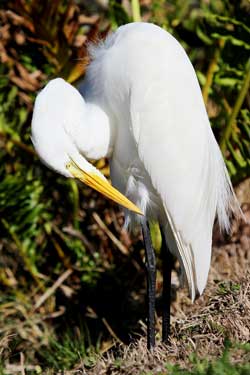
Great egret with fish. In addition to fish, great egrets dine on frogs, snakes, small mammals, crayfish, and a variety of insects. (Photos by Mary Holland.
The great egret is migratory throughout much of its range, but the degree and distance of migration are influenced by annual fluctuations in temperature. During milder years, the egrets have remained year round as far north as Massachusetts. The typical scenario is for great egrets to nest along the New England coast and points south, and then wander north during their post-breeding dispersal. This phenomenon occurs throughout the summer, with most sightings this far north taking place in August and September.
Between 1920 and 1950, there were frequently years when large numbers of egrets dispersed. In 1948 a total of 1,500 great egrets were sighted in Massachusetts between July and October. These large invasions appear to have stopped since the recovery of the species took place.
After spending a month or more outside their breeding grounds, great egrets migrate to their wintering grounds in southern United States, Mexico, and Central America. Their fall migration peaks at this time of year, so the birds we have been seeing lately will be departing soon, if they haven’t already. Keep your eyes peeled when near rivers, marshes and ponds, where you might get a glimpse of this temporary, welcome visitor.
You’re not likely to mistake a great egret for any other bird, unless you live in southern Florida, where a white morph of the great blue heron bears a striking resemblance. Few of New England’s birds are over three feet tall and have a wingspan of almost five feet. If they are, their plumage isn’t white. All other white wading birds in New England are distinctly smaller than the great egret.
Mary Holland is the author of “Naturally Curious: A Photographic Field Guide and Month-by-Month Journey Through the Fields, Woods, and Marshes of New England” and “Milkweed Visitors.” She has a natural history blog which can be found at www.naturallycuriouswithmaryholland.wordpress.com.