
May Lorente can still remember the moment when she knew her mother, Ann Scannell Carlstrom, had become a victim of Alzheimer’s disease, a progressive and terminal disease with no cure.
“My mom was living at the Willows, which is a retirement community in Westborough. She had gone upstairs to leave her friend a note. The problem was that she wrote the message directly onto the wall. When I asked her why she wrote on the wall she said, ‘Because there was no paper,'” Lorente said. “She didn’t see anything wrong with that at all. That’s when I knew something was definitely wrong.”
Lorente’s mother, now 83, had been living independently in a senior community for five years before her diagnosis. She was free to come and go. According to Lorente, moving to a specialized facility was one of the hardest things for her mother to handle.
“Because of the danger my mother became to herself and the potential for her to wander off, we had to move her to assisted living,” Lorente said. “She is basically under 24-hour lockdown there. She can only go out with supervision.
Lorente and her five siblings knew that it was important their mother receive proper care.
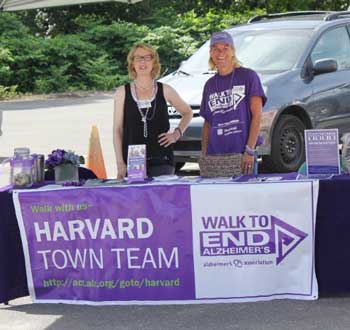
Kit Holland and Kim L’Ecuyer recruit members for the Harvard Town Team to walk for Alzheimer’s research. (Courtesy photo)
“You always have to be one step ahead of someone with Alzheimer’s, so you aren’t shocked by anything,” she said. “There is no cure for this disease. All that you can do is to be there and comfort them. Remove their anxieties and replace their obsessions gently. It is the hardest thing I’ve ever done but, it is also the most rewarding.”
Unfortunately, Lorente and her family are not alone. More than 5 million people in the United States have been diagnosed with the disease this year.
The staggering statistics and their personal experiences were the impetus for a group of Harvard residents to band together to organize a team for the Walk to End Alzheimer’s. The “Walk,” which is held annually in over 600 communities nationwide, is the largest event to raise awareness and money for Alzheimer’s care, support and research. This year, the Greater Boston Walk will be held on Sunday, Sept. 23 at Canal Park in Cambridge.
Kim L’Ecuyer, co-captain of Harvard’s team is reaching out to the community to help them meet their $5,000 goal. L’Ecuyer knows all too well about the ravaging effects of this illness.
“This disease can strike anyone at any time,” she said. “My father was diagnosed with Alzheimer’s when he was 51 and died at 57. Since my dad was so young, we had trouble getting his diagnosis. At that time, there wasn’t a lot of information available. There certainly wasn’t the support that is available now. I am participating in the walk to ensure that people in the future don’t have to go through this.”
According to team co-founder Kit Holland, the importance of this walk is more than clear.
“Why am I asking people to donate? Alzheimer’s is the sixth leading cause of death in the U.S. and the only cause of death among the top 10 that cannot be prevented, cured, or even delayed,” she said. “The greatest risk factor for Alzheimer’s is at age. At 65 you have a one in seven chance of developing Alzheimer’s. By age 85, your risk is one in two. Alzheimer’s is not a normal part of the aging process.”
Holland’s mother, Katy, suffered from Alzheimer’s for 10 years.
Holland, who has been participating in Alzheimer’s walks in New England for the last eight years, is proud of her team.
“This is our first year as a town team,” she said. “We have 22 members to date. We are almost half way to our goal of $5,000.”
Donations for the Walk can be accepted until October. People may donate directly via the team website (act.alz.org/goto/Harvard), or by sending a check to the Alzheimer’s Association, Attn: Walk to End Alzheimer’s, 480 Pleasant St., Watertown, MA 02472. On the check, note: Greater Boston Walk, Town of Havard Team.
All proceeds support research to treat and prevent Alzheimer’s and go to local programs that help families affected by the disease.