Many of those who had attended the March 21 candidates’ debate reassembled the following night at Town Hall for a second debate, sponsored by the Harvard Hillside and moderated by former selectman Leo Blair. With about 30 people present, the focus of the discussion was the competing warrant articles—Article 17 and Article 18—dealing with plans for the old library, Town Hall, and Hildreth House.
The case for Article 17 was presented by Ron Ostberg, chairman of the Municipal Buildings Committee (MBC), whose committee submitted the article. Ostberg noted that simply bringing the three buildings into compliance with current law—for disability access, energy efficiency, and seismic requirements—would require a lot of work. He described the “fit” between each building and its proposed use, with Town Hall fulfilling its traditional role as the center of self-government; Hildreth House better adapted for the Council on Aging (COA); and the old library operating under the current pilot project as a center for arts.
Selectman Bill Johnson spoke for Article 18. Johnson, together with Selectman Ron Ricci, developed the article. Johnson said that Article 18 was based on the MBC’s work, using the same figures but choosing a scenario for the old library that the MBC had rejected. Johnson presented a chart showing the square footage he said would be available for use under each of the scenarios. He asserted that Article 18 provided for more square footage at lower cost than Article 17. He referred to page 78 of the MBC report (available on the town website) as the basis for Article 18’s plans for the old library.
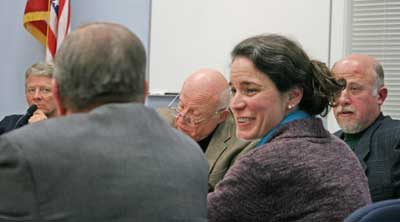
From left, Bill Johnson, Ron Ricci, Ron Ostberg, Marie Sobalvarro, and Stu Sklar on March 22. (Courtesy photo by Paul Green)
Much of the debate echoed points that had been made the evening before in the library, with many questions focusing on whether the COA would be moved in whole or in part to the old library. Ricci stated emphatically, as he has before, that the senior center will remain in Hildreth House under Article 18. But several questioners from the audience still found it unclear which functions of the COA would be located in which building. With phrases such as “bogus numbers” and “fraud” turning up, tempers were clearly beginning to fray.
Audience member SusanMary Redinger, who is also a candidate for School Committee, stated, “If this is any indication of how Town Meeting is going to go, my concern is that people will say no to both articles. This level of discourse is not working.” Redinger cited her experience working on the new Unitarian Fellowship Building, saying that the planning committee had established alternatives depending on how much money the church was able to raise. Pointing out that both articles ask for the same dollar amount, she wondered if an article might cover both scenarios. “It would really behoove the town if people could present this at Town Meeting in such a way as to move forward without all this discord,” she concluded.
Redinger’s question seemed to mark a change in the tone of the discussion. Several people expressed agreement with her, including Debbie Ricci of the Capital Investment and Planning Committee CPIC), Selectwoman Marie Sobalvarro, and School Committee Chairman Keith Cheveralls.
As the meeting drew to a close, George McKenna, who is chairman of CPIC and a member of the Finance Committee, reminded the group, “When people are confused they tend to vote no. Might there still be time with 10 days left before Town Meeting to get together and present something which would be a combination of some pieces of each article? If there is a united effort, with all the discourse that has taken place, that might be the success that will push something in terms of funding available to get the project moving forward.” He challenged Ostberg, Ricci, Sobalvarro, and Johnson to develop such a proposal. Ricci and Ostberg agreed to make the effort, with others around the table nodding their acceptance.