The three candidates for the Board of Selectmen sparred gently in a low-key debate Monday that focused mainly on two competing warrant articles for town buildings and how each might affect senior citizens. Ron Ricci, Stu Sklar, and Marie Sobalvarro are competing for two open positions on the Board of Selectmen (BOS). Ricci and Sobalvarro are incumbents, while Sklar is a former School Committee chairman.
The March 21 debate at the Volunteers Hall was jointly sponsored by the Harvard League of Women Voters and the Harvard Press, with Stefani Traina from the Andover chapter of the League as moderator. About 50 people attended.
The debate began with several rounds of questions that had been submitted in advance, after which the moderator opened the meeting to questions from the floor. Most of the discussion in both segments of the debate dealt with the candidates’ views of the future of the town—the upcoming Master Plan, the fate of three town-center buildings, and what facilities an aging population will need.
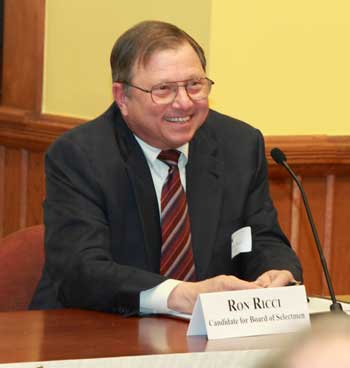
Ron Ricci. (Photos by Lisa Aciukewicz)

Marie Sobalvarro.

Stu Sklar.
All three candidates agreed that updating the Master Plan, which state regulations require in 2012, will be an opportunity for Harvard to evaluate its goals. And all three noted the need for public input. Ricci spoke of “the need to do something about the commercial district to benefit the town.” Sobalvarro noted that the Master Plan covers a wide array of topics, including open space and affordable housing. All three candidates supported the Planning Board’s request for funds to hire consultants to help in the development of the Master Plan.
Proposals for municipal buildings
A second round of questions focused on the candidates’ stance on plans for the old library, Hildreth House, and the Town Hall, as affected by two competing warrant articles that will be presented to Town Meeting on April 2. Article 17 was submitted by the Municipal Buildings Committee (MBC) and covers all three buildings. Article 18 was submitted by a citizens’ petition and covers only the old library and Town Hall.
Sobalvarro expressed support for Article 17, noting that selectmen had unanimously appointed the MBC to develop a plan for the three buildings. Her greatest concern about Article 18, she stated, was that it would move the Council on Aging (COA) to the old library, counter to the wishes expressed by COA members. She commented, “Building projects take a long time in this town, but they are meant to last for a long time.” Responding to reports of a high price tag on the MBC plan, Sobalvarro noted that the committee expected to raise about 40 percent through private funds rather than tax money.
Ricci stated that the two warrant articles are similar in many ways, but he charged that Article 17 begins “a journey toward spending at least $9 million.” He rejected the argument that the article asks for only $225,000 (the same amount requested by Article 18), saying, “It does not make sense to plan to expand unless you intend to do it.” To get anything done in Harvard, Ricci argued, requires the unanimous support of the selectmen, citizens, and major town committees. He pointed out that the Finance Committee and the Capital Planning and Investment Committee (CPIC) did not approve Article 17. Ricci urged townspeople to attend another meeting, to be held the following evening, when he said the matter would be discussed in more detail.
Sklar noted, “This is the topic I’ve heard most about during this campaign.” He praised the MBC for its numerous open meetings, interviews with all town employees, and discussions with groups that use all three of the buildings in question. “They [MBC members] really walked the walk on transparency,” he said, calling their report “maybe the best report this community has ever seen.” Sklar contrasted that process with Article 18, which was written by Ricci and selectman Bill Johnson with help from the CPIC shortly before the deadline for submitting warrant articles.
Senior housing and services
Discussion of the COA and the Hildreth House carried over into the next topic, that of housing and services for senior citizens in Harvard. Asked whether the affordable-housing project for seniors currently being built on Ayer Road by developer Lou Russo would meet the needs of Harvard seniors, all three candidates agreed that it would not. While the 42 units in the development have helped the town stave off other housing projects under Chapter 40B, very few Harvard seniors qualify to live there, because selling a Harvard house creates too high a level of net worth.
Sobalvarro asserted that the best way to facilitate senior housing in town is to help seniors remain in the houses they already own. She cited the programs for tax deferrals or offsets as helpful but not sufficient. With reference to senior services, she recalled that seniors have been asking since 1979 for a place to cook and serve meals. (Such a facility is part of the long-range plan for an expanded Hildreth House, as described in the MBC report.) “I can’t see that as a want,” she said. “It’s a need. And food is not just sustenance—it’s community.” In a later response to a question from the audience, she pointed out that senior citizens contribute a lot to the town, both in tax money and volunteer effort. “What are we giving them?” she asked.
Sklar urged the selectmen to listen to seniors. He noted that the acquisition of Hildreth House in 1979 was contentious, but it passed and has been well used ever since.
Identifying himself as “the only senior who is actually running,” Ricci expressed the hope that the Ayer Road project might help parents of some current residents move to Harvard. He also urged voters to support a bylaw that would allow the creation of affordable apartments as additions to existing houses.
Asked by the moderator how the town might develop more appropriate housing for seniors, the candidates responded with a range of options. Sklar suggested raising the income limits for tax deferrals. Ricci proposed decreasing the minimum lot size and keeping town spending low. And Sobalvarro advocated creating a multifamily overlay for housing in the town center. “It makes sense to me,” she said, “that you could have more reasonably priced units if you were not also subsidizing affordable units with high-priced ones.”
Future relationships with Devens
Another factor that will shape the future of Harvard is its relationship to Devens. Candidates discussed which services might be shared and how Harvard and Devens might be connected in coming years.
According to Sklar, “Harvard should look at bidding on services that we could provide, such as police. I think we can run a town better than MassDevelopment does.” He also acknowledged that he has changed his mind about Devens in some respects. “A few years ago, I was pretty antsy on this,” he admitted. “I wanted a resolution. But now I don’t think we need to move quickly. I don’t like making decisions without all the data. … There’s a process, and it’s going to take some time to play it out.”
Ricci agreed that Harvard might get a “tangible benefit” from sharing services such as police. He noted that such an arrangement would help to ensure adequate coverage on all shifts. He also stated that he would like to see the Devens Enterprise Commission (DEC) staffed differently, with appointments made locally rather than by the governor.
Sobalvarro supported the idea of moving toward shared services, as has been done with the school contract. She noted that recreational facilities are profitable for Devens, while Harvard lacks access to enough playing fields. She added that the selectmen were still awaiting the plan for Vicksburg Square that they had been promised by the proposed developer.