
A second debate on Nov. 30 and individual interviews with the Press have uncovered different priorities for Board of Selectmen candidates Bill Johnson and Marie Sobalvarro, but also have reinforced the similarities of their positions on virtually every issue.
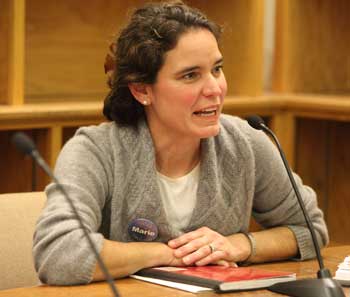
Marie Sobalvarro responds to an audience member’s question at a candidates’ debate. (Photos by Lisa Aciukewicz)

Candidate Bill Johnson gives his opening remarks as moderator Tom Daniels listens.
For Sobalvarro, key issues include better communication among town boards and committees; a solution to the town’s escalating health-care insurance costs; action items and timelines to make progress on long-term town goals; and the importance of volunteers to the town.
For Johnson, some central issues are a focus on problem-solving rather than process; the need for multi-year budgeting; action items and timelines to make progress on long-term town goals; and the need for the Board of Selectmen to delegate day-to-day matters so as to keep focus on strategic planning.
Business backgrounds seen as strengths
Sobalvarro presented her business experience as a valuable asset for the selectman’s job. Her background as a project manager, she argued, has given her experience in coordinating independent teams, each with its own authority and structure. She noted that an important function of the Board of Selectmen should be to monitor progress on various projects, with specific targets to be achieved by a given date, a position on which she and Johnson agree.
Sobalvarro sees her background in the health insurance industry as especially relevant to the town’s needs, given the upcoming contract negotiations for town employees in which health insurance costs will be a major issue. “What I want in the near term,” she said, “is to address our health-care issue and to solve it.”
Johnson also described his years of management experience, both in business and in nonprofit organizations, as an important asset. Asked how the Board of Selectmen should function, he compared it to a board of directors for the town, with town residents as shareholders who can approve or disapprove of the board’s activities at the Annual Town Meeting. “I don’t think the citizenry through the town meeting should be directing the day-to-day operations of the town,” he stated. “That is why we have a town administration.”
As an example of using good business practices for a town project, Johnson cited his presentation of the Financial Impact Analysis Team report, which included specific tasks, teams, and timeframes for the development of the Ayer Road commercial district.
Focus on finding new revenue sources, ways to cut costs
Due to decreasing state aid, Johnson emphasized the need for the town to “do more with less.” He pointed to his success with the Pond Committee in finding grants and matching funds from state and federal sources to make possible the yearly drawdowns that control weed growth in Bare Hill Pond. He suggested that the Harvard Public Library and the Council on Aging set up “operational endowments so that the people who love them can create funding sources that would buffer these groups from cyclical problems in finances.” Under such endowments, private donations would at least partly replace public funds for running those organizations.
Sobalvarro argued that Harvard needs to improve its financial situation through rebidding contracts, controlling costs such as health insurance, collecting back taxes, and finding other sources of funding such as the contract with MassDevelopment for educating Devens students. “Excellent schools serve the town well, but high tax bills serve no one well,“ she stated. “We need to get our fiscal house in order before we ask the schools and others to ‘do more with less.’”

The audience listens as selectman candidates Bill Johnson and Marie Sobalvarro share their views at a debate held in the old library and sponsored by the Harvard Hillside on Nov. 30.
Who makes decisions in a crisis?
When asked whether town boards should have called a special town meeting last year when cuts in state aid forced the town to reduce spending, Johnson stressed his focus on results rather than process. He turned the question around, and asked, “Did they [town boards] do the right thing? I would hope that folks in town would see the partnering that the tri-boards [the BOS, the School Committee, and the Finance Committee] did around managing the cuts and say, ‘They did the right thing. Maybe I can trust them, and I only need to check in on a year-to-year basis.’ This town would fall apart if we had a town meeting for everything.”
When Sobalvarro was asked about spending cuts, she noted that the selectmen have no authority over the town’s other independently elected boards. “It would have worked well to say, ‘These are our constraints,’ rather than making a change by fiat. But I tip my hat to the board that was sitting then—they did the budget many, many times that year.” She pointed out that Chelmsford, faced with the same situation, did hold a town meeting, and that process might be advisable for Harvard in the future.
Differing opinions: A strength?
Both candidates emphasize that residents agree on many of the most important goals and issues, and both feel that divisiveness in town has been exaggerated.
“I don’t believe the town is more divided today than in the past,” Sobalvarro said. She noted that Henry Nourse, in his History of the Town of Harvard, describes town meetings at which the constables had to be called in to keep order. “We all share a goal of wanting what is best for the town. Tensions and differences of opinion are natural, but we agree on the best compromise that we can obtain.”
Johnson also thinks that keeping the focus on shared goals can help to mitigate conflict. “Really high-performing organizations embrace a diversity of perspectives,” he notes. “But the Board of Selectmen serves the interests of the town, not of any one constituency.”
Strategies for holding on to seniors
The candidates were asked how they would meet the challenge of keeping senior citizens in Harvard. Johnson responded that rising residential taxes are especially burdensome to seniors on fixed incomes. He repeated his call for expanding the commercial tax base of the town and also credited former selectman Leo Blair with creating a way for seniors to defer taxes. Johnson also cited the need for a greater variety of housing in Harvard, including a “rich mixture, from small rental apartments to larger condos, to allow seniors to downsize,” as well as additional services for seniors through the Council on Aging.
Sobalvarro noted that the Board of Selectmen did not have direct authority over many of the issues that affect seniors. But she suggested that the first step in keeping seniors in Harvard was to get town expenses under control. Another way to mitigate seniors’ tax burden would be a home-rule petition to allow tax deferral for residents on declining or fixed incomes. A third possibility would be to exempt the first $100,000 of property from the community preservation tax. Finally, she said that Harvard needs a variety of housing that is not only affordable but also accessible.
Looking to collaborate with Devens
Both candidates hope the town can find ways to “connect” with the Devens area. Both mentioned athletic facilities as a possible point of connection.
Sobalvarro urged, “We should be reaching out in simple ways, such as through parks and recreation or the Fourth of July celebration.” She noted that Bare Hill Pond has had more swimming instructors than needed, but the town does not offer lessons to Devens children because Devens residents are not Harvard taxpayers. At the same time, Devens has soccer fields that Harvard teams are interested in using. “Can’t we work something out?” she asked. She stated that analysis for future economic development should include Devens as well as the existing commercial district, even though doing so might be “contentious.”
Johnson agreed that the town should “explore cost-sharing and partnering activities with Devens, including recreational facilities.” He suggested that the selectmen should not get involved themselves with the operational details of such plans, but should delegate the question to Parks and Recreation or the town administration.