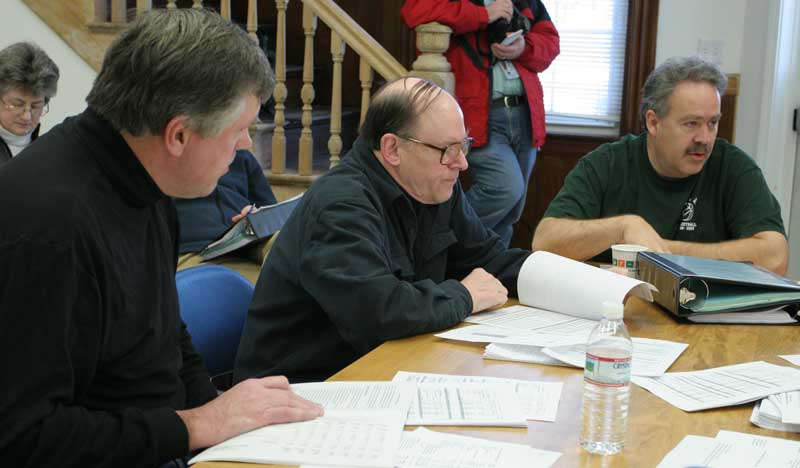
From left: George McKenna, Steve Colwell, and Bob Thurston discuss the budget at Saturday’s Finance Committee meeting. (Photo by Lisa Aciukewicz)
Heading into tomorrow’s fiscal year 2009 budget summit with the selectmen and the School Committee, the Finance Committee is faced with a projected revenue deficit of $1,304,358. Reporting to the committee on Tuesday night, Town Administrator Tim Bragan presented the most recent “recap sheet” based on actual budget requests from all town and school departments.
Bragan also presented a second scenario, which resulted from analyzing what those numbers might look like with no new programs or personnel across the board. He and Finance Director Lorraine Leonard prepared a budget that is “level-headed,” freezing all staffing at the current level and assuming all contractual salary increases of those employees; and “level-funded,” increasing only those expenses that are contractual, such as maintenance and busing contracts, or that have unavoidable annual increases, as in energy and health insurance costs.
This exercise netted budget reductions of $230,165 and a projected deficit of $1,074,193. Bragan and the committee are calling this the “recommended” budget, but the finance board hopes that the numbers for capital and small warrant articles, estimated at $150,000 and $65,000, respectively, will come in lower when the capital committee makes its recommendation, perhaps reducing the overall projected deficit to a number under or close to $1,000,000.
Finance Committee Chairwoman Debbie Ricci suggested that for Saturday’s meeting the committee’s position might be for two overrides.
“We are looking at some number for an override and then $230,165 for a second override for new programs,” she said.
This week Ricci told the Press that at a previous meeting, the committee had discussed the idea of not making recommendations one way or the other on anything that is new spending.
“Those are decisions the town will have to make,” she said.
This opinion was echoed by committee member George McKenna.
“We understand the level of service we provided last year and we feel that is still working. I don’t feel qualified to judge the impact of not providing the new services,” he said. He recommended getting to the “lowest and best number that provides some kind of continuity to fiscal 2008.”
Member Steve Colwell saw it somewhat differently. Referring to last fall’s Special Town Meeting vote to approve the use of free cash to fund a $198,612 shortfall related to labor contracts, he said, “We should start at $200,000, what we’re on the hook for, and add on to that somewhere between $200,000 and $1,000,000 for an override.”
Of the town’s 30 percent of the $230,165 in proposed reductions, the majority comes from pulling out personnel increases requested by the Council on Aging and the library, and from reducing increased levels of expenses and training requested by the Ambulance Squad. The schools’ 70 percent of the total comes primarily from reducing special education salary and technology expense requests. Leonard presented a revised school budget that, after the reductions, shows an increase of 4 percent over fiscal 2008. The fiscal 2008 budget she used for comparison includes reserve fund transfers, the override from Annual Town Meeting, and Special Town Meeting funding.
Ricci pointed out that because operating costs for the wastewater treatment plant have been moved from the school budget to the town budget for fiscal 2009, it is necessary to adjust for that in order to have an “apples-to-apples” comparison of the two years. After making that adjustment, the increase from fiscal 2008 to fiscal 2009 would be closer to 5 percent. By the same token, according to Ricci, the $11,479,705 budget request submitted by the School Committee is an increase of about 6.5 percent over fiscal 2008.
Tim Clark, representing the selectmen at the meeting, asked the committee if there are any new “behaviors” they will be recommending to the boards.
McKenna suggested that a member of the Personnel Board should become part of the labor contract bargaining teams for both town and school. He also urged the three boards—Finance Committee, School Committee and selectmen—to strive for a common mission with “uniform effort, uniform policy.”