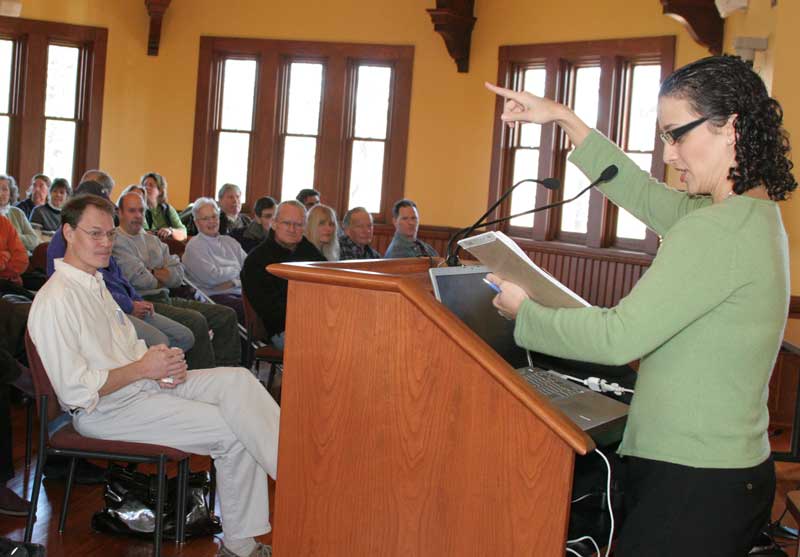
Ruth Silman, Chairman of the Wind Energy Conversion Systems Committee, points out her fellow task force members to the 80 plus attendees at a wind energy seminar. (Photos by Lisa Aciukewicz)
Of the more than 80 people who turned out at the library Saturday, Dec. 1, to hear what the newly formed Wind Energy Conversion Systems Committee had to say about wind turbines in Harvard, few were interested in talking about a possible bylaw allowing such turbines as an accessory use in town. Instead, most wanted to know how individuals could implement wind or solar power for their own use.
Audience questions were fielded by a panel consisting of Wind Energy Committee Chairman Ruth Silman, an environmental lawyer; Steven Strong, a 25-year resident of Harvard and an internationally recognized expert in the field of solar and wind energy; Ted van Dusen, a founder of US Windpower, the first company to develop wind farms in California; and committee member John Sweeney, an electrical engineer who has done a significant amount of research on wind power, and has even installed a small wind turbine on his sailboat.
“What is more economical, wind or solar?” asked one resident.
“In a good wind resource area, wind is more versatile and economical,” Strong replied.
Another resident asked, “Is there an intermediate scale [turbine] for neighborhoods?”

Alternative energy expert Steven Strong addresses residents.
Strong said that neighborhood-scale wind systems are in wide use in Europe, but that, with the growing interest in renewables, manufacturers who used to make community-scale systems have moved up into the commercial arena, making smaller-scale systems harder to come by.
“What’s the best way to see if you have enough wind [to support a turbine]?”asked a third person.
Committee member Eric Broadbent said that an anemometer was a good tool to help residents measure wind speeds on their property.
Sweeney said that online wind maps can be helpful. Another option, he said, is having the wind measured by professionals, which, he added, is an expensive proposition. While being an advocate of wind power, Sweeney cautioned, “It’s not going to solve our energy problems on its own. We need a mix of wind, solar, and other renewables.”
Paul Richards of Westcott Road wanted to know if it would be feasible for the town to lease land in another town to generate power for Harvard, since Harvard doesn’t have enough wind to power turbines of that scope. Strong said that would be a complicated issue relative to local laws, since the power-delivery system would cross town lines.
Other questions revolved around the costs and economics of windmills, such as the payback period from a windmill installation. Strong noted that payback depends on how the rates change over time and added, “The real key is how long you plan to stay where you are.”
When someone asked how he could go about getting wind power on his property, Broadbent reminded the audience, “You need a bylaw.”
Strong said that policy, along with politics, is the real barrier to wind power, rather than technology. He added that the time is ripe for considering renewable energy sources such as wind and solar power, pointing to successful projects like the wind turbine installed in Hull. That town, he said, has plans for four more turbines.
Some residents did raise concerns about wind turbines. Pat White, of Littleton Road, noted that studies on the impact of turbines on birds and bats, which indicate a low number of avian deaths compared to other causes, have been done on commercial-scale turbines, but not on smaller residential windmills, since there are so few in existence.
Another resident expressed concern that any bylaw developed by Harvard should have an “end of life” provision, addressing the disposal of obsolete equipment. Van Dusen acknowledged that the obsolescence of aging wind turbines had become a political issue in California.
A Still River resident, who had some personal experience with the noise from a wind turbine about 20 years ago, wanted to know what progress had been made in making them quieter. Sweeney replied that “significant advances” had been made, although some turbines are noisier than others. Silman noted that, in the bylaws she has studied, all have some requirement that the noise from turbines be kept under a specified decibel level.
Next Steps
Silman said that more than 50 of the state’s 351 cities and towns already have some kind of wind bylaw on the books. She said that the committee would summarize feedback from the meeting and present it to the Planning Board in December, and would be holding more public information sessions on the topic in January.