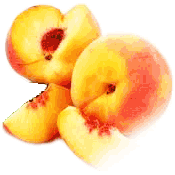
Last weekend’s 14th annual peach festival at Carlson Orchards on Oak Hill Road was likely a record-breaker for attendance, according to owner Frank Carlson. “It’s the biggest turnout probably ever,” Carlson told the Press as he helped direct cars to an ever-dwindling supply of parking spaces. “It couldn’t be any better; we’re almost in trouble now,” he added.
Peach lovers from Harvard and nearby towns flocked to the orchard Saturday and Sunday to fill flats with this year’s crop of peaches and nectarines. It was a welcome sight after last year’s loss of the entire peach crop to a February cold snap. That didn’t stop the festival, which was held last August to commemorate Carlson Orchards’ 80th anniversary, but attendance was light. This year made up for it. Carlson’s daughter, Katie Carlson-Hardy, who helped out at the event, said there were as many people at the festival on Saturday this year as there were for the entire weekend of the peach festival two years ago.
In search of white peaches
The festival date was held a week earlier this year to accommodate the many customers who come to pick white peaches, which ripen earlier than their yellow counterparts. Carlson told the Press that white peaches are a favorite of Asian-American families, and multigenerational groups of pickers in the White Lady orchard bore that out. Peaches originated in China and have been cultivated there for more than 4,000 years. White peaches are less acidic and sweeter than yellow peaches, and the flesh has a smoother texture. According to the article “Chinese Peaches: Past and Present” on the Clemson University Cooperative Extension website, white peaches account for 80 percent of the peaches grown in China, which is the largest peach-producing country in the world.
The day after the festival ended, Carlson-Hardy said the store had run out of peach crisp by Sunday afternoon and had to switch to selling apple crisp to dessert-hungry festivalgoers. They also sold a case more of peach pies than they did two years ago. When asked if attendance was the highest ever, she said, “I’d be shocked if it wasn’t.”

Franklyn Carlson (far left) stands waiting to direct visitors at Carlson Orchards during the 14th annual Peach Festival, August 14, as peach-laden customers head out with their fruit. (Photos by Lisa Aciukewicz)

The Liu family (from left, Jie, Peggy, and Wen) pick up a box for peach picking.

From left: Bowers Brook residents Roberta Petrocelli, Annie Tuomi, and Fran Ryan enjoy the music of the band “Loose Ends” at the peach festival.
Peach potpourri: Guide to summer’s ephemeral fruit
There are hundreds of varieties of peaches grown in the United States. The main differences among varieties are tartness or sweetness, juiciness, flesh texture and color, size, type of stone, and harvest time.
Varieties
All peaches and nectarines are categorized as clingstone, freestone, or semi-freestone, depending on how much the flesh of the fruit clings to the stone inside. Clingstones are usually the first to ripen each season and tend to be smaller, juicier, and sweeter than freestone fruit.
Clingstones are good for dicing or puréeing, while freestones are better for slicing. Semi-freestones were developed to be both juicy and sweet and have an easy-to-remove pit. White and yellow peaches and nectarines all have clingstone, freestone, and semi-freestone varieties. Most peaches sold in the produce section of the grocery store are freestone, and most peaches canned in syrup are clingstone.
Westward Orchards carries 15 to 20 varieties of mostly freestone white and yellow peaches, as well as four varieties of yellow nectarines. Carlson Orchards grows about 15 varieties of white and yellow, clingstone, freestone, and semi-freestone peaches and five varieties of yellow and white nectarines, including one clingstone variety. Doe Orchards also grows a large variety of mostly freestone and semi-freestone yellow and white peaches, although owner Pam Lawson said Doe’s white peaches, Sugar May, are over for the season.
Is it ripe?
When a peach ripens on the tree, the part of the peach that doesn’t face the sun starts to turn from green to yellow. As it continues to ripen, all the green color, including around the stem, disappears, and the yellow color deepens. The fruit will have some give to it when squeezed, and it will smell “peachy.”
After picking, peaches and nectarines will continue to ripen if left at room temperature, and they also lose moisture, which intensifies the flavor. Place the fruit stem-side down and not touching each other on newspaper, a paper bag, or a cotton or linen towel—anything that will not trap moisture, which could lead to mold. Putting the fruit in a sealed paper bag will speed up the ripening process. You’ll know the fruit is ripe when it softens up and the skin around the stem of the fruit starts to shrivel.
Once ripe, peaches and nectarines should be stored in the refrigerator to stop the ripening process. They will keep about a week.
Sources:
-
http://bit.ly/2wQvtdA – Picking and handling
tree-ripe peaches - http://bit.ly/2i6gMjc – Michigan Peach Sponsors
- http://bit.ly/2v2meVL – Clingstone Vs Freestone
- http://armagazine.com/2wfu5Do – How To Buy, Store, And Eat Peaches
—Joan Eliyesil