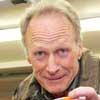
Lorin Johnson grew up in Harvard when it was still a farm town and his connection to nature seems hard-wired. He graduated from Bromfield in 1965, briefly attended Wentworth Institute, then enlisted in the Navy for two years of active duty. Returning home in the late 1960s, Johnson went to work on the land. He started at Bill Mead’s Harvard Tree Service, then worked for Bill Westcott’s Rock Spring Farm, which he eventually leased after Westcott died. He worked for other orchardists, too, and started his own business, Johnson’s Orchards, doing what he calls “custom farming”: orchard work and mowing and putting in fields, mostly for grain crops. In the winter, he plowed snow for private customers and sometimes as a contractor for the town.

Lorin Johnson signs his nomination paper at Town Caucus. (Courtesy photo)
In the early 1970s Johnson bought a house on Still River Depot Road and a few years later started working on passive solar improvements. He built solar panels into the sunny side of the house, added windows and insulation, and “kept making the walls thicker” with each renovation. By the time he was done, the house was comfortable during the day, he says, even in cold winter weather.
Around that time he got interested in wind power and built an 80-foot tower on his property, with a platform he could climb up to and take measurements. He found that very high winds were not uncommon when a front came in, and he saw a potential for harnessing that energy. He knew a couple of engineers who were working on a windmill design, so they agreed to install a windmill on the tower to see how it worked. It soon became clear that the design wasn’t strong enough. Johnson gave up on the power-generation idea, he says, because “the price of oil came down and the economics didn’t make sense.”
From windmills, he turned to making model helicopters, starting a company called Top Chopper. Then he got a real helicopter and a private license, and he eventually became a certified flight instructor. He gave helicopter rides, did frost-control work in local orchards, and even filled in for WBZ traffic reporter Joe Green, flying the “Green Machine” when Green was on vacation.
Proactively helping people
Seven years ago, there was an opening on the Board of Health and somebody asked if he was interested. He researched the qualifications and found that local health board members are not expected to be medical or public health professionals, but only to seek professional advice when needed. His interest in serving on the board stems from his own interest in staying healthy, he says, and in helping to keep his neighbors healthy.
Johnson enjoys working with other board members to help townspeople navigate the complexities of Title 5, the state sanitary code. He likes doing the research to fully understand the problems and going to seminars to find out what other towns are doing. But his big concern right now, as tick and mosquito season begins anew, is finding a way to educate townspeople about how to protect themselves and their families from disease-carrying vectors.
He would like Harvard to be “more proactive” in mosquito control, he says, which doesn’t necessarily mean widespread spraying. At a minimum, he’d like to see a monitoring program to determine what kind of mosquitoes breed in Harvard and what diseases, if any, they carry. Mosquitoes seem to concentrate in different areas of town, not necessarily near wetlands, he says. Ideally, he’d like the town to be able “to do something about an inundated area” before it becomes a health problem.
He says the Board of Health welcomes input from townspeople about this and other public health concerns. “We’re their Board of Health,” he says. “We’re looking for ways to help people.”