A 35-page five-year forecast released by town administrators two weeks ago predicts steady if unremarkable growth in the town’s revenues next fiscal year and beyond, a welcome change from the fears of economic hardship that followed the onset of the COVID-19 pandemic in 2020. But that growth will continue to be fueled by taxpayers, with little relief from either state aid or local sources of revenue, and total revenue will struggle to keep pace with town expenses
The report, an analysis of more than two dozen of the town’s sources of revenue, was prepared this summer by Town Administrator Tim Bragan, Assistant Town Administrator Marie Sobalvarro, and Finance Director Jared Mullane and presented last month for the first time to the Finance Committee and Select Board. FinCom has been asking for such an analysis for years. Bragan told the Press the report was, to his knowledge, the first in town history.
Knowing how much revenue to expect in the coming fiscal year is crucial for the town’s budgeters. Municipal budgets must balance, and the ability of a town to serve its residents is limited by the money in its coffers. And yet, as the report authors say, the ability of town officials to control town revenue is limited. Sometimes they’re “innocent bystanders,” the authors write, as the ups and downs of the economy affect, say, the number of building permits issued or cars purchased, and the state government sets the amount of state aid the town will receive—a number that is often unknown until late in the budget season.
In their report, Bragan, Sobalvarro, and Mullane assessed the future outlook for tax revenues, the greatest source of town income, as well as state aid and a variety of local income sources. They concluded that officials can plan on a 3% increase in the tax levy per year through 2027. The levy is the amount of income Harvard is allowed to raise by taxing property owners. The forecast presumes that officials in each of those years will approve the maximum amount allowed by state law.
State aid and local receipts are the second and third largest sources of income (see graph). State aid consists of unrestricted aid to Town Hall and money for schools, also known as Chapter 70. These amounts are set by the governor and the Legislature, but have increased very little over the past 10 years. The report recommends that planners anticipate no increase in state aid beyond this year’s number.
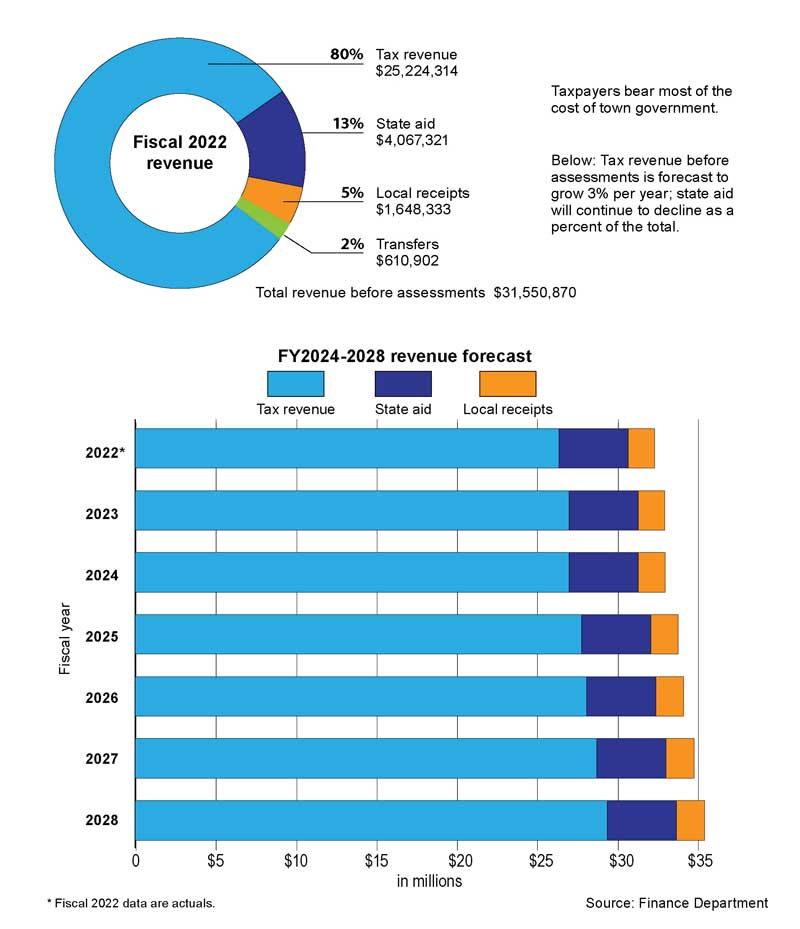
The local receipts category is dominated by the amount of automobile excise tax the town collects—nearly $1 million in fiscal 2022—but also includes a variety of fees such as those paid for building permits or dump stickers. The number is affected by factors beyond the town’s control, such as the rate of inflation and permits for wiring, plumbing, and other construction. The report recommends the town plan on no more than roughly 2% growth per year.
Taxpayers bear the burden
As in past years and through 2027, residential taxpayers will provide most of the money the town needs to pay for police, fire, schools, and other services, as well as debt. In the fiscal year just ended, residential taxpayers provided 78% of the $31.6 million raised by the town. And as in past years, commercial taxes on local businesses provided only an additional 3% .
State law constrains how much a town can raise taxes each year, limited to 2.5% of the prior year’s levy. However, towns are allowed to borrow for large projects—such as construction of the new elementary school or this year’s purchase of the new senior center—and to add that debt, known as “excluded debt” to the tax bill. Towns may also add so-called “new growth” to the levy, comprising the assessed value of new residential and commercial construction.
As a result, the tax levy has increased in Harvard an average 4.26% per year over the past 10 years, according to the report. In fiscal 2022, the year just ended, new growth added $173,043 to the levy while principal and interest payments due on town debt added another $2.9 million.
A first step
Forecasting the income the town can expect in the coming year is a crucial first step in building the annual budget. But, as the authors of this year’s report say, forecasting is as much an art as a science. The team’s conservatism can be seen in the methodology they employed for each line of their forecast. Each was calculated using actual values for the past 10 years, tossing aside outliers, and then computing an average. A community is more likely to have gone through economic peaks and valleys over a 10-year period, they wrote, providing better insight into what the future might hold in similar circumstances.
“Underestimating revenue is always better than overestimating it,” they wrote. “Adjusting budgets due to not enough revenue means cuts. These cuts, which are usually made in the last quarter of a fiscal year—and depending on how far off your estimates were—may mean reducing your workforce headcount or cutting employee hours.”
Although not formally a part of the revenue forecast, Mullane included a provisional revenue and expense forecast in the package he provided the Select Board at their last meeting. That forecast predicts a slight deficit of $31,000 in fiscal 2024 that rises to $1.5 million in 2027.
As budgeting for fiscal 2024 gets underway, the authors advise, the Select Board and FinCom must remain flexible and, like a good weather forecaster, be alert to changes in outlook.
A copy of the “Revenue forecast for FY2024 to FY2027” is available at the Finance Committee website, www.harvard-ma.gov/finance-committee.