Barry Van Dusen is renowned as an artist of birds and as a landscape artist as well, but because it is his practice to draw and paint outdoors, directly from life, he is a field artist. Thus, his 40 paintings and additional sketches and drawings in Fivesparks’ current exhibit, “Natural Inspirations—Paintings by Barry Van Dusen” project a liveliness and immediacy that make you feel that you are in nature and in the presence of birds.
His work has taken him to far away places and to ones as nearby as outside his studio window in Princeton. In an interview April 4 he discussed his work as an invited member of the Artists for Nature Foundation, a group that, according to the foundation, uses art “to draw attention to the need for nature to be appreciated as an essential element of sustainable development.” With the foundation, he has traveled and worked around the world with other international field artists. Some of his work with this group is on display in the Fivesparks exhibit.
In the interview, he also discussed his artist residency with Mass Audubon. During that time he visited and documented in words and art all the Audubon sanctuaries in Massachusetts, resulting in his book, “Finding Sanctuary: An Artist Explores the Nature of Mass Audubon,” published in 2020. (Mass Audubon has donated a book to every public library in Massachusetts.)
Van Dusen moved from Maine to Harvard when he was in the fourth grade, graduating from Bromfield in 1973. Even as a child in Harvard, Van Dusen was drawn to the art in the family’s prized volumes of the Nature Lover’s Library, containing the illustrations of ornithologist Louis Agassiz Fuertes. Meanwhile Van Dusen was also drawing requested war scenes for classmates at 25 cents a picture, in addition to his own drawing and studying science in Dr. Dorothy Andrews’ class at Bromfield.
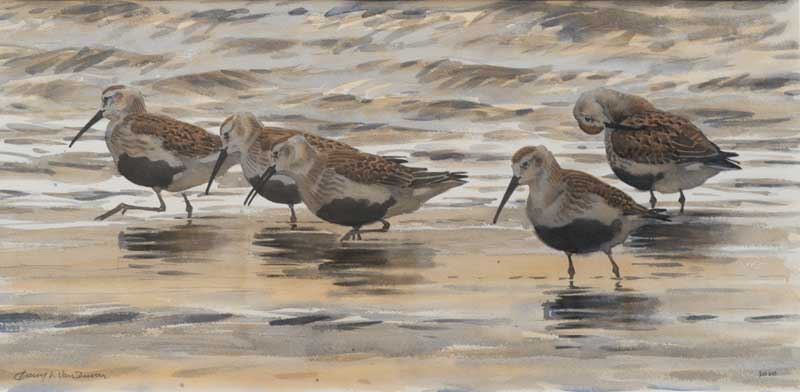
Evening on the Sandbar” by Barry Van Dusen. (Photos by Lisa Aciukewicz)
About 10 years after graduating in 1977 from what was then called Southern Massachusetts University (now UMass Dartmouth) with a degree in visual design, Van Dusen was working for Mass Audubon publications, which included the habitat field guides, and was navigating the quickly changing world of graphic design and Photoshop.
Through his work at Mass Audubon, he became aware of the work of European nature artists like Eric Ennion; Ennion’s student, John Busby; and Lars Jonson, whose works in the field were “richer from life.” All recommended the practice of keeping a field sketchbook. A small field painting by Busby from Van Dusen’s personal collection is included in this exhibit.

“Marsh on Finn Road, Harvard,” watercolor by Barry Van Dusen.
The challenge of drawing in the field
Van Dusen said field drawing was discouraging at first. Getting close enough to his fast-moving subjects while capturing their essential details was challenging. He committed to continuing to practice the various drawing techniques he had learned in college: techniques that involve looking at the subject more than at the paper, using blind contour, modified blind contour, gestural, and tonal drawing. Through that practice he learned to draw quickly and to “capture the essence of a subject with very few lines.” He eventually mastered drawing while viewing his subjects through binoculars and a telescope. He gravitated to using watercolors in his drawings, sometimes completing his work in the studio, referring to his notes, sketches, and photos.
Sometimes animals just sit, resting or waiting. One day, Van Dusen, without going into the wilderness, spotted a bobcat sitting on the lawn outside his studio. With his telescope aimed and the bobcat sitting quietly nearby, he drew its portrait from inside his studio.
An inspirational artist
Van Dusen is inspirational in person. The day after my interview, I picked up a sketchbook and drew the rough shape of a browsing deer in the woods outside the kitchen window. I will probably never use a telescope to draw the nature that surrounds me, but I can always have a pencil and sketchbook nearby. Van Dusen points out that natural subjects to draw are everywhere: in a city park, on the trail, on a farm, and in the garden. I might draw the little bird on a wire, perhaps just getting its basic shape; or the squirrel digging for acorns; or the emerging ferns. Then, with the little watercolor tray and water brush he showed me, I can add a bit of color, just like a field artist.
- “Natural Inspirations—Paintings by Barry Van Dusen” will be on exhibit at Fivesparks until May 25. The exhibit also includes some examples of sketchbook drawings and painting, book illustrations, and art from his collection of works by other field artists. The public reception will be held Sunday, April 14, from 3 to 5 p.m.
- Van Dusen will lead a drawing and painting workshop at Fivesparks Saturday, April 27, 10 a.m. to 4 p.m.
- An “Illustrated Talk: The Making of a Field Artist” with Barry Van Dusen will take place at Fivesparks Saturday, May 18, 4 to 5 p.m.
- In coordination with the release of a book that he illustrated, “A Year of Birds: Writings on Birds from the Journal of Henry David Thoreau,” Van Dusen’s paintings will be on display from May 10 to July 25 at Thoreau Farm and at the Walden Pond Visitor Center from May 2 to July 31.