Clara Wool, right, and some medical students prepare to head out into the Nicaraguan countryside to the clinic. (Courtesy photo)
Bromfield senior Clara Wool came across her third opportunity to accompany a mission trip to Nicaragua when she participated in the “Nashoba in Nicaragua” contest last fall.
The contest, brainchild of Hudson resident Dr. Brian Lisse, offers high school juniors and seniors from Nashoba Regional High School, Hudson, and Harvard the opportunity to compete for the annual expense-paid trip to a remote region of Nicaragua each February, to assist a medical mission team of doctors and medical students and learn something about the country and its people. Applicants must attend two three-hour lectures on tropical diseases and Nicaraguan history and culture (the latter in Spanish), and take a 48-question multiple-choice test on the material presented. The high scorer wins the trip. After Wool tied for first place in the contest with Olivia Saisa, from Nashoba Regional High School, the two decided to split the prize, with each one paying out of pocket for half the cost of the trip.
Wool first became interested in Nicaragua through her church, the First Parish Church of Groton. Adults from that church had been going on mission trips to Nicaragua’s Santa Rosa area for a few years, she said, and her youth group decided it was time for them to go too. They embarked on a fundraising campaign which netted them around $16,000, and in April 2007 they set out to the Nicaraguan villages of Francia 1 and Francia 2 to help build a school.
Wool’s second journey to Nicaragua was in August 2007, with the organization Travel Alive, which promotes international volunteerism. On this trip, Wool did some teaching at a special education school, where the students had a variety of physical and learning disabilities.
In going on the medical mission trip this past February, Wool was following in the footsteps of her brother, Bromfield grad Joel Wool, who accompanied Lisse and his team to Nicaragua in 2006.
Lisse’s mission trip is coordinated by Bridges to Community, a nonprofit cultural exchange organization that takes volunteers to developing countries “to work, learn, and reflect,” according to its mission statement. His team focuses on providing medical care at small clinics in and around Siuna, an old gold-mining town in northeastern Nicaragua. Most of the work is done in Siuna’s small, outlying villages. Doctors and medical students stay for a month; the high school students stay for two weeks.
Wool said the 24-person team stayed on a farm in the village of Campo Uno.
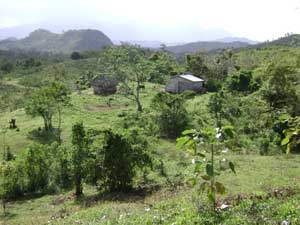
A view of a farm in Campo Uno. (Courtesy photo)
“It was in the middle of nowhere,” she said, but added, “It was very pretty.”
She said half the group slept in one room in the small house, and the remaining 12 slept outside under a tarp.
The high school students got to help out in a number of areas, said Wool. Every other day teams of two worked on building a new stove in the community kitchen. Most of the ovens in the humble houses that make up these small villages are not vented to the outside, she said, thereby causing many health problems, especially for the women and children who are around them all day. The stove the team built was made of dirt, cement, and brick, and most importantly, included a vent and pipe to carry smoke away from the house.
Upon hearing the announcement of the medical team’s impending arrival, villagers often travel for days on horseback or by foot to reach one of the small clinics and be seen by American doctors. There is often a steady stream of patients at the clinic each day the team is there, from the time it opens, to the time it closes for the day. When the students on the mission team weren’t working on the stove in the community kitchen, they helped at the clinic, checking patients in, and taking down basic information such as name, neighborhood, and age. They also took patients’ weight and blood pressure, and helped in translating patients’ complaints into English for the doctors and medical students.
Wool said, “You see the same illnesses over and over.”
Many are illnesses that Lisse has said are symptomatic of the “disease of poverty”—dehydration, migraine headaches, acid reflux, gastritis.
There were also a lot of people with asthma, said Wool, likely related to the cooking situations in many of the homes. She said that Lisse brought a Nebulizer with him on this trip and donated it to the local clinic, to help the medical staff there—usually a nurse with minimal training—treat serious cases of asthma.
The team did see some things that were unexpected, Wool said, such as the case of a 7-year-old boy who doctors thought might have a worm in his brain. (Doctors sent him to the hospital in Managua.)
Besides building a stove and triaging patients, Wool and the other students also helped with water testing in the local wells, a project Lisse helped start three years ago to determine the degree to which contaminated water contributed to some of the diseases his team was treating in the region. The students tested four to five wells, but according to Wool, “didn’t find much that would cause concern.”
Wool said her trips to Nicaragua changed her view of her life back in the U.S., and also burst some stereotypes about this Central American country.
“I saw the poverty and realized how much we have” she said. “It’s such a nice environment. People are so friendly. They’re happy we’re helping them. Our country did so much damage there during the Sandinista war in the 1980s—it’s amazing they are so welcoming.”
Comparing life in the U.S. to life in Nicaragua, Wool said, “We work so hard to get more money and more things. We don’t take time to look around us and appreciate family and friends and what we have. They work hard, but don’t try to have more stuff than they need.”
Wool said her trips have helped her focus on a goal for the future—a career in international relations, possibly preceded by an internship with Bridges to Community.
Noting the important part her travels have played in her education, Wool said, “People should try to get out of the country in high school so they can see how people in other parts of the world live.”