2012 plans unaffected, says Nota
In an era of draconian cuts to state aid to towns, one category is about to increase by nearly 30 percent in the coming fiscal year, an unexpected windfall that will directly benefit Harvard as well as the state’s other 350 cities and towns.
Fulfilling a campaign promise to make more money available to towns in Massachusetts to repair their deteriorating roads and bridges, Governor Deval Patrick signed legislation this week that will raise $200 million for local governments to spend on such work under a 1973 law known as Chapter 90. This amount is 29 percent more than the amount raised in 2011, the highest ever apportioned to local transportation, according to the Massachusetts Municipal Association (MMA). Harvard’s share? An extra $70,000 to spend on its roads in 2012, bringing its Chapter 90 total for the year to a new high of $312,785.
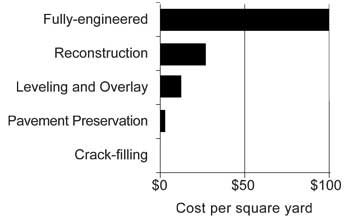
Estimated cost per square yard
of proposed DPW maintenance options.
However, the increase, says Department of Public Works (DPW) Director Rich Nota, will have no immediate impact on construction his department has budgeted for the coming year. “The money doesn’t have to all be spent in the year it is received,” he says, and for now he expects to stick with the program approved by the selectmen in February. That scheme, part of a five-year roadway capital plan, allocates roughly $260,000 of Harvard’s Chapter 90 money to maintenance in 2012, with the rest remaining in a reserve fund for future use.
Harvard has nearly 65 miles of road, from country lanes like Littleton County Road, which skirts the town’s eastern boundary, to major thoroughfares like Ayer Road. Some are in good shape; others are in dire need of reconstruction. In his appearance before the selectmen earlier this year, Nota asked for an annual budget of roughly $500,000, “half to maintenance and the other half to catch up on the roads we have let go to the point where they have to be reconstructed.”
Maintenance, as noted, will be paid for with Chapter 90 money, but reconstruction will be paid for with an annual $250,000 allotment from the Capital Stabilization and Investment Fund, an amount that will have to be approved each year by Town Meeting.
“To some people, the approach is counter-intuitive,” said Nota. Conventional wisdom would say that “you’re supposed to throw the most money at your worst roads.” But there’s another way to look at it, said Nota. For the roads that are still in good shape, “let’s not let them get into that terrible condition.”
The rationale for Nota’s approach, which was endorsed unanimously by the selectmen, is evident in the relative cost of maintaining town roads when compared to the cost of major repairs. DPW has proposed a “four-prong” approach to “pavement management,” each level requiring a different level of expense. The levels (whose relative cost is depicted in Figure 1) include:
- Crack-filling, where the goal is to prevent moisture from penetrating the road, which causes potholes and deterioration, according to Nota (Cost: $0.50/square yard).
- Pavement preservation, a “stone seal,” gutter-to-gutter service that’s used on a road that’s gone beyond 20 percent cracking but doesn’t yet require a pavement overlay; can extend life of the road by five years. (Cost: $2/square yard).
- Leveling and overlay, which is used on roads that “have lost their shape,” which leads to puddling and freezing of water in the winter and in heavy rains (Cost: $12/ square yard).
- Reconstruction (Cost: $28/ square yard).
As the weather warms and construction season gets under way in Harvard, Nota is planning for one reconstruction and three leveling and overlay projects, all of which will be subcontracted. Work on Littleton County Road, which began in 2010, will continue with an additional half-mile of construction, from Cleaves Hill Road to Old Schoolhouse Road. Old Schoolhouse Road, as well as Park Lane and Ayer Road (from Route 2 to Depot Road), will receive a leveling and a new overlay. Many of the remaining roads in town will get crack-filling and stone seals.
Chapter 90 funding, which will pay for all of the maintenance work done this year, is awarded to communities based on three factors: road miles, population, and employment levels. Harvard has 65 miles of roads, a population of 6,500 and employs 894 in town businesses, according to the state Department of Workforce Development. Reconstruction of Littleton County Road will be paid for mostly by the $250,000 allocation from the capital fund approved by Town Meeting this year.