Like a raft in white water, the $3.9 million proposal to renovate Town Hall continued to bob and drift towards April Town Meeting last week, as Selectmen and town committees cheered or opined on its progress, and the Municipal Building Committee, manning the tiller, seemed eager for someone else to jump aboard and take charge.
On Tuesday, March 21, Selectmen voted unanimously—absent Selectman Bill Johnson—to include in the Annual Town Meeting warrant both the article and ballot question needed to fund the detailed design and construction of Town Hall later this year. Gone for the moment was talk of funding only detailed and biddable designs for the 1872 building, while deferring a second vote to begin construction until November or December.
The article can always be amended at Town Meeting, but as written, it asks for permission to borrow the entire amount needed to complete the project. If the article passes, voters will get a second chance to approve it at town-wide elections on Tuesday, May 1.
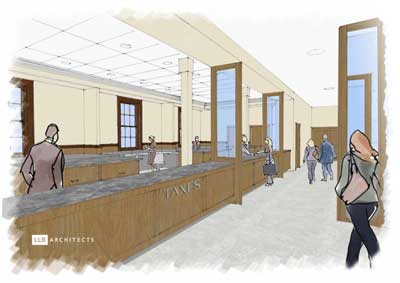
Rendering of the first floor of Town Hall after proposed renovation. (Drawing by LLB Architects)
Although they have added the measure to the warrant, the Selectmen themselves have yet to vote on whether to recommend it. They are the only town committee with a role in planning and financing the project that has yet to take a position. The Finance Committee, the Community Preservation Committee, and the Capital Planning and Investment Committee have already spoken.
The decision of the Finance Committee came last week. Earlier this month the Community Preservation Committee voted to recommend funding $1 million over 20 years to help pay for the work. And the Capital Planning and Investment Committee chose to issue a report that lists pros and cons of the project, but takes no formal position.
FinCom: Town Hall can’t wait
The vote of the six Finance Committee members present at the Wednesday, March 22, meeting was unanimous. After hearing a persuasive presentation by one of its members, FinCom recommended the article and the ballot question to residents. George McKenna, who has frequently criticized the plan for failing, in his view, to evaluate less expensive alternatives, was absent.
The presentation by member Rudy Minar, a financial analyst, seemed to allay what doubts remained among some committee members. In a series of slides he reviewed what he called the “years of neglect” that had followed the failure of a committee appointed by the Board of Selectmen in 1983 to come up with a plan to repair Town Hall. In the nearly 30 years since then, he noted, the town has built a new police station and library addition, renovated the old library, the schools, the Public Works building, and the Bromfield building, but has left Town Hall untouched.
“For a long time, for 30 years – 30 years!” he exclaimed. “There’ve been committees. There have been assessments. There have been studies. There have been task forces. There’s been a lot of stuff going on, but nothing has been done.”
Now, finally, he said, there was a proposal for updating Town Hall that “had momentum.”
Recalling a lesson he said he had learned from his father, Minar said, “When you are a lieutenant, you look at the map very closely…But when you’re a general, you need to step back and you see the whole theater of operations…and then you make your decision.”
“And you don’t necessarily need to know all the details,” he added, “because you’ve got other people who’ve taken care of all of that for you. You trust in the delegation that you’ve made to the folks who are in the field, who are the experts in that.”
As a FinCom member, he said, it was “really hard” for him to start questioning details such as “whether we have enough parking spaces” or whether the shell of the building could be restored and renovation left for a later year.
“There have been studies done,” Minar said. “The work was done by people who have done other work similar to this. They’ve done work on the Acton Town Hall. They’ve done work for all the other towns around here, and for big universities, big public projects, and those are the folks that have been contracted [for this project], as well as the folks who are on the MBC, who are all professionals who have worked on similarly scoped projects.”
‘We have done our homework’
At this point Minar began to pull various studies of Town Hall out of a box he had brought to the meeting.
“To say that we haven’t done our homework and that we haven’t adequately done the visioning of the project…” he said, his voice trailing off. “It would be hard to question that, given the amount of time and effort that has gone into this.”
Minar noted that the short-term lending rate for municipalities today is below 1 percent, but that the index for 20-year bonds had jumped from a low of 3.6 to nearly 4.0 percent since January. He said Massachusetts experts had told him that short-term rates had never been lower. Moreover, he said, his review of the various estimates of the cost of deferring maintenance would likely exceed the cost of the proposed renovation project, while a “Band Aid” restoration of the exterior would not produce substantial savings.
Minar said that when he reviewed the course of the Town Hall proposal over the past year, “there was town-wide support … to move forward” in the nearly-unanimous vote of Town Meeting attendees. And he noted that the Finance Committee had recommended that article and had written, “We cannot afford to defer required maintenance another year.”
The money needed to complete detailed designs and renovate the building will be raised by the sale of a municipal bond and repaid with interest over 20 years. To reduce the amount of new taxes that the town would otherwise need to levy on residents, the Community Preservation Committee has already voted to use a portion of the revenue it receives every year through the Community Preservation Act surcharge to pay for the principal and interest on $1 million of the total borrowed amount. That decision leaves the taxpayers on the hook for $2.9 million, a number that Selectmen and the building committee hope to reduce through grants and private fund raising.
“We’ve got a lot of momentum, we’ve invested a lot of time and money getting it to this point, and it would be to me tragic not to continue that momentum to leverage all that investment of time and money and expertise that’s been accumulated and to move forward,” Minar concluded.
MBC to focus on informing and educating
The Municipal Building Committee met Thursday, March 22, to discuss how to better inform residents of its plans for Town Hall and to deal with loose ends. Co-chair Peter Jackson proposed that the committee hold open houses at Town Hall and Hildreth House to help undecided voters better understand its plans.
Member Lou Russo, however, urged that the committee be careful in how it presents its work to the public.
“It seems to me we really weren’t charged to be advocates,” Russo said. “[Our charge] was to come up with solutions.”
“But shouldn’t the committee be willing to say, ‘Our recommendation is that you do this work?’ asked member Doug Coots.
“I’m not sure we’re making a recommendation,” Russo responded. “We were charged to come up with a plan to renovate the building…and to remedy [its flaws], and the plan does address that.”
“There are people who are saying, let’s just paint the outside and leave it go at that,” Russo said. “I don’t know that we as a committee have analyzed whether that’s a viable solution…We haven’t done code reviews. I wouldn’t want to be making presentations to the public saying that you could or couldn’t do that. Because that wasn’t in our charge. We haven’t discussed it. And we haven’t asked our experts to review that.”
“This is going to be a political football,” said Russo. “I think we should be sticking to [the understanding] that we had a charge, we executed [it], we’ve done due diligence, and this is what we came up with. If people do or don’t like it, that’s a different thing.”
Public meetings, he urged, should be “informative, educational.”
As of midweek, then, here’s where matters stood. An article to fund the detailed design and construction of Town Hall is in the Town Meeting warrant. The Finance Committee has recommended the article, as well as an article to increase the Community Preservation Act surcharge for future projects. The Community Preservation Committee has agreed to contribute $1 million of its surcharge revenue to the Town Hall project, should it pass. And the Municipal Building Committee, its work largely done, says the job of promoting the Town Hall renovation belongs to the Selectmen.
The Selectmen, however, must themselves first vote to recommend their article, which Chair Marie Sobalvarro says will happen April 1. Then it will be up to Harvard residents. First, at Town Meeting, where attendees will be asked to approve the $3.9 million debt needed to proceed. And then, at town elections the following Tuesday.