My wife and I participated in the Great Backyard Bird Count during a weekend in February.
The Great Backyard Bird Count is a citizens’ science project managed by the Cornell Laboratory of Ornithology. Participants count the number and species of birds seen in a 15-minute period on a given weekend. This is probably one of the easiest ways to contribute to the study and understanding of birds. All you have to do is watch your feeders, note the species, and tally their totals.
You enter the species at the Bird Count website (http://www.birdsource.org/gbbc/howto.html), which contributes to the study of birds worldwide. Through the website you can track the number of participants, their location, and the bird species observed. I could even check out the number of species seen in Worcester County (55) and compare that to the number that I saw (21 or 38.18 percent of the total). In Massachusetts, 144 species were reported and in the whole country, 617 species were reported. Last time I checked more than 127,000 people had participated worldwide and had observed 3,221 species.
Plentiful redpolls
The most plentiful bird at our feeders has been a flock of 40-50 redpolls visiting from Canada. The bluebirds are getting to be an even more vibrant blue and are already checking out the nest boxes. I must go around and clear out all the old nests and evict the field mice who have taken up residence over the winter so that the boxes are more inviting to the bluebirds and tree swallows who will be arriving in the first or second week of April.
Several friends have mentioned they have seen bluebirds this year. Friends have reported seeing cedar waxwings feeding on their privet fruit, and on our last trip to Parker River Refuge we found a flock of these silky looking birds gorging on juniper (cedar) berries.
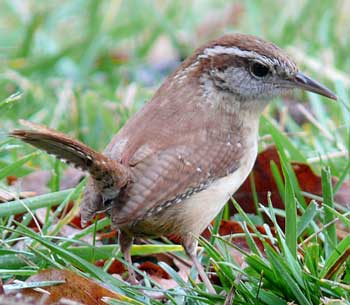
A Carollina wren looks for food. (Courtesy photo)
Carolina wren’s ‘tropical’ song
Jim S. described to me the song of a bird he did not recognize and described it as kind of tropical song. I thought it might be Carolina wren. Indeed, he did see the wren, which had also been reported to me by Joanne W., who delights in their antics while feeding on the peanuts she puts out for them. There is a sub-species of this wren in Central America, which is probably why I always associate the call of the Carolina wren with a tropical species.
While I was doing one of my feeder counts, I was surprised to see a blue jay with a junco in its mouth. Whether the junco was sick or injured before the jay grabbed it, I do not know. I know blue jays will rob nests of eggs and nestlings, but I had no idea that they would kill a grown bird. The last I saw of them was the blue jay flying into the woods behind the barn, presumably to finish off the junco and have a tasty meal.
The subject of the last module of the Birders Certificate Course that Pam and I are taking at Joppa Flats is Bird Conservation. It was taught by Kim Peters, Chief Scientist and Director of Bird Conservation of the Massachusetts Audubon Society. I found it to be a depressing lecture. Although great strides have been taken in conserving areas for birds, the greatest threat to their existence remains habitat loss, both here in the United States and around the world.
Cats: the number-one killer
The number-one killer of birds is domestic cats. Billions are killed every year in this country by domestic cats who are allowed to roam freely outside. If you own a cat, please keep it inside. Chemicals are also a continuing threat to birds, even though Rachel Carson brought their detrimental effects to public awareness with her book “Silent Spring” more than 50 years ago. A grain of salt applied to our roads and ingested by a finch pecking for grit (which aids their digestion) can have fatal consequences.
There are dozens of other human actions that are harmful to birds, but on the bright side, I think there is more awareness of the problems. There are “dark city” initiatives by which owners are urged to turn off lights in their buildings to avoid bird collisions. There is an effort to produce a glass that will somehow deter bird/window collisions. For wind farms, studies have to be conducted to learn more about their potential impact on bird populations and major flyways.
The biggest unknown at this point is the extent to which climate change will affect bird populations. Some birds have already been observed returning to their breeding grounds before their normal food sources are available, and this will have devastating impacts on breeding and the raising of their young.
Hopefully, as more and more people come to observe and appreciate birds, we can all pull together to make our world more friendly to these incredible animals.