CLICK GRAPH TO ENLARGE
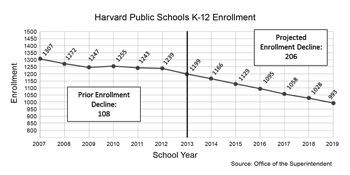
A report done for Harvard’s schools last year predicted that school enrollment at Hildreth Elementary School (HES) and the Bromfield School could drop by as much as 25 percent in the next 10 years .
This week the School Committee heard from a panel appointed to consider strategies for dealing with the change. The aptly named “Subcommittee on Strategies to Manage Declining Enrollment” consists of Superintendent Joseph Connelly, who led the Tuesday morning presentation, along with Bob Sullebarger and Kirsten Wright of the School Committee. Their report was published in June, but summer vacations and the urgency of deciding on the candidacy of HES Principal Linda Dwight for the position of School Superintendent prevented an earlier discussion of its findings.
In their report, the subcommittee noted that there were two broad approaches available: scale down costs in proportion to the decline in enrollment, or redirect teacher time and classroom space to “enhance the current curriculum and educational opportunities for students.”
If the committee chose to adopt the first option, reducing expenses would be the top priority. Since the fixed costs of operating HES and Bromfield would remain, this approach would lead to reductions in staff. While it would lower costs to the town, it “would almost certainly negatively impact the curriculum and education experience that the Harvard public schools deliver,” the report states.
The second option would redeploy savings at the elementary school to add support staff to both HES and Bromfield, and more particularly, to expand curriculum offerings at the latter.
Connelly told the full School Committee, whose members had gathered for the 8 a.m. meeting in Town Hall, that both HES and Bromfield were operating at full capacity. Every classroom is being used at HES, he said, and only “a couple” are being shared at Bromfield. “An enrollment of 1,100 to 1,200 students is optimal,” he said. “We would never want to go below that number.”
Substituing Devens revenue for Choice
This coming year, 12 choice students are expected to graduate from Bromfield, which will cause a drop in choice revenue of $60,000. Connelly noted with the additional eight Devens students who have enrolled at Bromfield this year, the schools have an extra $100,000 available. He suggested that the money be used to make up for the loss of choice revenue next year, and that $60,000 be added to the school operating budget next year.
Maintaining the quality and richness of the Bromfield curriculum seemed to be on everyone’s mind. The subcommittee report cited a survey of eleven of the 33 parents who send their children to schools outside of Harvard which had found that “increased course selection” was a “driver” in every case. The 2012 Climate Survey done by the School Council found that 55 percent of students were satisfied with the available electives at Bromfield; 46 percent were not. Bromfield parents had a somewhat more favorable view: 62 percent were satisfied or somewhat satisfied with the alternatives.
“Can we all say that we don’t want the curriculum to contract,” asked Bob Sullebarger? “We’re talking about enriching the curriculum right now, but if we were to contract the curriculum, that’s perilous to the town. That jeopardizes the prestige—if you want to call it that—of the school system, which will directly affect the real estate of every family in town.”
Students or curriculum first?
“The question,” said Keith Cheverals, is “does the number of students drive what we offer, or should what we offer drive the number of students.”
“But are they inextricably linked?” asked Sullebarger. “Can we say there is a curriculum we’re going to offer regardless of the enrollment? There is a bottom…that you can never go below.” He added that his sense was that people were not leaving town to get more curriculum for their child. “Would they like more? Yes,” he said. “Is what we have better than adequate? I would say yes…Would we like to do more? Yeah, to the extent we can afford it.”
Commenting on the choice before the town, Chairwoman SusanMary Redinger said she would love to keep the money that a decline in class size at the elementary school might provide. “I just don’t know that that’s an idea that’s valid. The citizens of the town might like some relief.”
Connelly replied that the projected decline will be gradual, “not dramatic.”
“We’re talking two to three teachers at the most,” he said.
In considering how Bromfield might adapt its curriculum to offer more choice as the student population declines, the committee concluded it needed to better understand existing class schedules. Their next step is to invite Bromfield Principal Jim O’Shea, Vice Principal Scott Hoffman and the school guidance counselor to a meeting next month to better understand the schedules that have created science classes as large as 28 students and conflicts that have prevented students from fitting electives into their curricula.