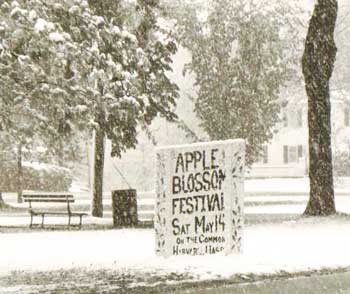
The snow on May 13, 1977, cleared for the next day’s Apple Blossom Festival, but not before causing a lot of angst. (Courtesy photo))
“A touch of olde New England,” “scenes reminiscent of yesteryear” on the “picturesque common green,” in “the charming apple-growing community of historic Harvard,” which can “rightfully lay claim to the most beautiful sylvan views of any town in the Greater Boston area.” Such was the publicity in regional papers during the 1960s and early ’70s as the annual Apple Blossom Festival came to the Harvard Common in May.
The Couples Club of the Unitarian Church, an organization set up to welcome newcomers to Harvard, started the Apple Blossom Festival in 1952 as a community project to benefit the town in various ways. Members of the club volunteered at tables that included refreshments, crafts, home-baked goods, and games such as throwing a ball into a clown mouth or “dunk-the-dame.”
Funds for town causes
Proceeds from the festival went to fund such things as books for the Bromfield and elementary school libraries, support for the school music program, clearing weeds from the pond in 1975 when state funding was cut off, and in 1974 a sailboat for the school, so children could learn to sail. Later, the town ambulance maintenance fund and the Village Nursery School were also recipients of the proceeds.
The festival expands
In 1965 the area press announced “something unique this year—the addition of several booths sponsored by various organizations of the town.” The Girl Scouts had a rug wool booth; the Woman’s Club had a mystery table; the Unitarian Women’s Alliance, a sewing table. The American Legion sold flags and flag poles, and the Historical Society offered antiques. Later, other town groups joined in: the 4-H Club, the Harvard-Roxbury Summer Group, the Harvard Players, the PTO, and seniors or juniors at Bromfield selling ice cream.
In the same year, Arline Marteney, who, along with her husband Gene, was general chairperson of the festival, had what she now calls the “bright idea” that it would be nice to include an art show. The show would draw from the more than 30 recognized artists among Harvard’s 2,000 residents.
Art in Fellowship Hall
For the first two years, Arline told the Press this week, the exhibit was held in the Unitarian Fellowship Hall, where she and Gene put up molding from which to hang wires for the paintings, and Gene made free-standing easels for art work. The art show then moved to the Congregational Church the year its parish hall was completed. She says the two-day show was a great venue for artists of all kinds to sell their work—weaving, photography, and jewelry, as well as watercolors and oil paintings.
Arline recalls that one of the artists was well-known watercolorist Agnes Abbot, from whom she later took lessons. Agnes’s brother Frank exhibited photographs, as did Arline’s late husband, Gene. The art show continued as an annual event at least into the mid-1970s but then became financially unsustainable.
Arline recalls that in the early years of the festival, the fire truck would take people up to the orchards. In their first year as chairpersons, Gene and Arline were riding up Bare Hill one day and spotted the fire chief up ahead. Gene speeded to catch him, anxious to talk to him about that year’s festival. It was only after pulling up behind Chief Johnston in someone’s driveway that Gene realized the chief was on official business and this was not the time to talk apple blossoms.
Bands, baskets, and buses
For many years there was a schedule of musical events, often featuring the Wonderful Schmaltzy German Band Concert, the Town Band, banjo players, barbershop quartets, folk singers, and square dancing. There were all-day displays and demonstrations: sheep-shearing, soap making, blacksmithing, basket-making, chair-caning, and many others. Staples of the festival were the ever-popular cotton-candy machine, the Moon Walk, pony rides, and homemade baked goods. For a few years, festival-goers could enjoy a tethered hot-air balloon ride or the Boy Scouts’ rope walk; and starting in 1992 the ambulance had a spot on the edge of the Common to offer blood pressure screenings.
A picture in the Harvard Post from that year shows Board of Selectmen Chairman Rick Maiore shivering in bathing trunks atop a dunking pond. In 1994 Irene Mannix and her famous shortbread and jams debuted. Favorite guest appearances over the years include Big Bird and a parade of antique autos on their way to Prospect Hill. Free kittens always offered a mixed bag—“oooh”s and begging from children, sighs and “no”s from parents.
In 1983 a letter to the editor appeared in the Harvard Post commending the Conservation Trust and tour guide Larry Finnegan for offering an enjoyable and educational bus ride to the orchards to learn about Harvard’s apple industry. For more than 10 years the trust sponsored visits to Carlson and Westward orchards. Many in town have memories of a bouncy hay wagon ride through Carlson’s orchard and the cool darkness of the apple storage room at Westward Orchard and the crisp taste of an Empire apple.
Enter the ducky wuckies
An omen of things to come appeared in a letter of 1985 when the chairpersons of that year’s festival wrote that attendees of the festival would never know “how perilously close we came to not having one this year.” They thanked volunteers, Fire Chief Paul Johnston, the highway department, Park (sic) and Rec, Cream Crock Foods, and others for having made the festival possible. By 1988 “commercial venders were hawking their wares”—seemingly as a way to bring in additional revenue and keep the festival going. For many moms in Harvard that was the beginning of years of Mother’s Day gifts purchased at the Apple Blossom Festival.
1992 brought an even bigger change to the festival when it was taken over by the Ayer-Shirley-Harvard Rotary Club. The “ducky wuckies” became the newest of the festival’s traditions. Soon after, there is no mention of the orchard tours—perhaps the ducks replaced apples as the biggest draw. A couple of years later, a fire engine gave rides around town center. In 2002 then-Postmaster Jerry Copeland’s son won the Ducky Wucky Race’s coveted prize: dinner for two anywhere in the world. Jerry had visited his son out west in March and sold him a ticket at that time.
The weather: always a worry
One thing that never changed throughout the years was the worry about the weather and the timing of the blossoming of the apple trees. One can hear the disappointment in 1969 coverage of the festival: “The height of blossom season was last week,” and on May 21, 1972, the apple blossoms “had not yet burst into bloom.” However, in 1971 “for the first time in years, every apple tree in town was in full bloom”—only to have snow the day before the festival in 1977.
But no matter the weather, and all the changes to the festival over the years, a quote from a May 1988 issue of the Post still resonates: “Harvard seems unique in its ability to maintain small-town traditions.”