
For Jenifer Goldman Fraser of Ayer Road, this year’s overlapping of Hanukkah and Christmas has brought into sharp focus her experiences of straddling the two worlds of Judaism and Christianity. “It’s hard being a Jew living in a Christian country,” she reflected. She has often felt “other,” the one with the strange language and strange rituals. The two religions are different, and there is a religious tension, Jenifer noted, but they share a common sense of humanity and the importance of caring for one another. It’s been a long journey, she said, but she is now comfortable with her chosen faith.
Jenifer’s “straddling” began with the interfaith marriage of her parents. Her mom was Scottish and came to the United States in the 1960s. She was working as a nurse at the University of Chicago hospital when she met her future husband, a Jewish man from a rather insular community in New Jersey, whose father had escaped persecution in Poland. They married and moved to Richmond, Virginia, where Jenifer was born and raised.
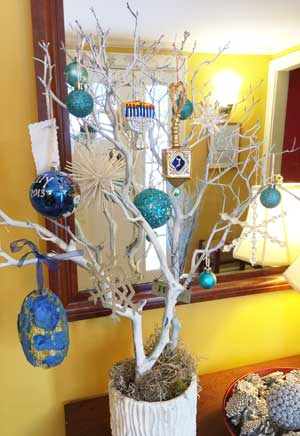
Hanukkah ornaments hang on a tree at the Goldman Fraser house. (Courtesy photo)
Her mom converted to Judaism and kept a Kosher home. Jenifer attended a Hebrew day school from grades 4 to 8, where she recited prayers in Hebrew for an hour each day. She said she had trouble relating to the teachings of the Talmud because they were so patriarchal. She found little that she could relate to in the religious teachings. But she felt a strong Jewish identity, a connection to the people who thrived over the centuries, and who have a deep desire to preserve who they are as a people.
Family traditions
Her family had strong, though simple, traditions around Hanukkah. There were gatherings with relatives, singing prayers, lighting the candles of the menorah, making latkes, receiving gelt—gold-covered chocolate coins—and getting a gift of a dollar or some small item. It was not an important holiday, not a time for presents. It was a time, though, of bringing people together to remember their common history.
At the same time, there were pulls to Christianity. Her parents lived in a white, Protestant part of Richmond, and so Jenifer was isolated from Jewish friends. Her mother had kept certain memories and traditions of Christmas. Jenifer recalled that every Christmas Eve day her mom would tune in BBC and listen to the King’s Chapel Choir sing the “Festival of Nine Lessons and Carols.” She said she loved those songs and remembers them still.
For high school she went to an Episcopalian girls school. She knew nothing about Christianity, but she loved the hymns they sang in chapel every day. “Who wouldn’t love the hymns?” she asked with a smile, singing a line from one. At prayer time, though, she didn’t pray. She did join in the Lord’s Prayer—but felt guilty about it being “through Christ, our Lord.” She wanted to fit in, but she worried God would strike her dead if she went against her Jewish traditions.
She also loved the Christmas movies, especially “Charlie Brown’s Christmas,” but she felt tremendously left out. “It was like looking through a window, watching people celebrating Christmas and knowing you could never be part of it,” she said. At the point in the movie where Linus quotes from the New Testament, Jenifer would cover her ears; she was at once enthralled and guilt-ridden.
When it came time for college, Jenifer was anxious to go to a school with a large population of Jewish students, and she found the perfect place in Wesleyan, a small liberal arts college in Connecticut. There “I felt comfortable being Jewish, able to celebrate and be proud,” she said. At home, Hanukkah celebration continued to be “no big deal”—people getting together to sing prayers and light candles.
A shared commitment
She met her future husband, Angus Fraser, a Methodist from the South. Before they got married, they had long conversations about raising children. Jenifer didn’t ask Gus to convert, but she needed to be sure that he was committed to raising their children Jewish, together. She said his family was very welcoming, and although Christmas is her mother-in-law’s favorite holiday, she has never been intolerant of Jewish traditions. Jenifer recalled the first time she visited her in-laws at Christmas. “It was even better than it had looked like through the window,” she said, recalling her childhood feelings. She wondered, “Can I do both?”
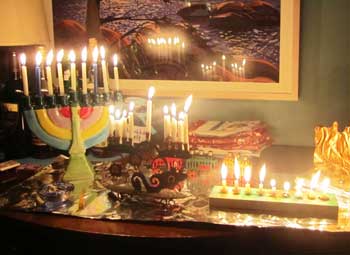
Candles burn low on the eighth night of Hanukkah. (Courtesy photo)
They settled in Arlington and had three children, who are now in grades 4, 10, and 12. Jenifer wanted a Jewish home for the children and for them to develop a strong Jewish identity. She always made Hanukkah very special. As it turned out, the Arlington school was not fitting their education needs at the time, and when a job offer came up, they moved to North Carolina. The kids went to a Hebrew school, she said, laughing at how they were repeating her own childhood experience.
But the South was not a good fit, politically and intellectually: “It was not a place Gus and I wanted to grow old.” So in 2010 they came north. When they were living in Arlington, Gus, an avid cyclist, often rode through Harvard. So they chose Harvard. “I was not thinking a thing about being Jewish,” she said of the decision. But it turned out OK. “I feel very welcomed here,” Jenifer said. But, as was true for her growing up, there are hardly any Jewish friends for her kids in town.
A saving grace
“A vibrant temple has been a saving grace in raising kids in a town with few Jews,” Jenifer said. They attend temple in West Concord, where the young rabbi preaches Reconstructionism, which Jenifer described as a mid-20th-century movement that views Judaism as a civilization, bigger than a religion, making Jewishness real and relevant. It is an intellectual, liberal, inclusive movement, where the focus is not to get “hung up on God.” Jenifer used some Hebrew words to explain the message “listen, pay attention. The Lord is one”; we are all connected. Jenifer said she loves the humor and the intellectualism of Jewish people, and their commitment to making a contribution to society. “Tikkum loam” from the Hebrew means “repair the world.” With others in her temple, Jenifer is exploring ways to do that. “I feel comfortable being Jewish; I want to pass on the legacy,” she said.
While she is very involved with her Jewish life, Jenifer said she feels very integrated. “I love having friends of different religions,” she said. She loves Christmastime and enjoys making Christmas cookies to give to her Christian friends.
Still, Christmas raises some conflicts. One year her older daughter asked her, “Why can’t we have a Christmas tree?” Although almost all her Jewish friends put up a tree, Jenifer had to explain to her daughter that “it’s not my tradition.” Recently, her younger daughter came home from school crying. She told her mom that everyone at school was talking about leaving cookies for Santa, and “I don’t know anything about that.”
Over the years, especially as Christmas has become less religious and more secular (read “commercial”), Jenifer has adopted new traditions, ones that differ from the simple Hanukkah celebrations of her growing up. They have put up outside lights and fun, festive Hanukkah decorations inside.
New traditions
This year, for the first time, “I have greenery in the house—evergreen garlands with silver and blue decorations.” She confessed that when she was purchasing the garlands she looked around with an uncomfortable feeling like “I shouldn’t be doing this.” But “I don’t feel any less Jewish with my garland,” she said. (But she confessed there is one Jewish friend whom she won’t tell about the garland.) She’s also hanging stockings this year—to hold the many small gifts her mother-in-law sends every year. And they will have a special meal on Christmas. “Why not?” she said. “Everyone else is having a special meal.”
“I have never felt marginalized here,” said Jenifer, “but I wish there were more Jewish families for my kids.” It’s hard to straddle two worlds. She feels that Christian kids don’t know about Jewish traditions and that her kids don’t talk about being Jewish. “And that’s burying who you are,” she said. “I feel I need to shore up my kids’ Jewishness,” she added.
She mused about how it could be better. “It would be wonderful for [a Christian kid] to say, ‘Hey, tell me about your holiday. What’s it like?’ What if a friend gave my younger daughter a small gift wrapped in Hanukkah paper? It’s important that people don’t feel they have to tiptoe around someone who’s Jewish. You are different, but there’s enough mutuality to celebrate and understand differences. And not to be overly serious about it. It’s fine to wish a Jewish person a Merry Christmas.”