In 1982 Brenda Berkman won a lawsuit against the Fire Department of New York making it illegal not to hire qualified women for firefighters; on her day off on Sept. 11, 2001, she chose to make her way to mid-Manhattan to join the first responders at the twin towers; and without any art background, she created 36 lithograph prints of the building of One World Trade Center. Now a retired FDNY captain, Berkman will come to Harvard Thursday, March 7, to speak to several Bromfield classes and to the community in a free evening event in Volunteers Hall at 7 p.m.
In addition to her speaking engagements at the school and the library, Berkman has made a loan of her exhibit, “Thirty-six Views of One World Trade Center.” The framed images will be displayed in Volunteers Hall beginning March 1, hopefully to remain until the end of the month. The public is invited to browse the exhibit during open hours at the library.
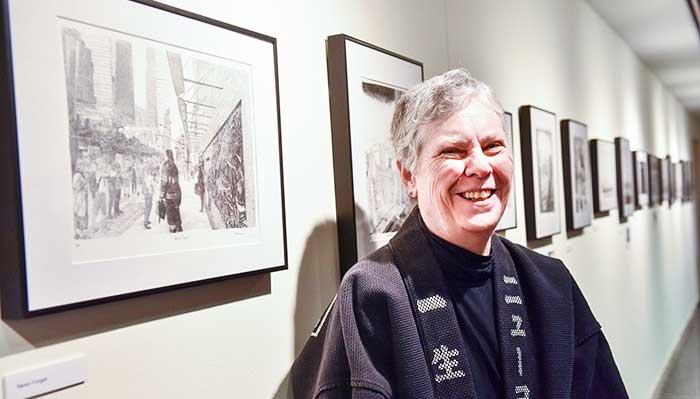
Brenda Berkman with her images of One World Trade Center. (Courtesy photo)
“I knew that day in July that I wanted to bring her to Harvard,” said Bromfield teacher and social studies department leader Kathleen Doherty in speaking of Berkman, who gave a talk at an institute for teachers held at The National September 11 Memorial and Museum last summer. Doherty said she is thrilled that the Harvard Schools Trust is funding Berkman’s visit and making it possible. “I found her fascinating on multiple levels,” she said.
The story of Berkman’s courage and perseverance in becoming a firefighter is inspirational. Prior to 1977, a woman was not allowed to apply to become a FDNY firefighter, but in that year, federal laws forced the department to allow women to take the firefighter entrance exam. At that time, Brenda Berkman was in her mid-20s, in her third and last year of law school, and still searching for what she would make her life’s work. Having wanted to be a firefighter since she was a young girl, she decided to study and train for the firefighter exam.
From law to firefighting
She and 90 or so other women passed the written exam but failed the physical test. Against the advice of family, Berkman made the decision to challenge the legality of the scoring system for the physical test, and she became the sole named class plaintiff in a major lawsuit challenging the FDNY discriminatory hiring practices, even though it would bring her ridicule and ostracism—even death threats. Her brave decision would have lasting effects on her and on hundreds of other women.
It took five years, but Beckman won her lawsuit. She gave up her law practice and took a 50 percent pay cut to join the fire department. She and the token group of other women who went on the job with her were shunned, ridiculed, physically threatened, and even assaulted by some male coworkers. It was a hostile environment in which the women had to trust—sometimes for their own survival—the very men who had made it clear they didn’t want women in the firehouse. Many women dropped out. There were no laws against harassment, and there was backlash from parts of society demanding: “Don’t send a girl to do a man’s job.”
That Berkman remained on the job and eventually made the rank of captain is testimony to her character. She found out she loved firefighting—helping people, being physically and mentally challenged, and constantly learning new things. And she realized she would “no longer tolerate people telling me I couldn’t do something because I was a girl.” She made it her mission to change the culture: “I don’t regret taking the heat for advocating for change,” Berkman said.
On Sept. 11, 2001, Berkman had the day off from her job as lieutenant at Ladder Co. 12 in midtown Manhattan. When she heard of the attack on the twin towers, her first thought was “They’re going to need extra people.” In addition to all the others, New York City lost more than 300 firefighters that day. Said Berkman of her experiences, “It was like your worst sci-fi nightmare.”
Berkman retired in 2006, and as a volunteer leading tours for the World Trade Center Tribute organization, she watched the new building being constructed. Ten years later she had an exhibit of a series of stone lithograph prints, inspired by “Thirty-six Views of Mount Fuji,” which she had drawn and printed over a period of three years. Creating “Thirty-six Views of One World Trade Center” was, perhaps, her way of dealing with the trauma from the catastrophe and watching the rebuilding with a sense of tribute and renewal.
Berkman’s statement about her firefighter experience applies to other aspects of her life as well: “In a small way I was trying to challenge the stereotypes and fears that keep us from achieving our greatest potential.”