Editor’s note: This is the second installment in an ongoing Press series on Harvard’s growing senior population, the challenges many older residents face in living here, and Harvard’s challenges in serving them.
Living in Harvard means that everything from groceries to medical appointments is a car ride away. But for a growing number of seniors who limit their driving or no longer drive at all, staying in Harvard means relying on some form of community-provided transportation to stock refrigerators, fill prescriptions, or attend a social event.
The number of seniors living in town is currently 1,682, roughly 28 percent of Harvard’s total population. But more are coming. More than 30 percent of town residents were born during the baby boom years of 1946 through 1964, and the oldest of those boomers turned 72 in 2018, while the youngest is just 54. As this segment of the population ages and stops driving, its needs will grow, as will the demand for town- or volunteer-provided transportation.
The quality of life for seniors who live in rural communities and no longer drive, especially those without family in the area, is limited by the transportation options offered in those communities. According to a 2012 Cornell University report, “Most people will outlive their ability to drive, and many will face isolation when they can no longer get behind the wheel. Older adults in rural and suburban areas will feel this acutely as communities designed for the car offer few other transportation options.”
Harvard has no public transportation, and it is not a walkable or bikeable town. Its roads have no sidewalks, and few have shoulders wide enough for comfort. While the General Store offers some staples, the nearest supermarket (Shop ’n Save in Ayer) is about 6 miles from the center of town. The nearest pharmacy, which is about 5 miles away, is the recently opened Ayer Family Pharmacy. Local shopping accounts for the most trips taken by Harvard’s Council on Aging (COA) van (see pie chart, below).
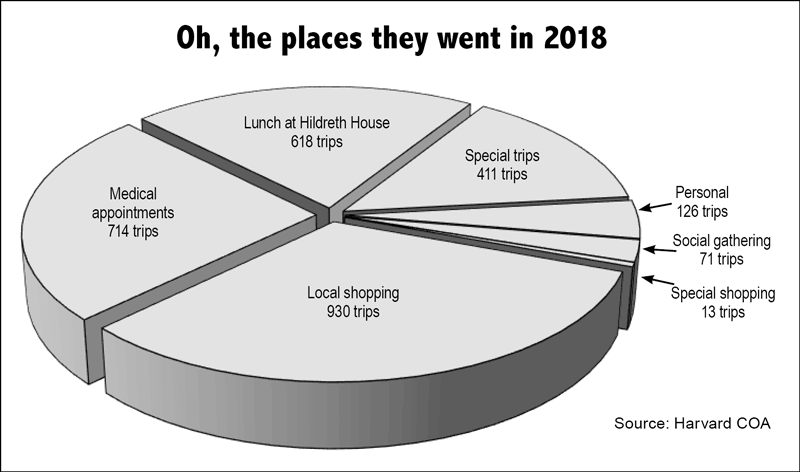
This chart shows where people went on the 2,883 rides that Harvard’s COA van provided in 2018. The number of individual riders who took the van to local shopping was 30; to medical appointments, 51; and to COA lunches, 37. While those numbers are low, the high number of trips in each of those three categories shows how much a small subset of seniors depends on COA transportation. As the senior population grows, so will that subset.
Who needs a ride?
According to the National Institute on Aging, impaired vision or hearing, dementia, and taking medications that impair driving are common reasons seniors give up their car keys. Other ailments such as stiff joints can limit a driver’s ability to react quickly, and loss of feeling in feet or fingers can make it difficult to grip and turn the steering wheel or press the accelerator or brake.
Research shows that many seniors “self-police” when they no longer feel comfortable driving everywhere. Some avoid highways, heavy traffic, night driving, or even taking routes that would require a left turn. Although these seniors continue to drive, they still need transportation on routes they no longer feel safe driving.
Harvard’s ride services
The Harvard Council on Aging (COA) has one wheelchair-accessible van owned by the Montachusett Regional Transit Authority (MART), which can carry either 10 passengers or eight passengers and one person in a wheelchair. The van is on the road Monday through Friday from 8 a.m. to 4 p.m., but that doesn’t mean someone can get a ride on the same day if the milk runs out. The COA asks for at least 48 hours’ notice, and medical appointments take priority. In addition, the van has regular runs when it is not available for appointments or errands, such as the Friday morning grocery store trips and rides to and from lunch twice a week at Hildreth House.
The van will take riders to medical appointments in nearby towns such as Concord or a few more distant towns such as Worcester, but not to Boston. COA Director Debbie Thompson said there are a few seniors who need to go to Boston, and the van takes them to the Littleton commuter rail station.
When the van fills up or a request doesn’t fit its route for a given day, the COA directs seniors to Harvard Help, a volunteer organization in town that provides rides for anyone who is ambulatory, including those who use a walker. Harvard Help has about 20 drivers and five logkeepers who keep track of rides needed each week. Last year Harvard Help covered 320 trips that the COA could not accommodate, an average of six per week.
Logkeeper Marty Green, who has been with Harvard Help for nine years (and is a reporter for this paper), has seen an increase in the number of rides to medical appointments over the past few years, including more people who need weekly or twice-weekly rides. Not all weeks are busy, she said, but the busy ones are “busier than they used to be.” For instance, during one week this past January, Green recalled, the organization received 15 requests but could fill only 14. It was the first time she remembers having to turn down a request.
Harvard Help is short of drivers, who are themselves mostly retired seniors. Thompson said she is concerned that Harvard Help drivers are not protected by the town’s liability umbrella policy, nor do they receive the training that is required of MART van drivers, which includes yearly defensive driving, CPR, and first-aid courses.
What do other towns do?
The single 10-passenger van from either MART or the Lowell Regional Transit Authority (LRTA) is the typical mode of senior transportation in our neighboring towns. But some Councils on Aging have town-owned vehicles as well, and those vehicles lower the number of “seniors per van seat” in towns with higher senior populations. Only Lancaster has more “seniors per seat” than Harvard does (see table below).
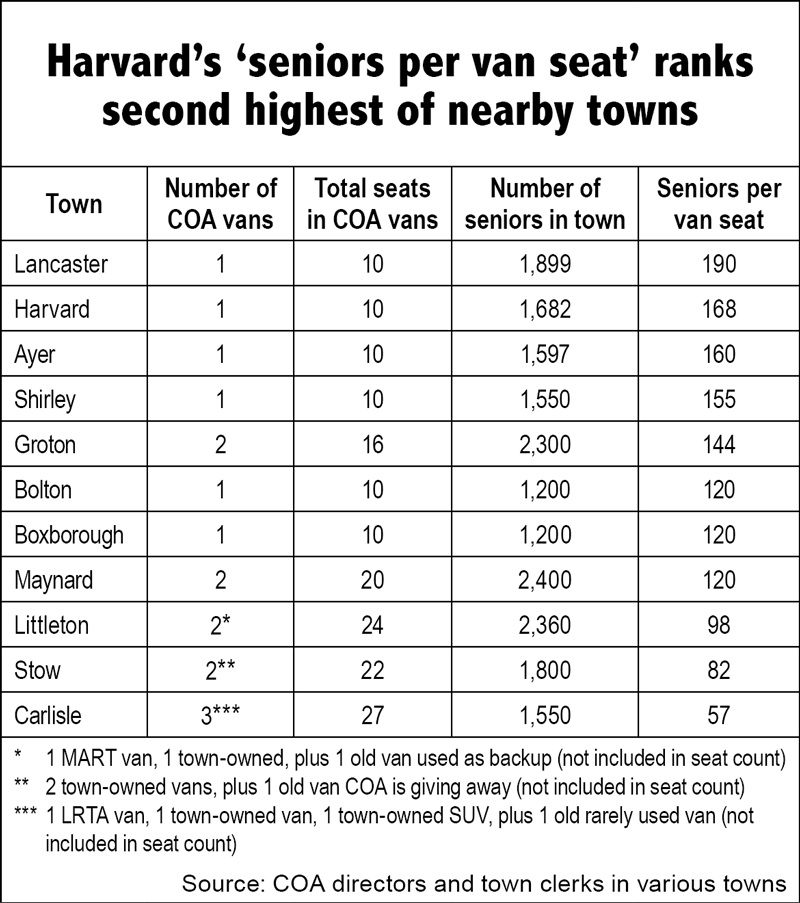
This table ranks Harvard and 10 nearby towns by how many seniors would be competing for a single van seat if they all required a ride at the same time. While that is not a realistic situation, the table does show which towns are more likely to adequately serve their seniors who do not drive. The table is ordered from most seniors per van seat to least, so the towns at the bottom of the table are able to transport more seniors; Harvard ranks second highest. The vans listed are either MART or LRTA vans except where noted. Acton is not included because its COA uses the town’s Dial-A-Ride service, which is available to all residents.
Stow has two town-owned vans but no MART van. Even so, MART provides funds to cover the van drivers’ salaries and van maintenance. One of Stow’s vans was purchased with a grant from the Massachusetts Department of Transportation, as was one of Littleton’s vans.
Carlisle COA Director David Klein told the Press that, in addition to an LRTA van, his town owns another large van donated by a resident in 2006 and also a 2014 SUV paid for by donations. Klein said the SUV is used for 60 percent of senior rides; it’s more comfortable and more economical to drive than a large van, and because it has four-wheel drive, it can navigate the icy driveways that a van can’t.
There is no doubt that a second van allows for more trips, and an increased number of trips equates to improved quality of life for seniors with limited or no ability to drive. Stow’s two vans made 6,407 trips last year, including daily trips to a grocery store, compared to Harvard’s 2,883 trips with only Friday grocery store trips. A second vehicle also allows for more flexibility in scheduling. Stow COA Director Alyson Toole told the Press that Stow’s two vans are sometimes on the road at the same time covering different routes, such as Hudson/Marlborough and Acton/Concord. Groton’s second van is used to take people to medical appointments in Boston or Lahey Hospital & Medical Center in Burlington.
Carlisle is testing a six-month pilot program with Lyft. Klein said the program is subsidized by a grant so that the rides are a more affordable option for seniors. Ride-sharing (unsubsidized) is already being used in Harvard; 2,071 Uber rides originated in Harvard in 2017, according to the Massachusetts Department of Public Utilities’ ride-sharing map. But the average cost of an Uber ride is $2 per mile, putting even a round trip to the nearest grocery store in the range of $24.
Who drives?
Difficulty hiring drivers is another issue. In January, Harvard lost two of its van drivers when one moved out of town and one had knee surgery. Although Thompson said two drivers were recently hired to replace them, the town now has no drivers with a commercial driver’s license, required for driving heavy vans or those with 16 or more passengers. While that’s not a problem with the existing van, it will limit the number of special trips the COA can schedule this year, because those trips typically use an additional large van rented from MART to make the trip financially viable.
Thompson said most COA drivers are retirees who live in Harvard and drive not so much for the extra income, as to help the community. Harvard currently offers the lowest salaries of nearby towns (see table below). In 2020, Harvard’s starting salary will go up 30 cents an hour, and Assistant Town Administrator Marie Sobalvarro said it will now include an annual cost-of-living increase, which may make Harvard more competitive with other towns’ salaries. Carlisle pays its drivers $19 an hour to start, compared with Harvard’s $13.70. Carlisle currently has six drivers; Harvard has four. Thompson said she doesn’t understand why the town doesn’t pay a higher salary to its drivers, because those salaries are reimbursed 100 percent by MART.
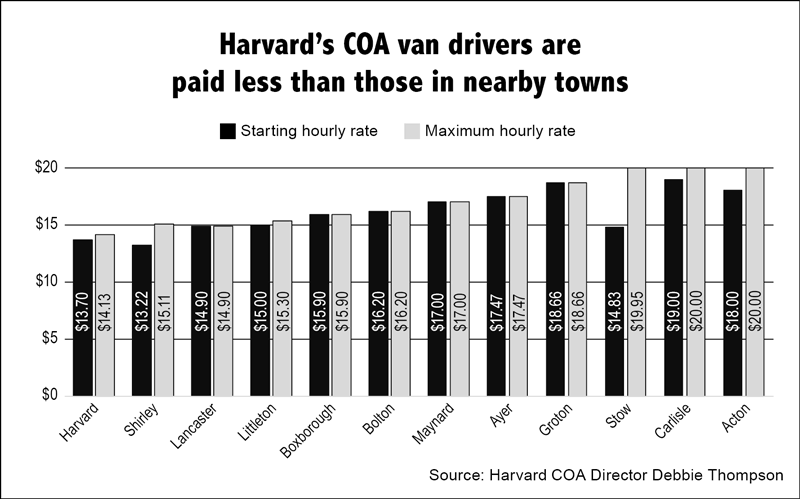
This chart shows the starting hourly rate (in black) and the highest hourly rate (in gray) for COA van drivers in Harvard and 11 nearby towns. The rate Harvard pays new drivers is low, second only to Shirley. The rate it pays its most experienced drivers is the lowest of all the towns; in fact, the highest rate Harvard pays is lower than the starting pay in 10 of the 11 other towns. In 2020, Harvard will raise its starting pay to $14 an hour, but that increase will not raise its standing among the other towns shown here.
A second van?
Thompson asked the Friends of the Council on Aging (FCOA) if it could raise funds to purchase a second van. That effort is now well under way, but the COA still needs to come up with money for additional drivers and van maintenance. Thompson submitted a warrant article this year asking to increase the COA budget by $25,500 a year to support a town-owned second van.
The Finance Committee will decide within the next two weeks whether to recommend the article, but the decision to place it on the Town Meeting warrant will be made by the Select Board. There has been pushback from Town Administrator Tim Bragan, who is recommending that the article be cut because the van has not yet been purchased. Thompson said she doubts the FCOA would purchase a van that the town hasn’t yet voted to support. If the article makes it into the warrant, the town will have a chance to vote on supporting the second van at Annual Town Meeting in May.
Sources for this article
- Harvard Town Clerk
- “Planning for the Aging Population: Rural Responses to the Challenge” by Lydia Morken and Mildred Warner, Department of City and Regional Planning, Cornell University, prepared for the National Association of Area Agencies on Aging
- National Institute on Aging: Older Drivers
- “When should elderly people stop driving?” by Eric D. Lawrence of the Detroit Free Press, published in USA Today, Jan. 20, 2014
- Rideshare in Massachusetts: https://tnc.sites.digital.mass.gov
A morning with the COA van
by Carlene Phillips
It’s almost 11 a.m. Tuesday, Feb. 12, and I am about to have my first ride in the current Council on Aging van. I see it pull into my driveway a little ahead of schedule, and I hurry out so as not to keep it waiting. I am the first one to be picked up for lunch at Hildreth House today.
The driver greets me and waits patiently while I wrestle with my seatbelt. It turns out the driver is Frank Magrath, who, with his wife Marie, used to live on the next street over from me. He explains that he is working an extra day a week while Peter, one of the other two van drivers, recovers from a knee operation. Frank says it’s been difficult for the COA to get qualified drivers. Later, COA Director Debbie Thompson tells me that she has just hired two new drivers, as Peter won’t be returning anytime soon.
Although I have seen the van around town, I am still surprised at how small it is—only four double seats. (An additional pair is available if wheelchair space is not needed.) I remember taking a few trips in a larger vehicle, and my last experience with a COA van was on a trip to a musical in Boston when there were 18 of us. Thompson later explains to me that it is possible to rent one of the larger vans, but it requires a commercial driver’s license to drive it, and right now she doesn’t have anyone who qualifies.
Frank tells me the COA’s MART van has to be wheelchair accessible. He says he has about two trips a week where a person in a wheelchair needs the lift. He adds that the day before, a woman had a lot of trouble getting up the steps with her walker, and in the end, he had used the lift for her.
This is Frank’s second trip of the day; at 9:15 he took a woman to Littleton for an appointment to get her nails done. Frank says today we have three other people to pick up on the northeast side of town. Then we will be dropped off at Hildreth House, and Frank will head out in the other direction to pick up three or four other people.
Giving up license is a turning point
We turn down Old Mill Road to pick up Jerry Curtin at the end of a long, private road. Frank comments that with today’s forecast, it is fortunate Jerry’s son-in-law has a plow. Jerry comes out his door with a cane but easily maneuvers the van steps. We chat a bit, and he tells me he gave up his license six months ago; “It was hard,” he says. I understand that whether the decision is voluntary or involuntary, giving up a driver’s license is a real turning point in a senior’s life.
Jerry tells me the van serves him well—“except for Frank,” he jokes. He has family and friends from church who drive him places, and he also uses Harvard Help. In addition to being a regular at lunch twice a week, Jerry enjoys the men’s coffee Wednesday mornings. He had been taking the van, but then a couple of other men in the group offered to pick him up each week.
Next we stop for Paul Flaherty, who is also using a cane. He seems a bit upset as he settles in and asks us if we think $7 and change is a lot to pay for a doughnut and coffee at Dunkin’ Donuts. We all agree that seems way too much money. Paul explains that he had gotten coffee in Groton after his medical appointment that morning and that’s what he was charged. We acknowledge that it must have been a mistake. When I ask how he got to his earlier appointment, he explains that his insurance company, Fallon Health, pays for transportation to a doctor visit. It will also provide transportation to swimming twice a week, as long as it is for therapeutic reasons. To a question from Jerry, Paul says it is a private car the company sends. Paul also uses Harvard Help for transportation.
Last we pick up Bernadine Aciukewicz. She still drives, but says she chooses riding in the van to come to lunch. Later, Arline Marteney will tell me she had driven herself to lunch this day, but she sometimes takes the van. It strikes me that as more and more seniors come to rely on the van for a ride to lunch, eight or 10 seats are not going to be enough to accommodate them—even in two shifts.
The dining room is almost full—looks like about two dozen people are here for lunch. About a third of them have, like me, used the COA van to get here. Thompson tells me later that a number of people get dropped off for lunch by a friend or family member. In addition to regular rides to lunch at Hildreth House on Tuesdays and Thursdays, the van takes people to Market Basket Friday mornings. It does two runs: the 8:15 departure takes five or six people who have to be ready to return in time for the van to get back for its second run at 9:30 for two or three shoppers. Marteney tells me although she still drives, she takes the van grocery shopping because she “wants to make sure the van keeps going” on grocery trips. That makes me think how frightening it would be to have no reliable means of transportation and to wonder how I could get what I needed.
The van leaves right after lunch Tuesday to keep ahead of the expected snowstorm. Frank reverses the order in which he had picked us up, except for me. I noticed that people had handed Frank a dollar—the cost of a round-trip van ride within Harvard—so when he pulls into my driveway, I offer to run in and get a dollar since I had left the house with no money. He replies, “That’s OK, they told me not to take money from you.” (Being a reporter has its perks.)
Frank is very personable and an excellent driver, and I’ve thoroughly enjoyed my ride. I know that if I had no choice, if I no longer had a license and were heavily dependent on the van, I might feel different. But it’s reassuring to know there is a van. In addition to fulfilling a practical need, the van offers a chance to talk to other people. For my part on Tuesday, I loved meeting and talking to my van mates.
Getting around Harvard in the olden days
by Carlene Phillips
It is hard to believe, but it’s a fact that Harvard residents in the 19th and early 20th centuries had easier access to public transportation than they do today.
In the late 1800s George Harrod, who owned a blacksmith shop in the town center, drove a stagecoach between the center and the Harvard Depot, where passengers could catch a train to Nashua or Worcester or get off at Ayer Junction and board a train for Boston. It’s not clear whether townspeople could park their own horse and buggy at the depot while they took a trip to the city or if George had a monopoly on passenger-to-train connections.
Louise Willard Bateman of Still River kept a diary from the 1860s until her death in 1910. She wrote about going to Worcester and coming home on the “Shoofly,” a train that ran from Worcester to probably Ayer Junction. Maybe the Shoofly was an express and someone picked up Louisa in Ayer. She wrote that she and Eleanor [her niece Eleanor Merrifield] went to Worcester and “got a new dress,” and just seven days before her death, at the age of 82, she noted that she went to Boston: “Lida and I did some shopping. Lida bought her a dark blue serge suit at Stearns paid $25 for it marked down from $38. I bought a white bedspread paid $1.75.”

Harvard stagecoach. (Photo courtesy of Harvard Historical Society)
A letter by a traveler from Boston dated 1858 describes how he and a friend decided to explore the countryside and they randomly “board the Fitchburg.” He describes how “the train fled on, each town was shouted by the conductor but we stayed in our seats. At last we arrived at Groton Junction. Cars were branching off in all directions. ‘For Still River, this car, sir?’ beckons the conductor as we gaze inquiringly around us.” I imagine they were happy to have, by chance, ended up in the idyllic countryside of Still River.
Shaker journals from the 1800s abound with references to an eldress and sisters going to Boston to sell herbs and medicines. The depot in Ayer would have been closer to them than coming in to the Harvard Depot.
In addition to being a boon to travelers and merchants, the train also had a downside. A Greek Revival house in Still River was built as a girls academy in 1834. Before Bromfield was built, boys could attend private schools in Groton, but until the Still River Academy, there was no high school for girls close by. The school closed after nine years. According to a later owner, “It was the coming of the railroad, giving access to the schools of Worcester and Boston, that caused the demise of the academy.”
Getting to school
During a winter storm, kids still had transportation to school, though that may have been true only for those around the center school, not for kids in other district schools in town. If the roads had been cleared, the kids would walk as usual, but if not, they could get a lift from the town “plow.” Mrs. Houghton Gale walked a half-mile to school at the age of 4; and in the winter, “Often we rode to school on a big sled drawn by four or six oxen during the course of breaking out the roads.”
Betty Marr, describing Harvard in the 1950s, wrote, “Another town center convenience was bus service which ran from Lowell to Worcester, where one could make other connections.” The main bus stops were in front of the public library and the Still River post office, but “the bus would stop if one waved it down from the side of the road. It was a treat to catch a bus to Clinton or Ayer to see a movie.”
The automobile, while a benefit to individuals, was largely to blame for the end of bus and train routes in places like Harvard. Getting anywhere around town or out of town became more and more dependent on having one’s own car.
Cars were a problem in the winter. Donald Foss, who had a newspaper route, wrote, “Chains and mud hooks were the kings of the road and the darn things were always snapping and banging the fenders … I can well remember my dad pouring hot water over the gas line next to the carburetor before trying to start the old Dodge pickup. Many a time we pushed it out of the driveway, and he would coast across to Oak Hill Road [from his house on Fairbank at the eastern end of the Little Common], jump the clutch, and hope it would kick over.”
But when your car was up and running, it was easy to find gas and service in town. In the 1930s the Willard twins–both female–ran a gas station in Still River with two pumps and a small variety store inside with a tiny spot for the post office. Just north of the town center was Hillside Garage. Current owner Scott Evans said he isn’t sure they pumped gas there in the 1920s when his grandfather bought the garage/blacksmith shop. Somewhere along the line pumps were installed, and one could buy gas there until about 2005.
Material from Historical Society archives.