Over the past two years, there has been at least one “no” vote on every article presented at annual and special town meetings. And, during that time, the number of votes cast on any article has never equaled the total number of attendees checked into the meeting.
Those are just two surprising facts that the data from the electronic voting devices, or clickers, in use since the first session of the Annual Town Meeting in 2024, bring to light.
In the years prior to 2024, Town Meeting voters were asked to first raise a card if they wanted to vote “yes,” then raise the card if they wanted to vote “no.” Votes that were close required volunteers to walk the auditorium to count raised cards. That process delayed meetings and sometimes required several attempts to verify, challenging the shoulder strength of the crowd. Two-thirds majorities needed to be human calculated on the fly.
That all changed with clickers. Now when a vote closes, the number of “yes” and “no” votes is displayed on a large screen for everyone to see. When more than a simple majority is required, software handles the math, leaving no question as to whether a vote passed or failed. And, thanks to clicker data recorded in Town Meeting minutes and shown on the screen on meeting recordings, the town has more information about voter participation and the number of “yays” and “nays” on every vote.
Voting waxes and wanes
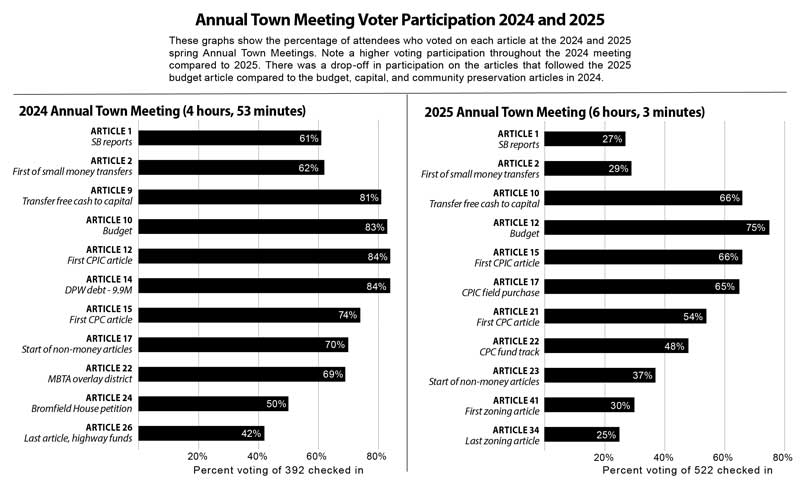
Data from the past two Annual Town Meetings held in the spring showed that voting ramped up gradually after the start of the meeting, peaked around the time of the budget vote, and dropped off at specific milestones after that (see graphs below). But that drop-off happened much sooner this year than last, and, overall, voter participation in last year’s meeting was much higher during all segments of the meeting.
Higher participation was evident early on in 2024’s meeting, when 61% of those who attended cast a vote on the first article. This year, things got off to a slower start. Only 27% percent of the total voters who checked in at 2025 Annual Town Meeting in May participated in Article 1’s vote.
The trend continued. In 2024, voter participation hit 83% on the budget article, and, for the most part, it remained in that range for all 15 of the Capital Planning and Investment Committee articles, peaking at 88% participation on Article 12-4, $200,000 for library mechanicals. Following the CPIC article, 84% participated in the vote on the article to fund the Department of Public Works facility with $9.9 million in excluded debt. Voting then dropped off into the 70% range for the Community Preservation Fund articles and stayed there for all but the last five articles. Participation dropped to its lowest level, 39%, on the second-to-last article, acceptance of gifts of property. The meeting lasted just short of five hours.
In 2025, voter participation never went beyond 75%, the percentage of those who voted on the budget article. None of the 13 CPIC articles that followed the budget received more than 71% participation. And as soon as the meeting moved on to the Community Preservation Fund articles, voting dropped into the 50% range. It fell again to 37% immediately after those articles, and it continued to go lower.
By the time the meeting was ready to vote on the 11 zoning articles at the end of the warrant, voter participation was a mere 30%. It reached its lowest point, 25%, for the last two articles voted on: permitted uses in the commercial district and erosion control. With three articles still to go, the meeting had gone on for six hours, and attendees voted to adjourn the meeting and continue it in the fall.
Voting privacy: More ‘no’ votes?
One advantage of voting with a clicker rather than by raising a card is that voting is private. No one can see who is raising their card for what, and anecdotally, there seem to be more “‘no” votes than in card-raising days. In 2024, over 48 votes, the average vote was 88% yes, 12% no. In 2025, over 58 votes, the average vote was 86% yes, 14% no.
Both years, the lowest number of “no” votes cast on any article was four. Acceptance of highway funds from the state received four nays in 2024 and 2025, and even accepting gifts of property did not sit well with four voters in 2024. Also in both years, exactly 22 people voted against Article 1, letting it be known they did not want to hear the reports of the Select Board or the School Committee.
Fall voters have staying power
The two meetings held in the fall since clickers were introduced show less of a voting pattern. In 2024, the major issue on the 14-article warrant was the vote for an additional $2.3 million of excluded debt necessary to pay for connecting Harvard’s municipal water supply to the Devens water system. It was the only article asking taxpayers for money, yet voter participation on that article (no. 7) was only 69%. Participation increased on every article that followed it, to a high of 84% on Article 13, which established a revolving fund for school facility rentals. The final article, changes to the stretch energy code, had a voter participation rate of 80%.
This fall, two meetings were held on the same day. The first was a continuation of May’s Annual Town Meeting. The warrant contained three zoning articles, two of which the town was asked to pass over. Voter participation in this first meeting was low—only 53% actually voted on the single article under consideration, an update to the town’s commercial zoning. The three votes took 16 minutes.
In the Special Town Meeting that followed, the most controversial article was Article 4, asking the town for a second time to purchase land for an athletic field. That article was likely responsible for bringing out the 463 voters that checked in to the meetings. It received the highest voter participation of any article voted on that day—91%. The other four articles in the STM warrant received about 80% participation. The STM portion of the afternoon lasted less than an hour.
What could it mean?
Town meeting attendees have known for years that voters tend to trickle in as the voting is already underway and leave before it ends. The crowd is typically the largest during the votes on big money articles, like the budget or large projects funded by excluded debt. But there is no data on crowd size during the various portions of the meeting, only the number of votes cast for each article.
At the second session of 2024 Annual Town Meeting, the number of people who voted on the multimillion dollar excluded debt article, which happened midmeeting, was lower than those who voted on the articles creating various revolving funds that followed it. Did people arrive too late to vote on the debt article? Were they on the fence? Were they more interested in the revolving fund articles? It’s impossible to say without more information.
It is clear that voter participation throughout this year’s Annual Town Meeting in May was lower than the meeting held in April the year before. Were voters showing up to vote on one or two specific articles, then leaving? That would have driven total attendance numbers up, even though it was only at that level for a small segment of the meeting. In 2025’s meeting, participation was highest for the budget vote, but dropped for the Capital Planning and Investment Committee articles, which included the first ever vote on the purchase of a new athletic field. It dropped again for the Community Preservation Committee articles that followed, which included funding the track restoration. In 2024, the budget, capital, and community preservation articles all had participation of more than 80%.
The reason for lack of interest in the zoning articles is unclear. This year’s meeting in May lasted only one hour longer than 2024’s April meeting, but voter participation remained high throughout the 2024 meeting, which had only one zoning article. Zoning articles are wordy. In this year’s warrant, the 11 zoning articles took up 57 of the 73 pages. Voters may not have confidence in what they are voting on given the complexity of the verbiage. Or it could be a lack of interest, or some combination of all these and other factors.
Perhaps more information could help town administration structure meetings in a way that promotes higher voter participation throughout every Town Meeting. Clicker data is at least a start.