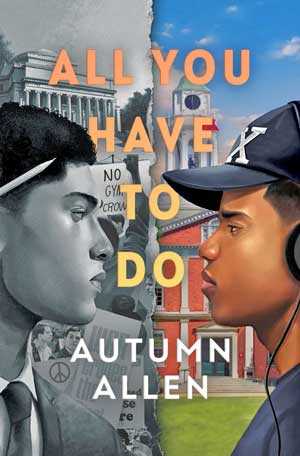
What is it like, going to a predominantly white school as a person of color? All you have to do is read Autumn Allen’s young adult novel to gain perspective, and then attend her talk on Thursday, Oct. 30, at 6:30 p.m. in Volunteers Hall at the Harvard Public Library.
“The more we act like you, the more comfortable you are, and the less you see us as a threat. But the more we become like you, the more we abandon our right to be who we are. To become nonthreatening, we abandon our needs and the needs of our people. What is the point of an education that teaches us to abandon our people?”

Autumn Allen. (Courtesy photo)
The quote above is an excerpt from Allen’s 2023 book published by Kokila, Penguin Books, and named one of People magazine’s “must-reads.” “All You Have To Do” is a story about two young black men coming of age in separate timelines, 30 years apart. The protagonists, Kevin and Gibran, navigate racial, socioeconomic, and intergenerational identity struggles in 1968 and 1995, respectively.
Allen’s talk is presented in partnership among the Warner Free Lecture Trust, the Harvard Public Library, the Harvard Schools Trust, and Arm in Arm (Harvard’s organization for diversity and inclusion initiatives, founded in 2016). The event is being offered free of charge to the community, and refreshments will be provided.
“I’ve known Autumn in passing since our grad school days, and when I heard she had written a novel, I couldn’t wait to read it,” said Sarah Saleh, a founding member of Arm in Arm and library trustee. “From the start, I was struck by how powerful and layered it was, both historically and emotionally. Our school shares many parallels with the one in Autumn’s novel, such as academically driven environments where students are navigating complex questions about identity, belonging, and success.”
Allen, originally from Boston and currently residing in Stoughton, is a senior editor at Barefoot Books in Concord; a scholar, holding a bachelor’s degree in literature from Yale University, and graduate degrees from Simmons University and Harvard Graduate School of Education; an educator and speaker.
In an interview with the Press, Allen said her work as a speaker predates the publication of her novel, but that its success has given her an unexpected platform to address a wider audience.
“I didn’t expect [the book] to impact my work with adults much, maybe with teachers and librarians,” said Allen. “It’s been a pleasant trajectory. Having a specific story helps people understand the impact on real lives.”
That specific story is personal to Allen. Gibran, the young man at the center of the story in the timeline from 1995, was written based on the experiences of one of her siblings. Allen was third in line to attend the prestigious private school Milton Academy, in Milton. Her older brother and sister graduated before her, but her youngest sibling struggled at the institution and ultimately left the school.
“The reason I wrote the book was to figure out what happened: Why were [my older siblings and I] able to get through and he wasn’t?” said Allen. “There were so many different aspects to think about: race and class issues of feeling different in prep schools, and then gender and personality, the wild-card elements that made it so hard for him.”
Two timelines
Allen said that to fully explore Black kids graduating from prep schools and the gender difference in outcomes, she felt she needed to understand the generation that came before her own. The transition from civil rights to Black Power to color blindness happened so fast, she wanted to go back and study how the evolution occurred. To do so, Allen headed to the Schomburg Center for Research in Black Culture at the New York Public Library where in the archives of Columbia University she stumbled upon the protests that occurred there in 1968. That was how the character, Kevin, in the novel came to be.
“I had no idea [the protests] had happened. I couldn’t believe this huge, dramatic event took place,” said Allen. “I went [to the Schomburg Center] to soak up the culture of the 1960s, what people were watching and listening to, how it felt to be Black at that time. When I got into the archives about Columbia I was like, ‘Wait, what?’ It felt like it should have completely transformed a generation.”
Students at Columbia University had organized a protest to denounce the school’s involvement in the Vietnam War and planned expansion in Harlem. The protest took place over the course of seven days and was ultimately successful, resulting in Columbia’s disaffiliation from the U.S. government’s Institute for Defense Analyses, which was a military research organization supporting the war, and abandoning the construction of a gymnasium the university was attempting to construct in Harlem’s Morningside Park.
It’s personal
Writing the book changed the relationship Allen has with her brother. “It was a big black box: ‘Who are you? How did this happen?’” said Allen of her motivation for telling her brother’s story. “After interviewing him, I understood there were experiences and emotions he hadn’t expressed. Writing it, trying to get into his shoes, I grew in appreciation for him.”
Allen enjoys speaking to audiences about her novel and the journey she took from research to publication. “When I talk to teens of color, I’m thrilled. I want to hear from them: Do they relate? What’s changed?” said Allen. “With older Black women, many have said, ‘I thought you were writing about my son.’ That is wonderful and affirming. With mixed or predominantly white adult groups, I get a little nervous. I don’t know the learning curve. It’s vulnerable. I can’t talk about the book without my family and childhood. I trust that people who show up want to be there and will get something from it.”
“I hope this talk sparks honest reflection and meaningful dialogue,” said Saleh. “My wish is that people leave feeling both challenged and inspired—to think about the pressures students face, the role of race and identity in education, and the ways we can make our community more supportive and inclusive for everyone. Our students should never have to choose between success and identity or integrity. The story reminds us that progress comes through courage, empathy, and truth-telling.”
Interested attendees can register for the event via the Harvard Public Library’s events page or the Warner Free Lecture website, warnerfreelecture.org.