As many towns across the state struggle to spend the hundreds of thousands of dollars they have already received as part of the national opioid settlements, Harvard’s Addiction Abatement Working Group, charged with seeking and evaluating abatement fund spending proposals, is making progress toward its goal of pooling a portion of its oversized share of the funds.
The Addiction Abatement Working Group plans to contribute half of the town’s $620,000 settlement funds to a pool of seven towns served by the Nashoba Associated Boards of Health. The other half will be used for smaller projects that will cost less than $10,000 to stay under procurement law limits, as well as larger projects that have yet to be identified.
At a March 25 meeting, working group chair Brad Holub reported that the NABH had identified seven towns, including Harvard, that were interested in pooling settlement funds. Those towns were Harvard, Littleton, Bolton, Shirley, Ayer, Pepperell, and Groton. In addition to Harvard’s contribution of $310,000, Littleton will contribute its entire settlement of $393,000.
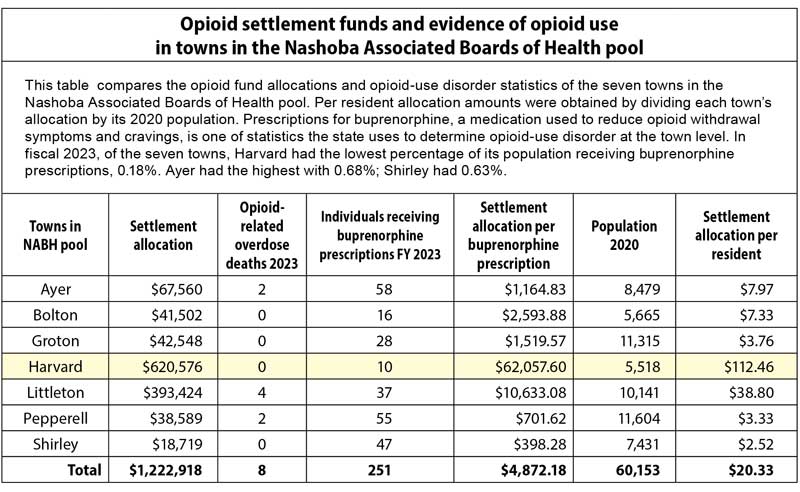
The other five towns also plan to contribute their full settlements, which total about $210,000. Those five towns received very small shares of the state’s settlement funds because they are in regional school districts. The allocation calculations used for Massachusetts towns left those with regional schools with tiny settlements, many less than $5 per resident (see table below). Harvard received about $112 per resident, while Shirley received less than $3 per resident. Conversely, statistics reported by the Massachusetts Department of Public Health’s Bureau of Substance Addiction Services suggest that Harvard’s opioid-use problem is much lower than that of the other six towns in the pool.
When the group of seven NABH towns agreed to work together, it first considered using the pooled funds to hire a full-time substance abuse specialist who would serve all the towns. Initial calculations showed the pool would fund the new position, with benefits, from 2025 through 2031. But at an April working group meeting, Holub reported there had been a mistake in the calculations. New figures showed that, with yearly salary and benefits increases, there would only be enough money in the pool to fund the position for three years. As a result, the idea of hiring the specialist was dropped.
Other full-time hiring ideas dropped
In the meantime, the working group had invited Olivia Dufour, a substance use prevention coordinator hired to assist the seven towns in the Great Meadows Public Health Collaborative, to speak at its April 11 meeting. As Dufour explained her role, it became clear to the committee that there would be a lot of overlap between that position and the co-clinician the town already shares with Stow. Moreover, the collaborative also had a lot more money to spend. In total, the seven Great Meadows towns will receive more than $4.4 million in opioid settlement funds, almost four times as much as the combined allocations of the towns in the NABH pool. Five of the Great Meadows towns received more settlement money than Harvard.
The Addiction Abatement Working Group also considered using a portion of its settlement funds to pay for half the salary of a community resource navigator, to be shared with Stow, like the co-clinician. But at a June 6 meeting, Police Chief James Babu told the working group that Stow had already hired a community resource navigator for a six-month contract, and the police chief there found the position to be so redundant with that of the shared co-clinician that he was not interested in extending the CRN’s contract. Babu said the intended role for the navigator was to assist with opioid overdoses, and the two towns don’t have many overdose calls.
Contracting for services instead
With Harvard and Stow’s lack of need for an opioid substance abuse professional, and not enough money in the NABH pool to support one for the seven towns contributing to the pool, the idea of hiring a full-time employee was scrapped. Instead, the towns in the NABH pool are now planning to contract out as-needed services with an organization like Riverbend, a nonprofit addiction services company in Lowell. Holub told the working group that Riverbend could easily meet the needs of the seven towns in the pool and could provide connections to care for any services it cannot provide. Riverbend also has three grant writers on staff whom it would share with Harvard so services might be able to continue when the settlement funds run out.
The working group is readying a request for proposals to solicit quotes from organizations or individuals that can provide a host of addiction services, including initial assessments of people requiring care, ambulatory services, referrals, diversion programs (which help keep substance abuse patients out of the justice system), and educational programs.
Other initiatives
The NABH pool proposal involves using only half the town’s settlement funds. The working group is also accepting proposals for mini grants (less than $10,000) for projects whose purpose is opioid addiction abatement. The application, project requirements, and evaluation criteria are posted on the Addiction Abatement Working Group page of the town website.
With over $300,000 to spend, the group is also considering more expensive addiction abatement projects. Member Hugh Silk suggested the possibility of hiring a mental health professional to help residents with emergency therapy sessions and referrals for longer-term mental health care. Dr. Silk, who works for the Department of Family Medicine and Community Health at UMass Memorial Health in Worcester, has experience in this area, and he told the group that waiting times for mental health professionals, especially for adolescents, can be very long. He said having access to a professional who could fill the gap while waiting could possibly prevent a substance abuse problem, and it might qualify as a valid use of the opioid settlement funds. Silk will investigate the logistics and cost and report back to the group at a future meeting.