A post concerning Harvard’s parade by local electrician and longtime resident Dave Woodsum on the social media site Nextdoor in late June sparked an explosion of commentary—120 posts as of Monday, July 7—many criticizing the Fourth of July Committee and the town of Harvard, many from out of town.
“I will be skipping the Fourth of July parade this year,” Woodsum wrote. “As a lifelong resident of Harvard of 63 years and driving an antique truck in the parade since 1981, I no longer feel welcome in my own town.”
The post evoked statements of sympathy, some suggesting he go elsewhere, to Grafton or Chelmsford, where he would be welcome, others wondering what all the fuss was about.
At issue was the Fourth of July Committee’s requirement that any owner of an antique auto who wished to drive in the parade needed to sign up ahead of time, contrary to tradition. In addition, the number of cars in the parade would be limited to 20, a first for Harvard. In previous years, antique car owners could simply show up at Town Hall, where committee volunteers stood ready to organize their entry into the parade. Last year, 54 antique cars participated.
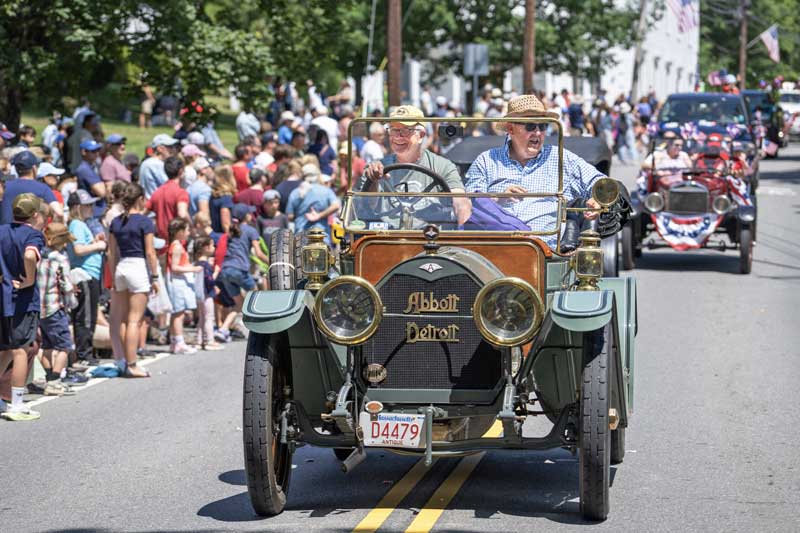
Bob Blanck and Jud Ratliff in a 1912 Abbot-Detroit.(Photo by Lisa Aciukewicz)
As committee member Molly Sinkewicz explained in a July 1 post on Nextdoor, the 20-car limit was not the committee’s idea but had been set by Chief Rick Sicard of the Harvard Fire-EMS Department, who determined that up to 20 cars—but no more—could be parked in front of Town Hall without blocking the exit of fire engines from the station should there be an emergency before the parade began at 11 a.m. The need for would-be participants to register online ahead of time followed. “We need people to sign up so we can plan ahead,” Sinkewicz advised disgruntled Nextdoor kibbitzers. And there was unlimited space on the library field for owners to display their vehicles, no registration required, she noted.

Orion and Canis Major. (Courtesy photo)
At the time Woodsum wrote his post, only 16 car owners had signed up for the parade, according to Sinkewicz. “We ended up not turning away any cars.” But in the end Woodsum chose not to register, stating on Nextdoor that he had made other plans. “Done. No big deal. We will see what happens next year.”
One rumor making the rounds was that the number of cars was limited because a group of marchers had complained last year of having to inhale their exhaust. Sinkewicz said that this year the committee made sure there was always a float between a column of antique cars and marchers. “We never wanted to restrict the cars because of fumes,” committee Chair Chris Chalifoux told the Press. “It was not part of our decision making.”
As for the 20-car restriction, Chalifoux said, “If we can find some other place to stage the antique autos, we can remove the limit.”