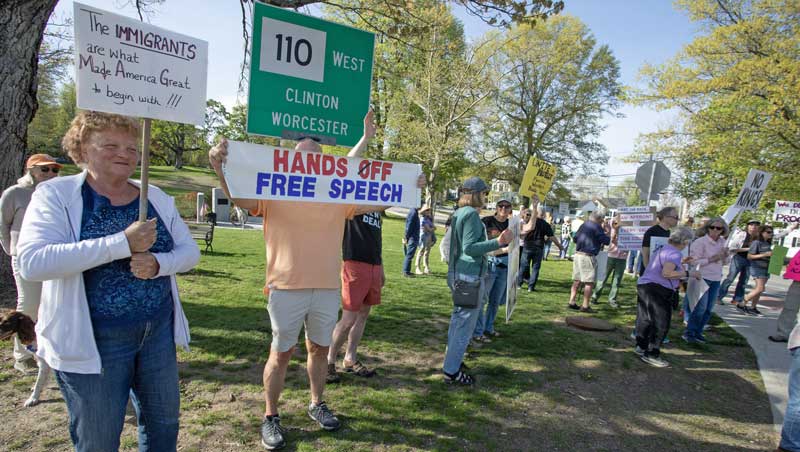
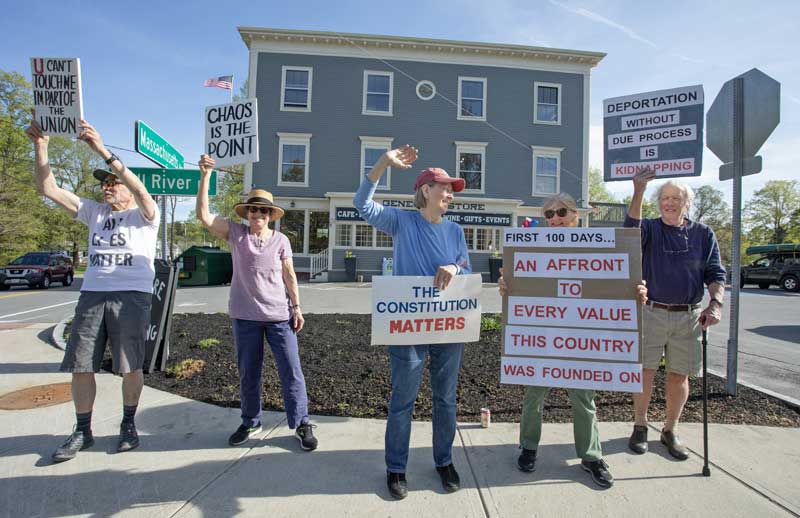
A palpable energy enlivened the town Common Thursday evening, May 1, as dozens of people gathered for a May Day demonstration and filled the sidewalk with protest chants and clever signs, while passing cars blared their horns in solidarity.
Mario Cardenas and Colleen Pearce organized the demonstration in Harvard, drawing an estimated 50 people from both Harvard and surrounding towns at its height.
Cardenas told the Press that his idea for holding a town May Day demonstration stemmed in response to the ongoing nationwide protests against the Trump administration. He felt it was significant to celebrate International Workers Day at a moment in time when, in his view, labor rights are at risk due to drastic changes in federal policies and the defunding of federal institutions.
“The current administration purports to support the working person,” Cardenas said, “but in fact, in everything that they do, they weaken worker rights.” In reference to the recent swath of federal layoffs, Cardenas added, “They fire people summarily without recourse. How is that pro-worker?”

Cardenas said the May Day demonstration had come together “organically” once he and Pearce reached out to the local community with their plan. As the size of the crowd demonstrated, the need to protest resonated, and the scope of the demonstration expanded beyond labor rights to embrace a host of issues and a single overarching concern—the fear, Cardenas said, that the very fate of democracy is at stake.
Pearce spoke to the Press about the importance of due process in a democracy, and she voiced concern at how the Trump administration has begun arresting and deporting people without trial while disregarding court orders to bring them back. “I am so horrified about what’s happening with the leadership in our country and the fact that due process is being obliterated,” Pearce said. “The entire administration is just thumbing their nose at the Constitution and the Supreme Court. … If we don’t have a rule of law, then we have nothing here,” she said.
Others expressed similar reasons for protesting, voicing concerns regarding threats to democracy and civil rights. “I feel like we’re going to lose it,” warned Barbra Ward. “Another four years of this administration will destroy parts of our democracy we won’t get back.”
“Our government is under attack by fascists attempting to dissolve it, and I need to be a part of that body fighting against them,” said Adam Lee. “And as a more personal reason, I’m transgender and I think that our rights are being attacked, and it’s important to stand up for my rights.”
Despite their sense of fear and dismay, many at the demonstration said they felt hope and were empowered by what they perceived to be a growing social movement rising in opposition to the Trump administration and a shift toward far-right politics.
“At this stage, we’re just trying to create a movement and create masses. The more people involved, the more likely we are to change things,” said Jim Ward, a resident of Littleton. “But it’s got to be loud and large.”
“Seeing all the people gathered, it just brings hope,” said Eliza Cutler, “but I wish there were more young people here. We need to get the younger generation involved.”
With the crowd leaning toward an older demographic, some demonstrators recalled protesting in the 1960s during the Civil Rights Movement and the Vietnam War, noting the similarities between the force of resistance against the federal government and the fight for democratic freedoms then and now.
Donnalisa Johnson, a resident of Stow, recounted her involvement with the Students for a Democratic Society. When she later told her children about the anti-war protests, Johnson said they had wished to be a part of a big social movement too. “I said, ‘just wait your turn,’” Johnson recalled. “And now it’s here. We need the students again.”
Guitarist Steve Peisch and gospel singer Suzanne Buell wrapped up the demonstration by playing music, performing the iconic protest song of the Civil Rights Movement, “We Shall Overcome.” Buell explained how the origins of protest music and gospel songs trace back through the Civil Rights Movement to traditional, spiritual music sung by enslaved people “when they had to sing to survive.” She said, “When people come together and resist, music is always a part of it.”
“The fight for democracy is never over, it just keeps going on forever,” Johnson mused, as the crowd began to dwindle. “We have to do what we can in each small way—think like a drop of water.”