Article 12 in this year’s warrant booklet asks Town Meeting to approve a $35.1 million omnibus budget to pay for the operation of town departments and the schools next fiscal year, which begins July 1.
But how much of that budget the town is willing to support will be determined by a question on the May 6 Town Election ballot. The truth about the fiscal 2026 budget, as recommended by both the Select Board and Finance Committee, is that without an increase in property taxes beyond the 2½% annual increase allowed by state law—plus the additional taxes provided by newly built and renovated homes—there won’t be enough money in town coffers to pay for it.
Article 12 and the ballot question are inseparable. Their passage or rejection has consequences not only for the level and quality of service that town departments and the schools can deliver in fiscal 2026, but also for the cost of owning or renting a home in Harvard.
An increase in a town’s tax levy beyond what’s allowed by Proposition 2½—the so-called “levy limit”—is known as a tax override. To exceed a town’s levy limit in any given year, a majority of voters must approve an override at the ballot box. Once approved, the override, unlike excluded debt, becomes permanent, the basis for future Prop 2½ tax increases.
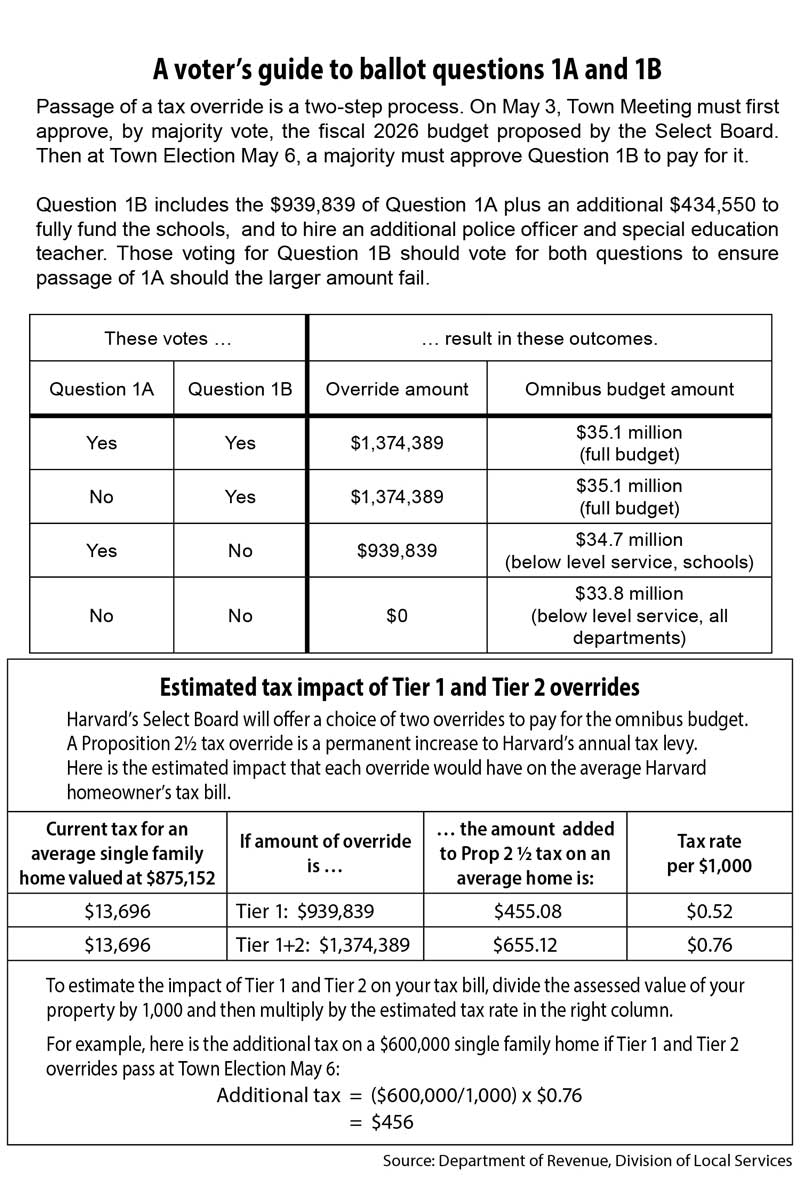
Worried that taxpayers would balk at the $35,131,266 amount of next year’s omnibus budget and the $1,374,389 override needed to pay for it, the Select Board voted this spring to offer two options, known on this year’s Town Election ballot as Questions 1A (also known as Tier 1) and 1B (Tier 2).
The choice
Passage of Question 1B would allow the town to collect an additional $1,374,389 beyond the fiscal 2026 Prop 2½% levy limit, enough to pay for the entire fiscal 2026 omnibus budget recommended by the Select Board and FinCom.
Passage of Question 1A would provide a lesser amount, $939,839, enough to pay for the town’s current level of service, but leaving the schools underfunded for the coming year.
Overrides are not a popular option. Five years ago, in 2020, when the Select Board proposed a $320,000 override, voters said ‘yes’ at Town Meeting but ‘no’ at the polls. The loss forced the Select Board and Finance Committee to return to a Special Town Meeting with a slimmed-down budget whose expenditures were within that year’s levy limit.
Last year, voters approved an override of $424,000, but rejected a second tier that would have added $752,964 to the levy limit.
The campaigns in support of Question 1B and the Tier 2 override have been intense this season. “Yes for Harvard” signs, the work of a parent-driven advocacy group, are sprinkled throughout town, urging passage of both Questions 1A and 1B. Town Administrator Dan Nason and School Superintendent Linda Dwight launched a five-stop “FY26 Budget Tour” last week with presentations at the Devens Community Center and the town library. More sessions are scheduled at the Harvard Senior Center and General Store. And the League of Women Voters of Harvard will hold an informational forum of its own online April 29 at 7 p.m.
Impact on town and school services
Advocates of an override, including Press letter writers, have focused on the benefits and downsides of three possible outcomes: passage of Question 1B; passage of Question 1A alone; or the failure of both at the ballot box.
Nason and Dwight say that Passage of 1B (aka Tier 2) will pay for all of the town and school services and personnel in the fiscal 2026 omnibus budget. These include the hiring and training of an additional police officer and beach director, administrative positions for the DPW and Board of Health, and a special education teacher for the schools. There would be money as well for the materials needed to implement a new state-mandated literacy program.
Passage of 1A alone (aka Tier 1) would be sufficient to maintain Town Hall services at their current levels, but the schools would be underfunded, Dwight has said, and forced to eliminate up to 4.5 positions. The town and schools would forgo the additional personnel they say are needed to improve public safety, DPW operations, and special education. And the schools would also have to cut elsewhere in their budget to pay for new literacy materials.
Failure of both 1A and 1B to pass would leave the town and schools underfunded for the coming year. Dwight has said the schools would need to eliminate up to 11.5 positions, leading to “reductions in student programs, activities, and athletics,” as a recent handout states. Hours at the library and Council on Aging would be reduced, and no additional staff would be hired.
The details of the fiscal 2026 omnibus budget are spelled out on pages 37 through 41 of the town meeting booklet. Readers should also consult the Finance Department’s five-year revenue and expense projection on page 18, also known as “the recap.” This document shows how fiscal 2026 revenues—as forecast by Finance Director Jared Mullane and others—and the two proposed overrides play against town department and school spending and other expenditures to create a balanced budget for the coming year. The Press has included a condensed version of this essential planning tool. (See “Budget in a nutshell: The recap” on page 14.)
If both 1A and 1B pass by a majority at the polls, 1B will prevail. If both fail, spending will be limited to the $748,167 increase allowed by Proposition 2 1⁄2.
The motion made at Town Meeting to approve Article 12 will state that passing it is contingent on passing an override at the ballot box. If 1B fails, the motion will state, the budgeted amount will be trimmed from $35.1 million to $34.7 million. If both 1A and 1B fail, the budget will be reduced to $33.8 million.
A vote for Article 12, however, is not a vote for or against an override. If it fails to pass, the ballot questions become moot and the Select Board will need to prepare a fresh budget and convene another Town Meeting to approve it.
The voter’s guide that appears nearby shows how to vote at the May 6 Town Election to achieve the outcome you prefer. (See “A voter’s guide to ballot questions 1A and 1B” below.)
Impact on taxes
While the benefits and losses of each ballot choice have dominated much recent discussion, of equal concern for many readers is the impact these options will have on taxes. The Division of Local Services within the state’s Department of Revenue provides a calculator for estimating the additional tax the owner of an average single-family home would pay if 1A or 1B took effect this fiscal year. We have summarized the results nearby, including how to figure the increase for your own home. (See table below, “Estimated tax impact of Tier 1 and Tier 2 overrides.”)
The actual impact to taxpayers’ fiscal 2026 bills won’t be known until the town’s annual tax classification hearing, typically held in late fall.
Any increase in taxes will affect Harvard’s most vulnerable homeowners and renters, especially seniors living on fixed incomes, young families, and those struggling to make ends meet. Harvard offers qualified seniors a number of programs to reduce the burden of taxes.
In addition to property taxes, Harvard homeowners also pay a 3% surcharge to send money to the town’s Community Preservation Act Fund. Harvard’s CPA bylaw provides a means-tested exemption from paying it to qualified low- and moderate-income residents and seniors. For a complete list, go to the Council on Aging website at www.harvard-ma.gov/council-aging and select “Assistance Programs.”