The Select Board voted Tuesday night to offer voters a fiscal layer cake at Town Meeting in May, one that allows voters to choose how much they are willing to increase property taxes to pay for the personnel and expenses that town departments and the schools say are necessary to adequately serve the town in the coming fiscal year.
The first layer requires no tax override and would limit the increase in property taxes to the amount allowed by state law: 2½% per year, plus an allowance for new construction. That, however, would leave town departments and the schools approximately $1.34 million shy of their “level funding” requests, the amount they say they need to maintain municipal and educational services at their current level.
The second option, Tier 1, asks voters to approve a property tax override of $782,505, slightly more than half of what departments requested. However, the $521,670 that Tier 1 allocates to the schools covers only 58% of their $955,112 level-service request, which school officials have said will lead to layoffs. By contrast, all of the town’s new hires, except an additional police officer, are covered by their Tier 1 allocation of $260,835.
The final option, Tier 2, would raise taxes by $1.34 million to pay for the entire requested budgets of both the town and schools, including an additional police officer for the town and a certified occupational therapist plus technology support for the schools. (For the details of what’s included in Tier 1 and Tier 2, see the table at the end of this article).
Tuesday’s Select Board vote in favor of offering a base budget and two tiers followed a one-hour discussion and was unanimous, 5-0, including the vote of former chair Don Ludwig, who was present for the first time since his censure and resignation as chair on Feb. 25.
More than 50 viewers tuned in, but Finance Director Jared Mullane was absent and no representative of the Finance Committee was present to explain the recommendation.
The Select Board’s decision is contrary to that of the Finance Committee which last week recommended a one-tier $1.34 million override to cover the level-service budgets of every town department and the schools. On Tuesday night, however, Select Board members preferred to add a middle option, recalling that voters’ had rejected a $752,964 override in last year’s town election.
“My concern is that [a $1.34 million override] will not pass. But I’m happy to put it out there for folks to vote on,” said Rich Maiore.
The Harvard Town Charter assigns FinCom the task of preparing an annual budget, recommending how much to spend each year on municipal services and the schools—and how to pay for them. But FinCom’s role is advisory and it is the Select Board’s job to present the coming year’s budget at Town Meeting.
In an email following Tuesday night’s meeting, School Committee Chair Abby Besse wrote that the decision to allocate only 58% of the Tier 1 override funds to the schools appeared “arbitrary and punitive.”
If Tier 1 passes, she wrote, “the schools will face deep cuts, while the town will not need to make similar reductions. Why is this the case? The $520,000 allocated to the schools under Tier 1 will not cover the contractual increases for our teachers and professional staff, nor will it address the rising, contractual costs associated with special education, utilities, and transportation. Additionally, Tier 1 will not cover the new literacy curriculum that is required by DESE or the Special Education teacher that was requested last year and again this year.”
School Superintendent Linda Dwight had a similar response. “The number … is a complete mystery to us,” she wrote. “After many, many months of working collaboratively with the Finance Committee, the Select Board did not take their recommendation and instead seemed to focus on the above-level service needs of the town and disregard the level service needs of the School District. The $521,000 does not even meet the contractual increases that have been detailed in our budget documents. It cannot be called a level-service increase for the schools.”
In an email Tuesday night Oliver explained that it has been FinCom’s policy in recent years to allocate 33% of revenue—minus excluded debt and benefits—to the town, with the remaining 66% going to the schools. Having decided on a Tier 1 override amount of $260,835 for the town, Oliver said, it followed that an additional $521,670 should be allocated to the schools for a total of $782,505.
Last week, as reported online by the Press, the Finance Committee voted 5-2 in favor of a single $1.34 million override, with Chair Mike Derse and Hady Lattouf voting against. Derse and Lattouf were not opposed to asking taxpayers for some or all of that amount, but felt voters should be offered two or more tiers so they could choose how much of the requested budget to support. Others, including Noyan Kinayman and Bob Thurston, argued that any amount less than the $1.34 million would deprive residents and students of essential services.
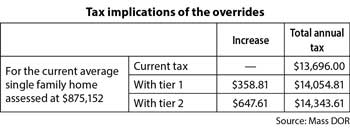
A tax calculator provided by the Massachusetts Department of Revenue shows a vote for the $752,964 of Tier 1 approved by the Select Board would add $358.81 to the annual tax bill of a single family home assessed at $875,152. A vote for Tier 2 would add $647.61.