A visit to Fivesparks, now through Feb. 22, will welcome you with an art show in the large gallery room and on walls throughout the building, featuring works by the nine artists in residence. And it will afford you the chance to watch the artists at work in their temporary studio spaces and to ask them questions. You’re unlikely to escape being inspired by their talent and their stories of how they came to their art and their joy in the work. Even I, the worst person to be next to in a game of Pictionary, wanted to set up an easel, squeeze a tube of paint or hold a pastel stick, and create something.
The artists I talked to were enthusiastic about their Fivesparks workspace, happy to have a larger area than what they are used to and where they can leave their work out. In contrast to her “closet” at home, with one window, Judy Warner said the spacious, light-filled “porch” space along the south side of the building is lovely. She can move from one side of her table to the other to adjust for the sunlight that streams in.
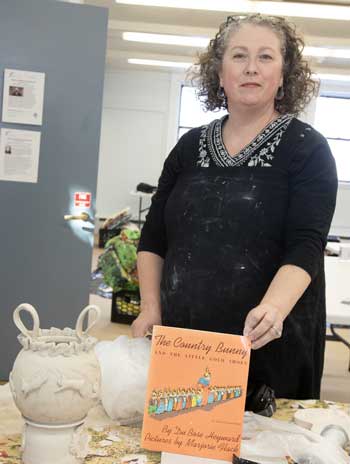
Elizabeth Noonan poses with a children’s book, “The Country Bunny, and the Little Gold Shoes,” that has inspired her recent ceramic work. (Photos by Lisa Aciukewicz)
Pastel artist Corinne Walker, who took up art after a career as a software engineer, said her Lancaster home studio had been her dining room. Pastel can be messy, she said, holding out her chalk-covered hand, so when she got a new rug for that room, she moved to the basement. The fireplace room at Fivesparks is a welcome change from her windowless space.
Working in the smaller front room, Suzan Osborn said the lighting is “gorgeous, even on a cloudy day.” She loves the space, and said the other afternoon she was painting to the beautiful music of a classical pianist practicing in the gallery room.
Upstairs in the mezzanine Oreon Mode, a mixed media artist from Sudbury, said the extra space has allowed her to explore painting larger landscapes, examples of which she has propped up on a row of chairs. Sharing the area is Keith Demanche, a pastel artist from Rochester, New Hampshire, who said for him the timing was perfect as he has had to be out of his house during renovations.
Although Osborn likes how quiet it is at Fivesparks, she also enjoys talking with other artists and sharing ideas; she has appreciated comments on her work “from skilled artists.” Warner said she loves the atmosphere in the beautiful building. “Nobody bothers you,” she said, “but there are people to talk to if you want.” Demanche has talked to all the other artists. He said he’s gotten good ideas, and working alongside other artists “gives a great incentive.”
Conversations with the artists
All of the artists were generous with their time in talking with me. Osborn said she used to find it “cringeworthy” when someone asked if they could watch her paint, but she has warmed to the idea. To help from getting too distracted, she is working on small pictures, portraits of single flowers, rather than her typically larger garden paintings. Her strategy is to have a canvas with a drawing already on it and to fill it in, like working on a “glorified coloring book,” while people are watching. She called my attention to the recycled pad thai containers that hold her tubes of oil paint. An iris dominated the small painting on her easel, and she demonstrated the versatility of her “new favorite color,” Payne’s gray, by mixing it with white and dabbing accents on the purple fritillaria in the painting. In the moment, she decided she didn’t like “this guy,” pointing to a flower in the bottom left of the small canvas. With a whisk of her turpentine, she rubbed it out of existence.
Judy Warner, who also works in oil, said she is waiting for an order of paints to arrive and will then be doing landscapes. She prefers plein air (painting outdoors) but works from photos in the winter—“so my fingers don’t freeze.” In the meantime, she is teaching herself how to do portraits by copying faces in “Sargent Portrait Drawings,” using pencil, not charcoal as John Singer Sargent did. She said he did hundreds of “mug shots” of high-society people, quick charcoal sketches that he gave to his subjects. Warner said portraiture is the hardest, most exacting to do—“you can’t get anything wrong.” A tree would be recognizable, even if you got a few branches askew, but not so with a person. She said she can see how Sargent used dark and light values, but it’s hard to replicate his skill. She is enjoying the challenge of something new; “It’s the process I like,” she said. “I don’t mind throwing things away.”
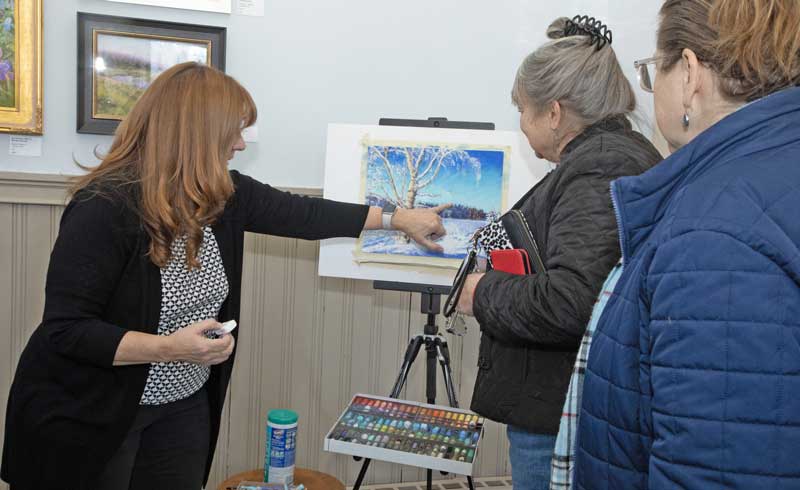
Artist Corrine Walker talks to Sue Hawkins about her work in progress, “The Winter Sentinel.”
“I love sharing the pastel process,” said Walker, who has a table full of boxes of pastels in a wide range of colors and shapes. She said the vibrancy of the colors comes from their pure pigment. Stubby pieces are easy to manipulate, and the edge of a square chalk can make a fine line. “I like the feel of the chalk, the immediacy of the process—there’s no drying time needed,” she said. “It’s very forgiving, and you can just brush away mistakes.” She explained that pastel paper has a rough texture so that the “tooth” grabs the dry color. One paints by layering the colors, applying different pressure for light and dark. Walker, who said she fell in love with pastel painting from her first small box of chalks, had a winter scene on her easel. A sturdy birch, with its interesting bark, dominates the winter scene of drifts of snow and a brilliant blue sky.
Contrasting landscapes
Upstairs, Demanche had just hung up a landscape of his backyard—a hedge of dark evergreens. I asked if he were done, since Walker had just told me that knowing when to be done is tricky. “I’ll put it aside, come back and see what it has to say for itself,” he responded. On the easel, was a plein air landscape he had done the other day at Great Brook Farm State Park in Carlisle. An expanse of golden grasses and a snowy path leading to bare trees in the background made a sharp contrast to the scene of the evergreens. I had not realized that pastel painting dates back to da Vinci and was widely used by impressionists like Degas for his bathers and dancers. Demanche said he has been working in pastel for the past 10 years, having given up watercolor which he found frustrating because it “does its own thing.”
In contrast, Mode said she had recently restarted her art practice after a hiatus of more than 15 years—and she has done so with watercolor. She likes the medium because it involves fewer tools—water and tubes of paint, a minimal outlay. She is experimenting with using oil pastel in a watercolor and pointed to one landscape where the eye is drawn to a few strokes of a vibrant rust color. She commented that she used to work in oil—and “throw in acrylic; I do everything but the kitchen sink.” Mode said she is having a great time rediscovering what she likes, blurring the line between abstraction and realism. “I’m pushing myself to be as abstract as I can, using a visual reference.”
Other artists in residence are Liz Noonan, ceramics; Anne Swinton, clay; Ann Marie Hershberger, mixed media; John Haiduk, acrylic. Visitors can catch artists at work during Fivesparks’ regular hours, Tuesday to Friday, 10 a.m. to 4 p.m. and Saturday noon to 4 p.m.
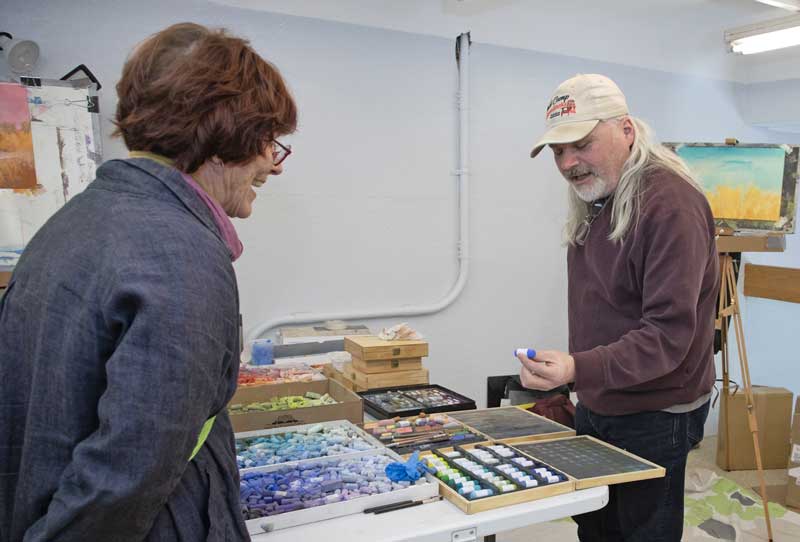
Harvard resident and new to pastels Joanne Godwin listens as Keith Demanche describes the Mamut pastels he uses that are nontoxic and hand-rolled in Spain. Godwin and Demanche also discussed underpainting and brushes among other topics at the Artists in Residence open house.