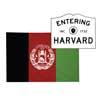
Created by Behishta Kabir and Jodi Hilton, “Welcome to Harvard” is an interactive photography exhibit that tells the stories of two families who fled Afghanistan and the Harvard volunteers who supported them and welcomed them into the community.
Hilton is a Cambridge-based photojournalist whose work centers around the sharing of refugee stories. She had been documenting the immigration and resettlement of Afghan refugees in local communities when she was introduced to Kabir, a 2024 Bromfield graduate with an interest in journalism whose family resettled here in December 2021.
Hilton and Kabir met each other through Terry Symula, the head of the Harvard Neighborhood Support Team that led the effort to help the Kabir and Niazy families move to Harvard, enroll their children in the public schools, and repurpose the Bromfield House into a home for them. Hilton told the Press that Symula asked her to work on a photojournalism story about the Harvard newcomers and volunteers, and suggested she connect with Kabir. But, “When I met [Kabir],” Hilton said, “I had second thoughts about me telling [her] story.”

Bromfield graduate Behishta Kabir and photojournalist Jodi Hilton organize their materials for an exhibit at the Harvard Public Library. (Photo by Lisa Aciukewicz)
As the two worked closely together on this project over the past year, the concept shifted from one of mere documentation to one of immersive storytelling. The idea behind the project, Kabir explained, is to “let people have the chance to tell their own stories.”
The exhibit features dozens of photographs highlighting each of the Kabir and Niazy family members as well as the volunteers, educators, and employers who have supported them. And while visually striking on their own, these photographs hold more than meets the eye. “I wanted to do more than just writing an article or taking a photo,” Kabir said, “That’s normal, everyone does that all the time.” Instead, she and Hilton chose to pair the portraits with video excerpts of each person speaking, and the videos themselves are uniquely displayed as augmented reality images when viewed through a special app.
In order to experience the exhibit to its full effect, visitors are asked to install the app “Artivive,” through which the photographs can be scanned to view them in augmented reality. Visitors can hold a phone up to one of the portraits with the app open and watch and listen as that person seemingly comes alive. “It feels like they’re telling their stories to you,” Hilton said, describing how she shot photo-video pairings from the same angle and location to give off the virtual effect of the subject speaking directly to the viewer. The locations in the background of each portrait are also significant, Hilton noted, and explained how she staged her photographs in the places that felt most important to each individual and the story they wanted to share.
By seamlessly blending photography, videography, and journalistic storytelling in this fashion, Hilton and Kabir have created at the same time an immersive exhibition and a multimedia memoir that captures the experiences of all those involved in the community effort to welcome the Afghan families. “Through this project, I wanted to show the people that they did a lot for my family,” Kabir said. “They gave us a place to live, they gave us the opportunity to go to school. … We’re thankful for all of that.” Kabir also acknowledged that many refugee families are not met with the same level of opportunity and generosity after evacuating their home countries, and she emphasized the importance of a supportive community. “A lot of people here are in a different situation than us,” she said. “I wanted to show that it’s a great idea to help people.”
The “Welcome to Harvard” exhibit, which opened this past Saturday, Nov. 9, will be on display until Saturday, Nov. 23, on the third floor of the Harvard Public Library. An open house will be held on Saturday, Nov. 16, from 1 to 3 p.m.
The Artivive app can be downloaded via a QR code provided at the exhibit entrance. Visitors should bring their own smartphone and earbuds; a limited number of earbuds will be available to borrow.