“Inheritance,” currently on exhibit in Fivesparks’ gallery, displays paintings by a father, Sebastian Kiss, and his daughter, Mercedes Kiss.
Sebastian’s oil paintings, sometimes large in size, depict energy and movement, explore shifting time and immersive perspectives, challenging the bounds of reality. Mercedes did not inherit her father’s style or medium, but rather his artistic motivation and his joy in creating art. Her medium is collage, and her artistic expressions are delicate depictions of self-held delights, interpreting her personal experiences. She exquisitely combines drawing, painting, found objects, cutout paper, and fragmented photographs.
Let’s visit the gallery and go beyond the first glance to take a closer look at works by both Sebastian and Mercedes.
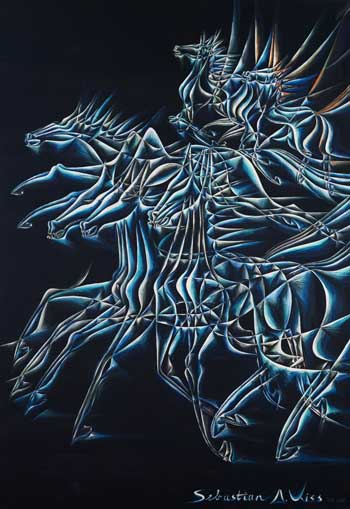
“Six Running Horses” by Sebastian Kiss. (Photos by Lisa Aciukewicz)
Upon entering Fivesparks, turn to the right. Look 50 feet down the hallway to see a large black canvas depicting a herd of galloping horses rendered in white and blue lines with the grace of French curves. Do you see overlapping images of identical horses or the same horse pictured in motion through time? Lift your gaze to the distant horses who appear to be flying with flashes of neon wings. Perhaps you notice that the undulations of line on this black painting complement the curves of the black Steinway piano below. Is this a coincidental placement or an indication of the well-arranged picture hanging that orchestrates the entire exhibit?
Before you move from the piano, turn and look toward the far wall. A quick glance might show a composition of colored vertical stripes painted on a variegated teal-blue background. Upon closer inspection, what first appears as a flat canvas reconfigures and draws you into its distant perspective. The vertical lines subtly brushed with black and orange paint appear as floating cylinders.
Step by step, move closer to the painting and its vista might seem to be moving toward you. You may become aware of yellow and orange light in the blue atmosphere. Possibly you feel surrounded by the painting’s illusion of depth as you are visually transported toward the distant tiny red posts, beyond which you might imagine infinity. Or you could just enjoy looking at the color transition of the lines and the illusion movement.

“Crystal Blue Dream Love All Day” by Mercedes Kiss
Step toward ‘Summer’ and the art of two generations
Shift your eyes to the right. You have stepped into the more intimate world of “Summer,” Mercedes’ collage of shimmering light on a swimming pool. The fragmented water is composed from aqua-toned photographs of soft bubbles, gentle surf, ocean waves, suspended diamonds, tiny swimming figures, and minuscule fish. A floral border that appears to be planted is actually glued. It is a dream garden aflutter with butterflies where you can discover a tiny yellow flower, once alive, now preserved. The top edge is a band of images of the time of the day passing. Dive into the pool; you are immersed in “Crystal Blue Dream Love All Day.”
Mercedes uses strips of tulle net fabric in two of her collages. The fabric is reminiscent of a ballet dancer’s tutu. One collage, “Tranquil Wave of Consciousness,” visits a rocky cliff by the sea, with the waves splashing on the beach expressed with a twist of tulle. The fraying along the fabric edge suggests cool mist billowing toward the viewer, the artist explained in conversation.
You will find more tulle embellishing the pink shimmer of “Magnetized to a Cinematic Sun.” Mercedes recalled a drive toward the setting sun. Its pink glow is portrayed as a bright disk of foil, and a tutu of tulle seems to represent the after image of a direct glance at the sun. Along the artwork’s bottom edge, multiple pink images recall individual moments of sunset. Those old enough to remember might liken it to an old-fashioned roll of undeveloped Kodachrome film.
Before leaving the building, you might wonder about the huge artwork in the fireplace room of giant fossils on a beach in Patagonia. Mercedes, explaining her father’s “Giants of Patagonia,” said they were fossils of humans from a past civilization. Sebastian, who was also present, said that they were an athletic species, noted for their unusually large shoulders. Mercedes added that they were reminiscent of the big-headed monoliths on Easter Island. The small figure walking away is a present-day person. The huge dancing fossil represents a possible future being, said Mercedes. There’s no accounting for the rectangular-shaped voids in the bones.
The two paintings in the front sitting room sum up the theme of “Inheritance.” Mercedes said that her father’s painting “Mediterranean House” was always hanging in her family’s art-filled, creatively inspiring home. Her collage of a fanciful treehouse complements the triangular shapes in Sebastian’s painting and the horizontal line, present in both works, draws together the art of two Kiss family generations.
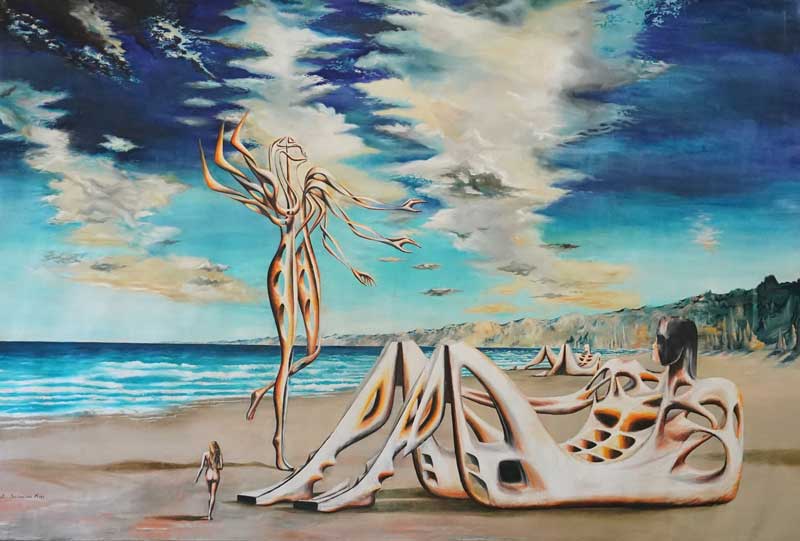
"Giants of Patagonia” by Sebastian Ambrus Kiss.