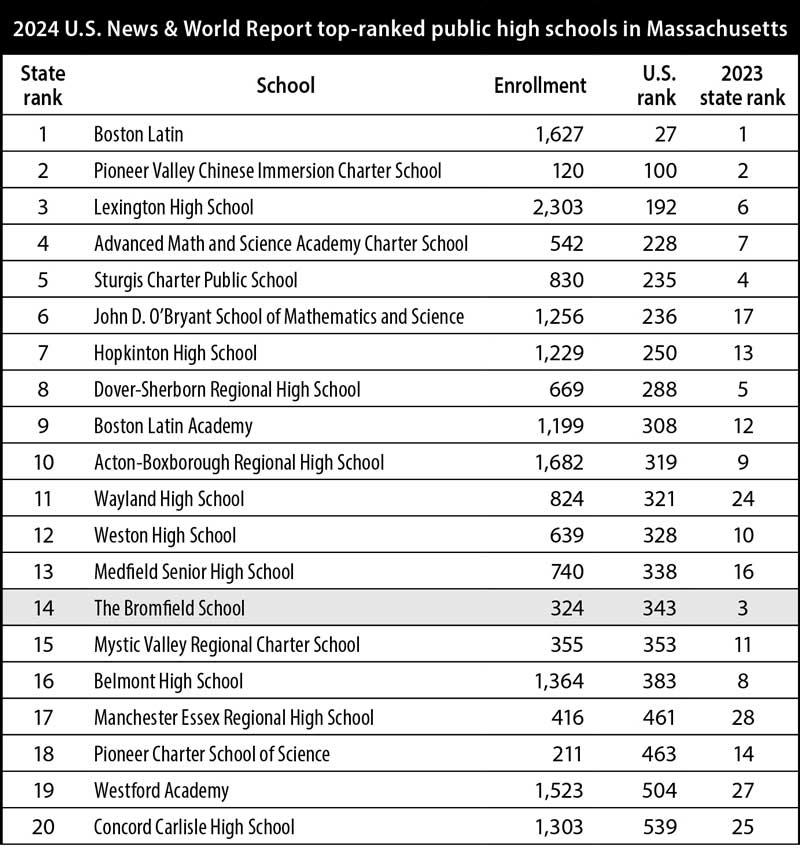
The magazine ranked Bromfield 14th among the 405 public schools that were rated in Massachusetts. Nationally, Bromfield is in the top 2%, ranked 343rd among nearly 25,000 schools.
Massachusetts again ranked first among the states, with the largest share of its schools (43.9%) in the top quarter of schools nationally. Connecticut was a close second, and New Jersey was third.
Bromfield consistently finishes high on the state list. But rankings are volatile, and tiny changes in test scores can lead to a large rise or fall in a school’s standing. In the past decade, Bromfield has bobbed around—often among the top 10, sometimes in the top 20, as this year.
Nonetheless, the list of top schools in the state shows consistency as well as volatility. Most schools in the top 20 were at or near that rank last year, as shown by the table at right. Those schools move up or down a few places, staying within the top 5% of Massachusetts schools.
According to U.S. News, the most heavily weighted factor in a school’s ranking is the college readiness of its graduates. The magazine measures readiness by looking at the share of a school’s seniors who take Advanced Placement or International Baccalaureate tests and then factors in the percentage of those test-takers who receive a “qualifying score” on the test. (A qualifying score is 3 on an AP test or 4 on an IB test.) Earning a qualifying score, the magazine points out, is worth three times more than just taking an AP test.
There is also a year’s time lag, given when test scores come out and then are made available to U.S. News. For the rankings this year, U.S. News used participation rates and scores from the 2021-2022 school year.
Standardized state tests also play a large part in ranking the schools. For Bromfield, this means the Massachusetts Comprehensive Assessment System, or MCAS, which high school students take in 10th grade and must pass for graduation. Again, U.S. News’ school ratings for Massachusetts this year were based on 2021–2022 MCAS scores.
Bromfield is one of the smallest schools in the state’s top 20. Only three charter schools on the list have smaller enrollments. As a small school, Bromfield’s percentage of students taking AP tests might rise or fall based on the decisions of just a few students—a number that would have no effect on the percentage for a larger school like Acton-Boxborough. The same is true for students scoring as proficient in English and math on the MCAS. A couple of students having a bad test day would have less effect on a bigger school’s ranking than on Bromfield’s.
As Linda Dwight, superintendent of schools, explained in an email: “When our class sizes are 70 [to] 100, our ranking is likely to swing more dramatically based on a few students. As we become a district that is more inclusive of students with diverse learning needs, we understand that our rankings may vary. This does not mean that our high performance is eroding; it means that we are including more students in their local schools.”