Whatever else the name Good Spirits Farm suggests, it certainly applies to the owners, Christiane and René Turnheim, who, for a decade, have been running a holistic and sustainable 8-acre farm at 106 East Bare Hill Road.
Their mission is to help educate people about the properties and uses of a variety of plants, how to grow them in harmony with the environment, and how to use them to be self-sustaining. The reality of climate change has been evident on their land, where extremes of weather have affected growing seasons and the viability of some plants. “I worry about the next generation,” said Christiane Turnheim.
Turnheim spoke to the Garden Club of Harvard Monday, April 29, and I had the opportunity to tour the farm with her after the talk. As I pulled up to the farmstand on the roadside, a young man was walking away with a bouquet of daffodils and a smile on his face. The small stand runs on an honor system, and in addition to flowers, seasonal produce is for sale. Turnheim said that the first weekend in May she will start setting out the different varieties—some familiar, some new—of tomato plants she has been raising in the large greenhouse attached to the house, which sits far back off the road.
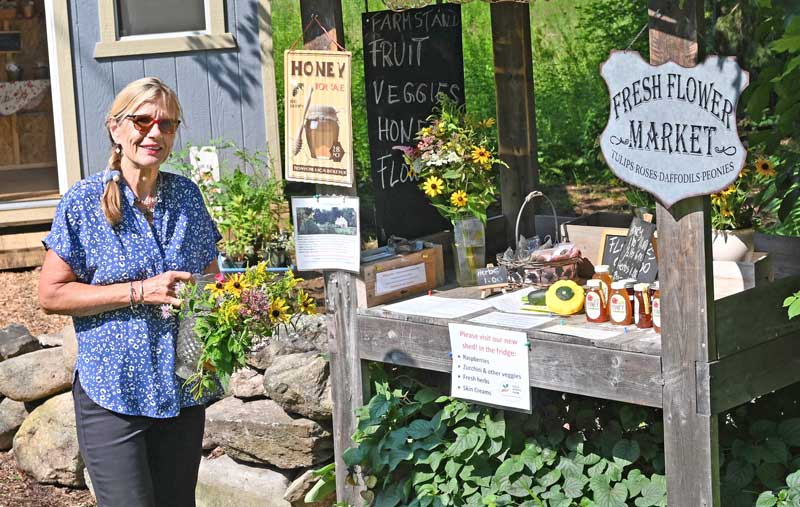
Christiane Turnheim prepares a bunch of wildflowers for Good Spirits Farm’s farmstand on East Bare Hill Road. Honey, seedlings, flowers, vegetables, and other plant-related products can be found at the farmstand. (Courtesy photos)

Next to the stand is a small shed where Turnheim’s jams, like aronia, raspberry, and tomato jalapeno, are for sale, along with teas, dried herbs and spices, and skin care products like herbal hand cream and lip balm. Honey will be available in two weeks; there was no honey last year because the spring had been too wet for the honey bees to fly. A large refrigerator holds chicken, duck, and turkey eggs, which Turnheim gets from the Goose and Hen Farm on Littleton Road. She said she likes to collaborate with small farmers like herself and to share mutual support.
As we started walking back toward the farm, which is surrounded by conservation land—forest and wetlands, with a small pond—Turnheim described the holistic approach to farming that she and René employ, where they consider the economic, environmental, and social impact of all they do. While they are not certified organic because of the expense and paperwork, they follow organic principles in using nonchemical products and regenerative methods.
Turnheim pointed out the small orchard surrounded by fencing against deer (a large Australian shepherd patrols the rest of the property) where a cherry tree was in blossom. Later in the season, a mulberry tree planted next to it will attract birds away from the cherries. Perry pear trees, a slow-growing variety that produces smaller fruit, will be used for making cider.
Embracing the imperfect
Turnheim said that because they don’t spray their trees, they won’t be able to sell the fruit commercially. It will not look perfect, and “people want to buy a fruit that looks perfect.” Her frustration was obvious as she talked about how doing the right thing environmentally often means making less money. She had said that both she and her husband have day jobs, but for those who rely on farming for a livelihood, it’s even more discouraging.
She told the story of being in line at the grocery store recently where a man and the cashier were marveling at the large, perfectly shaped purple and white turnip he was buying. Behind him, she was mentally shaking her head at the deception of the turnip’s appearance—it would have been over-watered and chemically fertilized, much less nutritious than a smaller, organic, but misshapen, one. She commented, “People need to change before farming can change.”
We came to an area of permaculture, where a variety of nut trees—hazelnut, English and American walnut—were growing. There’s also a medlar tree, what Turnheim called a heritage tree. All these trees will thrive undisturbed, totally on their own—no fertilizer, no mulch—and in time will provide food rich in calories. But, Turnheim said, there may have to be an intervention in the way of an electric deterrent to keep the squirrels from taking all the harvest.
For the love of bees
On to the beekeeping area, where a small fenced area is devoted to growing fiber hemp, an herb helpful to bees’ health. Turnheim explained that bees have an apothecary in the hive, where different beneficial nectars are stored. A variety of flowers, especially white, yellow, and blue, are grown for the pollen and nectar they provide the bees. If it becomes necessary to spray, she uses organic, but even neem oil is not good for the bees as it weakens them in the long run. She had said earlier that honeybees have plenty of food sources during late spring and summer, but they could use some help in early spring and fall, pussy willow, hellebore, and snowdrops for the former and hydrangea, dahlias, asters, and goldenrod for the latter. Unfortunately, forsythia, azaleas, and rhododendrons have no pollen or nectar. Sunflowers are good pollinators, but “Don’t plant or buy pollenless sunflowers that are useless to bees,” said Turnheim. (I was dismayed later when I checked a package of “Goldy Honey Bear” I had bought and read the boast of the “nearly pollenless” flowers the seeds would produce.)
Looking toward the west, beyond the house, are orchards with the more usual apple, peach, pear, and cherry trees but also nectarine and apricot trees and some rarer ones like pawpaw and persimmon. Turnheim said her fond memories of farming had influenced her later choices; she recalled that her love of fruit trees goes back to childhood when she could walk out into her grandmother’s garden and pick an apple. She pointed out the clumps of daffodils growing at the base of the apple trees, explaining that they deter mice from chewing a ring around the bark, which would, in time, destroy the trees. In her talk she had pointed out other examples of natural ways of deterring pests, like planting marigolds around vegetables.
Large numbers of berry bushes—blueberry, raspberry, blackberry—are surrounded by posts ready to hold netting to protect the berries from the birds. Turnheim has a licensed residential kitchen in the barn, with all the equipment for making jams. A harvest of 4 pounds of berries will yield 20 jars of jam, with nothing but sugar added.
Medicinal herbs, edible flowers
Closer to us was a long herb and flower bed, created by a stone wall along each side. Turnheim is very knowledgeable about the medicinal uses of all the plants. And she pointed out the health benefits of different wildflowers and “weeds,” touting the multiple powers of the dandelion. On the other side is a shrub garden of varieties of edible berries. Turnheim ordered them in bundles from the New Hampshire State Forest Nursery. The saplings, all natives, are inexpensive, a dollar apiece, but they are also small and have to be given special attention when first set out. There are 75 varieties of native plants and bushes on the property.
Looking around at the size of the farm and its diversity, I asked how she managed it. She agreed it’s a lot of work, but she loves it. Before coming to the United States 25 years ago, René and Christiane had a small farm in the country outside Vienna. While they were living in Arlington, they missed farming and knew in time they wanted to get back to it. It took two years to find the perfect spot in Harvard, a spot that met the town’s size requirement for agricultural zoning, did not need excessive clear-cutting, and was of a manageable size to handle themselves. It was not a farm when they bought it, and they started with 150 fruit trees. Flowers, herbs, and vegetables are started in the greenhouse from organic seeds and seeds that have pollen.
Turnheim is a psychology professor at Mass Bay Community College, and she has received a degree from UMass in sustainable food and farming. She feels a desire and a responsibility to educate people about how to grow plants for their own survival. “Anyone can plant an apple tree, blueberry bushes, a few herbs, and vegetables,” she said. She also wants to grow and sell “what my neighbors need.”
While Good Spirits Farm is inspirational in itself as a holistic model of how to live in harmony with the environment, Turnheim offers more explicit opportunities for education. The farm is open for self-guided tours along the medicinal plant trail, May to October, 2-4 p.m. She offers guided tours—the first of the season is Sunday, May 5, at 1 p.m. In addition, she offers workshops on topics such as passive composting; four-season crop rotation that enriches the soil naturally; good weeds; and planting companion plants that provide benefits for one another.
A small sign on the farmstand echoes the voices of other farmers in town: “Thank you for your honesty and for buying local. The survival of small farms depends on customers like you.”