More than 250 Harvard voters were already in the Cronin Auditorium when Moderator Bill Barton called the meeting to order at 12:10 pm last Saturday, April 6. People continued to arrive for the next half hour or more, up to the official total of 392, which is more than double the 2023 turnout.
The meeting was marked by a high level of agreement, with all the warrant articles that came to a vote passing by the required majorities. The only exceptions were Articles 4 and 25, on which voters agreed with requests to take no action. It was also a meeting marked by frequent outbursts of applause, as either supporters or opponents of various measures reacted to speakers for their side. Notably, however, there was only applause—no booing of the other side.
The meeting began with the Pledge of Allegiance, after which Barton thanked the League of Women Voters for supplying 500 electronic voting devices, or “clickers,” that provided rapid tallies of the yeas and nays on each question.
League members had handed out the devices at the check-in tables. Each came with a lanyard to loop around one’s neck so the devices did not get dropped, stepped on, or mislaid. Each clicker was numbered, and its number was recorded with the name of the voter who received it. Barton reminded people to be sure to return them. “Otherwise,” he said, “we will send Chief Babu to your house.”
As a test of the clickers, Barton asked an apolitical question: “Did you buy baked goods from the Girl Scouts?” Only 28 people admitted to buying goodies in the lobby outside the auditorium, while 188 denied having done so. Quite a few abstained from voting (and perhaps from cookies).
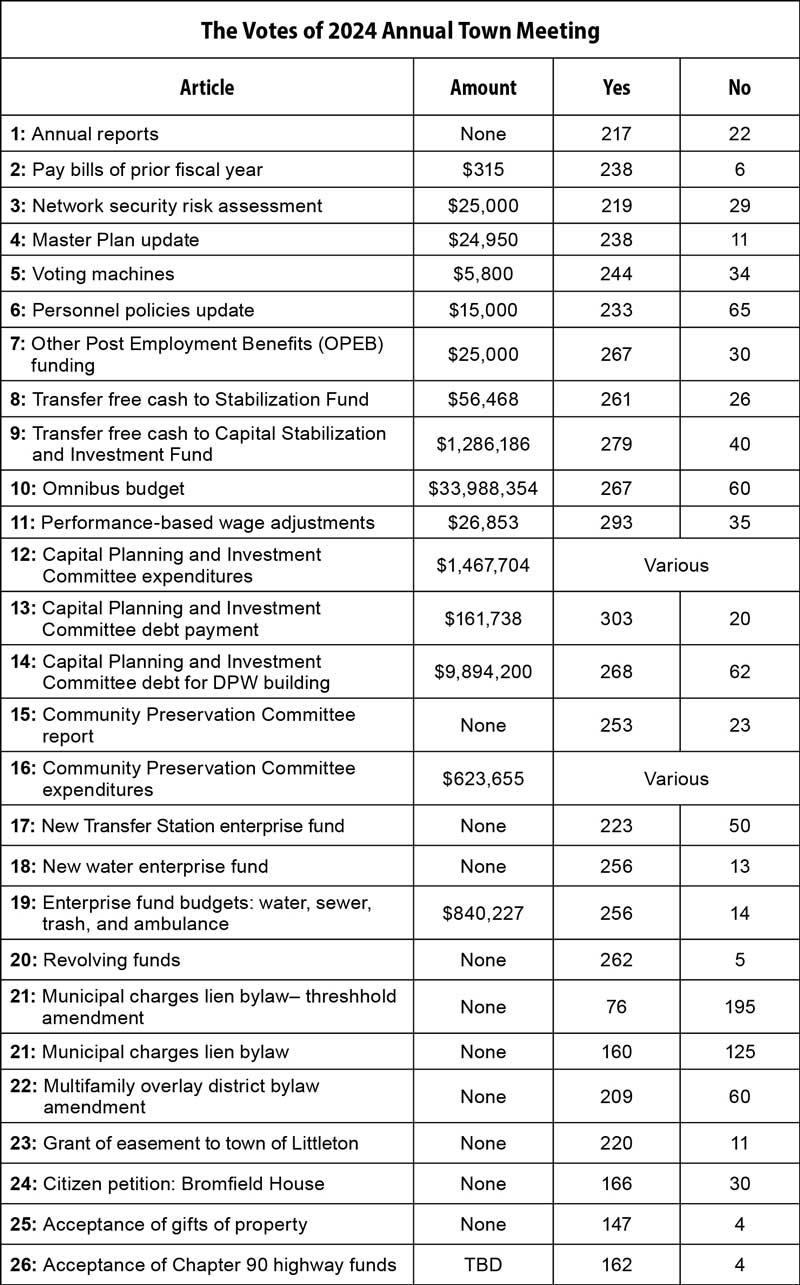
Voters whipped through Articles 1 through 11 in a little more than half an hour. By approving a series of expenditures from the General Stabilization Fund, voters authorized the town to pay bills from prior fiscal years, conduct a security assessment for the town’s computer network, buy a new voting machine, update personnel policies, add money to the town’s post-employment benefits fund, and transfer some of the free cash left over from 2023 to the Stabilization Fund. (See table below for vote totals and amounts for each article.)
The pace slowed briefly with Article 9. It proposed moving the rest of 2023’s free cash—almost $1.3 million—to the Capital Stabilization and Investment Fund, which is used for purchases that cost $20,000 or more and have a useful life of at least five years. Tony Svarczkopf came to the microphone to ask why that money had not been put into the operating budget, to avoid asking voters for an override. Select Board member Charles Oliver answered it wasn’t prudent to fund ongoing expenses with one-time revenue. Moreover, a 2010 town bylaw specifies using free cash for capital expenses through the Capital Planning and Investment Committee. The measure passed 279 to 40.
Voters picked up speed again with Article 10, approving the $33.9 million omnibus budget for fiscal 2025 in about five minutes by a vote of 267 to 60. That budget, however, was contingent on the passage of an override at Town Election three days later, so there was little point debating it on the floor. (See story)
Article 11, giving a maximum 1% merit raise to the 38 nonunion town employees, passed in even less time. Jennifer Finch commented that the raise, which she said would amount to about $10 a week at most, was “kind of insulting to our good employees.” The article passed 293-35.
At this point in the meeting, the moderator called for a pause to announce this year’s citizen of note, Bob O’Shea. Marisa Steele, a member of the Parks and Recreation Commission, described O’Shea’s long service to the town as harbormaster and as a member and former chair of Parks and Rec. (See story) O’Shea received a standing ovation.
CPIC and CPC articles call for many separate votes
The Capital Planning and Investment Committee presented its recommended expenditures in Article 12, which proposed spending $1,467,704 for 15 capital projects. Each was voted on individually, and each passed with the required two-thirds vote, although some more narrowly than others. Funding for all the projects comes from the Capital Stabilization and Investment Fund, which in turn is funded from free cash each year.
Early in the discussion of the capital projects, Svarczkopf came again to the mic, asking, “Is it wise to be spending this money?” Oliver explained that if capital items had to be added to the omnibus budget, their cost would become a permanent tax increase instead of a one-time expense. “These votes don’t make your taxes go up,” Oliver said, which seemed to end that argument.
One well-supported capital project was $200,000 for road repair. “It keeps our roads from being terrible—mostly,” CPIC Chair Nate Finch said, drawing a laugh from the crowd. The single biggest vote-getter, however, was $20,355 for beach house improvements at Bare Hill Pond. That measure passed 325-17 after O’Shea explained the repairs would solve many problems, including a major mouse invasion.
Article 14 sparked a half-hour debate on CPIC’s proposal to borrow just under $10 million to rebuild or renovate the Department of Public Works garage and pole barn. The garage dates from the 1950s, the pole barn from the 1930s. (See story) The measure eventually passed 268-62.
Article 16 set forth the proposed expenditures from funds accumulated under the Community Preservation Act. As printed in the warrant, it was an eight-part article with each item requiring a majority vote. However, with the approval of the Select Board and town counsel, O’Shea added a ninth item to support beach improvements that comply with the Americans with Disabilities Act.
Over the next 40 minutes, voters approved all nine items by very solid majorities. Among the projects that received funding were new stairs at the McCurdy Track, upgrades to the outdoor basketball court at Bromfield, and $200,000 for the Conservation Fund.
For several years, the Community Preservation Committee has also given money to preserve the town’s historic documents. This year’s allocation completes that project—an announcement that drew another round of applause.
All the remaining town financial matters were wrapped up within 10 minutes in Articles 16-20. Voters quickly approved creating two new enterprise funds, one for the Transfer Station and another for the town’s water operations. With equal speed, they approved budgets for the existing enterprise funds (for the Ambulance Service and sewer operations) and then agreed to the spending limits on the town’s nine revolving funds.
Liens, zoning, and Bromfield House spark extensive discussion
Having dealt with 20 articles involving many millions of dollars in less than three hours, the meeting devoted most of the next two hours to just three articles—21, 22, and 24.
Article 21 dealt with municipal liens, allowing the town to place a lien on real estate owned by someone who has not paid fees or fines set by the town bylaws. The article passed by a vote of 150 to 125, making it by far the closest vote of the meeting. (See story.)
After the sometimes heated debate on Article 21, the meeting turned to a moment of appreciation for two well-known town figures. Moderator Barton expressed the town’s gratitude to Paul Willard for his long service to Harvard. People rose and gave Willard a standing ovation, even though he was not present to hear it. Barton also thanked retiring Tim Bragan for his 17 years as town administrator, again to a round of applause.
Voters debated Article 22, which creates zoning for a multifamily overlay district, for about 40 minutes—the longest discussion of the day. By the time Bob Douglas went to the mic and called the question, another burst of applause signaled people were ready to vote. There had been some debate as to whether the article needed to pass by two-thirds or just a simple majority. But the final vote was 209 in favor of the new bylaw to 60 opposed, so it easily cleared the higher hurdle. (See story.)
Article 23 asked Harvard to grant Littleton an easement along Littleton County Road, so some Boxborough residences could connect to Littleton’s water supply. Andrew Perry of the Harvard Fire Department asked if Harvard could have fire hydrants on the new water supply, and the answer was yes. The measure passed overwhelmingly, 220-11.
Jason Cole presented Article 24, a nonbinding citizen petition that asked the Select Board to delay selling Bromfield House and allow it to be used as a home for refugees for at least five years. More than a dozen residents rose to speak to the question.
Billy Salter began simply, “It’s the right thing to do.” Several other speakers concurred. Terry Symula, who is head of the neighborhood support team that aids the refugees, said, “We have given them a great gift, but they have also given us a great gift.” And she noted the families are working toward independence.
As president of the Bromfield Trustees, Pete Jackson pointed out that a court decision had allowed the lease for only one year; and town counsel Mark Lanza agreed with Jackson that extending the lease would require a new petition to the court. Jackson added,“I can’t possibly endorse a five-year extension.”
Bev Dunlap Rodrigues urged selling Bromfield House to a private owner, so that the house could be well maintained rather than “limping along,” as she said it is now. Her grandfather lived in the house while he was headmaster of the Bromfield School, and her father grew up there.
The School Committee supported extending the lease, Chair Abby Besse told the meeting. And committee member Suzie Allen explained how her own thinking on the issue had evolved. “I voted at Town Meeting to sell this house … but now the situation has entirely changed. … It’s a huge point of pride to this community,” she said, referring to the help the town has given the refugee families. School Committee member Liz Joyce said, “This is an issue of humanity.”
As the clock neared 5 p.m. the citizens—whose numbers had dwindled considerably from mid-afternoon—voted 166 to 30 to support the petition and urged the Select Board to extend the lease.
All that remained was to take no action on gifts of property, as there were none, and to accept state highway funds, which passed 162-4. Barton then asked for a vote to adjourn Town Meeting until Saturday, Oct. 5. And people ambled off, turning in their clickers as they left. After the meeting, Barton reported every clicker had been returned, so there was no need to call for Chief Babu.