In recognition of Women’s History Month, the Warner Free Lecture Trustees will host attorney, author, and professor of law Barbara Berenson Friday, March 22, at 7 p.m. in Volunteers Hall at the library.
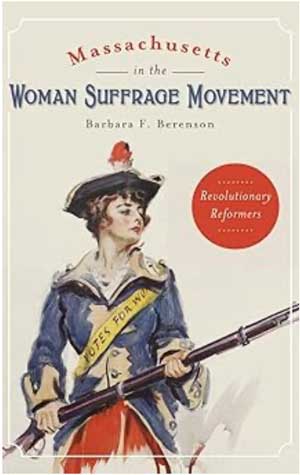
She will talk about her book, “Massachusetts in the Woman Suffrage Movement: Revolutionary Reformers.” Many, if not most, of us associate the 1848 convention at Seneca Falls, New York, with the start of woman suffrage and Susan B. Anthony and Elizabeth Cady Stanton as its initiators. Berenson brings a broader perspective to the movement and describes the essential part Massachusetts played, with Lucy Stone in her rightful role as a key force.
Berenson said in a phone conversation that she has always been passionate about history, particularly women’s history. In 2011 she published a first edition of “Walking Tours of Civil War Boston: Hub of Abolitionism” and in 2014 “Boston and the Civil War: Hub of the Second Revolution.” Because woman suffrage was so entwined with the abolitionist movement, Berenson said writing a book about it became the next logical step.
She said her research “uncovered” the extent to which many heroes of the suffrage movement had been “so pushed aside by Anthony and Stanton.” The two women wrote a multivolume book about the suffrage movement, with Seneca Falls the “birthplace” and themselves at the center. “The power lies in who writes the story,” said Berenson. She called the Seneca Falls Convention a “one-off.” While it was the first gathering to focus on the equality of women and the group issued a “Declaration of Sentiments,” when it was over, “they all went home.” It was two years later in Massachusetts that the suffrage movement was truly launched.
The most powerful force opposing woman suffrage was arguably not men, but women themselves. To put this seemingly “outdated” opposition in perspective, Berenson said one can look at the more recent anti-equal rights movement of the 1970s and ’80s. Phyllis Schlafly echoed arguments from the anti-suffrage movement to defeat the Equal Rights Amendment, warning of the moral decline that would ensue if women left their roles as wives and mothers.
Berenson’s book
The book, which is relatively short, is rich in details and quotes, but Berenson keeps a focus on the suffrage movement’s broad trends in progress and setbacks, particularly as they occurred in Massachusetts. She shows how activists had to adapt to the changing social and political background and demonstrates the way one thing inspired the next. A consistent forward thrust was the reenergizing of the movement by younger generations and the new approaches and strategies they brought.
Although the specifics vary, there was always the obstacle of anti-suffrage women. And the book reminds the reader that behind any movement are the egos of individual personalities that can forward or derail it. While Anthony and Stanton were important leaders, they were unrelenting in their own ideologies, and some politicians who favored a woman’s right to vote fought against it to remain in their party’s favor.

Barbara Berenson. (Courtesy photo)
Berenson introduces a wide range of women involved in the movement, which she said includes only a fraction of the actual number involved. “There were so many heroic figures, with so many different skills.” Many of them have their portraits in the book, and Berenson includes enough biographical detail to make each an individual. There are quotes from letters and journals. Lucy Stone described a day of walking miles, campaigning at a variety of stores, “and for all my day’s toil, I did not get a cent … it seemed as though the tired of a whole life came into my essence.”
Some young women brought new ideas—grassroots organizations, holding open-air meetings, flying banners from open-top cars (“sometimes dodging stale eggs and overripe tomatoes”), trolley tours, picketing the White House—and at least one created a scandal that drastically harmed the women’s cause. One of the book’s many examples of the movement’s daring and ingenuity occurred on Nantucket Beach. When officials barred women from speaking on the beach, they carried their “Votes for Women” banner into the water and spoke from the ocean.
Throughout the book, in addition to the portraits, are illustrations and political cartoons. The cartoons capture the worst-case scenarios inspired by the extremists on both sides of the issue. One shows three ladies, in fancy dresses and hats, climbing into a carriage with a woman holding the horsewhip. In the background are two husbands, one tending a baby and darning, the other washing clothes.
In a conclusion to the book, Berenson says that although the battle of the suffragists took almost a century, “Their example reminds us to never relinquish hope or concede defeats in our efforts to make the world more just.”
The book will be on sale at the lecture, through the Silver Unicorn bookstore.