Town and state officials were alarmed last week by news reports that Steward Health Care, the owner of the Nashoba Valley Medical Center in Ayer, was considering the sale or closure of the hospital—and three others in Massachusetts—to stem its mounting financial losses. The consequences for the region, especially Ayer and nearby towns, they said, would be devastating.
“Think about it,” Ayer Town Manager Robert Pontbriand told the Press. The Nashoba Valley Medical Center fills an important void. “We’ve got Fitchburg, Leominster, and Gardner and their hospitals to the west; Worcester to the south; and then you’ve got the MetroWest hospitals, such as Emerson, to the east.” But according to the hospital’s website, Nashoba Valley Medical Center serves 16 towns in the Nashoba Valley region of central Massachusetts, including Ayer and Harvard, with its emergency room and landing pad for LifeFlight helicopters.
Moreover, said Pontbriand, Nashoba is Ayer’s second largest employer. The hospital had 317 full-time employees in 2021, including 115 physicians. “They employ a lot of folks,” he said, not just doctors and nurses, but support staff and vendors. “So, of course, the town of Ayer is concerned about the recent news.”
Harvard Council on Aging Director Debbie Thompson told the Press the COA van regularly takes seniors to Nashoba and the adjoining doctors’ office building. The Ayer Council on Aging also provides van service to Nashoba. Pontbriand said Nashoba’s services are vital to area seniors, including the residents of three nearby senior living facilities: Nashoba Park and Ayer Valley Rehab and Nursing in Ayer, and RiverCourt in Groton.
A closure would also affect Harvard’s ambulance services and police. (See “Harvard ambulance and police have close ties to Nashoba Valley Medical Center” below.)
A surprise
The first hint that the hospital might be in Steward’s crosshairs came with publication of an eye-opening Jan. 19 Boston Globe story that reported Steward—the physician-owned group that operates NVMC and eight other Massachusetts hospitals—owes more than $50 million in back rent to its landlord, Medical Property Trust. Ayer’s two state legislators, Sen. Jamie Eldridge and Rep. Dan Sena, said they learned of Steward’s financial problems from the Globe, which was, said Eldridge, a complete surprise. Steward is based in Texas and owns 33 hospitals nationwide.
Though the company has yet to publicly state its intentions, the Globe and other news outlets have said Steward told state officials it wants to sell or close four of its hospitals, including Nashoba as well as St. Elizabeth’s Medical Center in Brighton, Holy Family Hospital in Methuen, and Norwood Hospital in Norwood, which is closed and undergoing reconstruction following a serious flood.
Steward executives have been tight-lipped. In a Tuesday phone call with the Press, Eldridge said, “Steward is very much keeping their cards close to the vest. None of the executives are talking. I think it’s pretty clear; they’ve all been instructed not to comment on their individual hospitals.”
Eldridge told the Press that in his opinion, Nashoba is a hospital that hasn’t been well supported by Steward. “It’s a small community hospital that serves a mostly working-class area that’s not a ‘money maker’ for Steward. I’m extremely concerned that it could be on the list to be closed.”
Pontbriand said he has been in touch with Nashoba Valley Medical Center‘s president, Dr. Salvatore Perla, to express his concerns. He was assured that the hospital “is not closing at the end of the month and is not being sold,” he said. State law, he added, requires a company to give 120-day notice of its intent to close a hospital, a process governed by the state Department of Public Health. In December, Steward notified the state that it will be closing the New England Sinai Acute Long-Term Care and Rehabilitation Hospital in Stoughton this spring after operations losses climbed to $22 million since it bought the facility in 2010. As of Jan. 30, Steward had not notified the state of any further closures.
Little leverage
Neither the state nor the towns have much leverage in dealing with a company like Steward, said Eldridge. “It’s not just that the hospitals are privately owned, but that the regulation of hospitals is so weak.” Eldridge noted that the state had tried and failed to dissuade UMass Memorial from closing the Leominster Hospital maternity ward. The Department of Public Health held hearings, but the DPH can’t force a health care unit or hospital to stay open, he said. He urged area residents, “Whether through their town officials or on their own … to be vocal and make their support for the hospital known.”
If there were a shutdown, officials would hear more from their constituents, said Sena. “Sometimes people are so busy with their lives, they’re not paying attention to all these details. But the hospital serves a lot of people in my district and [its closure] would be devastating.”
Searching for solutions
Meanwhile, the search goes on behind closed doors for a solution that will keep Nashoba and the other Steward hospitals open. Gov. Maura Healey has said that the state will not bail out Steward.
But other ideas are afoot. In a Commonwealth Beacon column this week, Paul Hattis, a senior fellow at the Lown Institute, and John McDonough, a professor of public health practice at the T.H. Chan School of Public Health at Harvard University, wrote that bringing Steward hospitals under management or control by a nonprofit such as UMass Memorial, Tufts Medicine, or Boston Medical Center might be an effective, though complex, solution.
The goal is “stable access to quality care,” Sena told the Press. Pontbriand said he wanted decision-makers to know that the people of Ayer support Nashoba and have done so since its founding as a community hospital more than 50 years ago. “It is a critical health care facility not only for Ayer but for this whole region,” he said, “and we are very supportive.”
A critical asset
Nashoba Valley Medical Center is one of 61 acute care hospitals in the state. According to the Center for Health Information and Analysis (CHIA), an independent state agency that provides data and analysis of the state’s health care systems, 10 of those hospitals, including NVMC, are for-profit. Eight of the 10 are run by Steward Health Care. The hospital is categorized by the state as a “community high public payer hospital,” which means that at least 63% of patient revenue comes from public payers such as Medicare or MassHealth. About half the hospitals in Massachusetts fall into this category.
In 2020, when COVID-19 hit, expenses at the NVMC exceeded revenue by $16 million, according to CHIA. The following year, expenses over revenue shrank to $1.6 million, and in 2022, it dropped further to $700,000. But in the first three quarters of 2023, expenses had already exceeded revenue by $1.9 million.
The hospital has about 40 “staffed” beds, which means beds that are licensed by the state and available, with enough staff to attend to the patients in those beds. In 2021, 89.6% of the beds were occupied, and the number of inpatients discharged from the hospital that year was 1,855, with an average stay of seven days.
The hospital’s emergency room receives about 16,000 patients annually according to its website. There are 13 treatment areas, with onsite diagnostic testing, and on-call physicians, specialists, and behavioral health clinicians. The emergency department has 24/7 cardiac care, and the hospital is designated by the state’s Department of Public Health as a primary stroke service provider. Patients requiring further care at a major medical facility are transported by ambulance with advanced life support capabilities, or via helicopter from the hospital’s helipad.
Nashoba’s services go beyond emergency and acute care. In 2021, there were over 38,000 outpatient visits to the facility. Services offered at the hospital range from knee replacement and cataract surgery to kidney dialysis, cardiac rehabilitation, and pain management. The Garvin Center for Geriatric Psychiatry is a 20-bed inpatient behavioral health program for patients over 55. The Diabetes and Endocrine Center offers help for area residents suffering from diabetes and other metabolic disorders, including monitoring, building individualized self-management programs, and support groups. The hospital also performs mammograms, colonoscopies, and hearing tests; and it has a cancer care center.
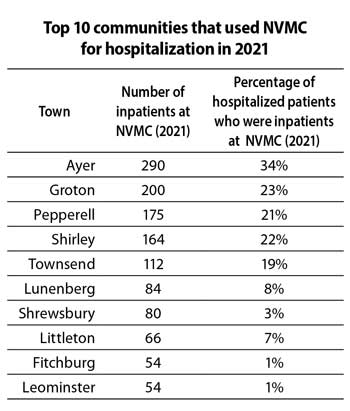
Statistics from CHIA show which communities are the heaviest users of the beds in each hospital in the state. Nashoba’s top user is Ayer (see “Top 10 communities that used NVMC for hospitalization in 2021”). In 2021, 34% of Ayer residents who were hospitalized were inpatients there. About one in five hospitalized patients from Groton, Pepperell, Shirley, and Townsend were at NVMC. Harvard was not on the list, which included only the top 10 communities.
But anecdotal evidence collected by an ongoing Press survey shows that Harvard residents make use of the outpatient services, as well as the services offered in the medical office buildings on the hospital campus. Family and internal medicine, ophthalmology, dermatology, orthopedics, and rehabilitation are just some of the services available. Many of the communities served by the hospital have few, if any, doctor’s offices within their borders. It is unclear how the medical offices on the Nashoba campus might be affected by the sale or closure of the hospital.
Harvard ambulance and police have close ties to Nashoba Valley Medical Center
Last year, the Harvard Ambulance Service took 117 patients to Nashoba Valley Medical Center—49% of all patients the ambulance transported in 2023. Jason Cotting, Harvard’s emergency medical services coordinator, estimated that Nashoba is the closest emergency room for between 40,000 to 50,000 people in the area. “Many of our sickest patients go to Nashoba, even if they ultimately require a higher level of care,” Cotting wrote in an email to the Press. “This is because they need rapid stabilization before they go to a larger hospital in another ambulance.”
Together, Nashoba Valley and Emerson Hospital accounted for about 90% of the people the Harvard Ambulance Service transported to emergency rooms over the past five years, according to George Orsula, who does much of the record keeping for the service. Other hospitals where patients were sometimes taken included Leominster, Clinton, Lowell General, and UMass Medical Center in Worcester.
Travel time from Harvard to Nashoba Valley averages 11 minutes, Orsula said. Travel time to Emerson is longer, at 18 minutes. And, because each trip is a two-way journey for the ambulance crew, a longer trip means the ambulance spends more time out of town, unavailable for other calls.
Wait times in the Nashoba emergency department also tend to be significantly shorter than those at Emerson, where the emergency department is already very busy, Cotting said. (Nashoba posts its emergency room wait times on its website, and a random check over two days showed 11 minutes as the longest wait.)
Every ambulance service must work under a specific doctor’s medical license. That doctor is called the service’s “affiliate hospital medical director.” For the Harvard Ambulance Service and many other nearby towns, that person is Dr. Gabriel Simon, the chief of emergency medicine at Nashoba. Simon sets standards and rules for the ambulance services and provides their authorization to practice, Cotting wrote. If Nashoba closes, the Harvard Ambulance Service would need to work under a new affiliate director, who might change the medications and equipment Harvard EMTs are authorized to use.
The Harvard Police Department would also feel the effects of the hospital closure. Police Chief James Babu wrote in an email, “I think any closing of the only nearby medical facility will impact all public safety.” He noted that mentally ill people who pose a serious risk of harm to themselves or others are currently taken to a hospital for psychiatric evaluation. “When we have a prisoner that needs to go to the hospital, Nashoba is our go-to medical facility,” he wrote.
—Marty Green