It takes less than a minute in conversation with Harvard resident Suzanne Buell to understand how passionate she is about her music. That enthusiasm and her talent as a professional singer will be in evidence Friday, Feb. 9, at 7 p.m. for the Warner Free Lecture in Volunteers Hall at the library. While Buell has both popular and classical songs in her repertoire, the evening’s program will feature traditional spiritual and gospel songs, with some music from contemporary artists. “Gospel music,” said Buell, “brings a sense of well-being and an energy that’s hard to describe. It speaks to your soul.”
For Buell, it’s important that listeners leave the performance with a sense of why gospel music is important. Not only does the music reflect our history, including its connection to the civil rights movement, but it also influenced folk singers of the ’60s and ’70s as well as contemporary artists. The more Buell sang gospel, the more she wanted to know about it—where a song came from, who wrote it, what it meant to them. That history will be described throughout the program.

Suzanne Buell. (Courtesy photos)

Michael Payette.
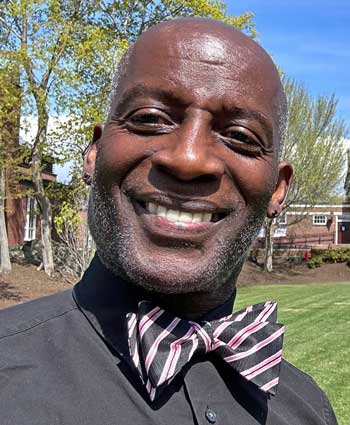
Donnell Patterson.
On Feb. 9 Buell will have two colleagues with her, the first time she has assembled a gospel trio. Each of the three will bring an expertise from their own relationship with gospel music. “It will be a lovely way to come together, to share our different paths,” said Buell of the upcoming performance. “The more people of different backgrounds share their story, the richer it is for everyone.” She has chosen 10 songs that she knows will work well for the trio. While she will be the lead singer on most, her fellow musicians will also take leads. Some songs will be a cappella, like “Hold On Just a Little While Longer,” while others will have instrumental accompaniment.
Donnell Patterson, a singer, pianist, educator, and director, is steeped in the tradition of African-American music. He is director of music at the Belmont School for Boys and directs Joyful Voices of Inspiration, a community choir that goes on an annual tour of Europe. He is also one of the five directors of the Millennium Gospel Choir that performs an annual holiday concert at the Boston Museum of Fine Arts. Friday night he will be the lead singer on “A Change Is Gonna Come,” written in 1964.
Michael Payette, a bass player, is a professional musician of 55 years. He has his own band, Acoustic Roadshow, doing mostly jazz and pop. He has an “amazing, soulful voice,” said Buell. They met at the Acton Jazz Cafe in 2015. Hearing him sing two Stevie Wonder songs, Buell told him, “I need to know you; we need to work together.” Payette “discovered gospel” and is part of Buell’s Gospel Connection band.
A musical journey
Buell remembers a moment from her childhood. She was 4 years old, spending the night at her aunt’s house. She woke up early and started singing. Her aunt came in, and Buell, perhaps afraid she was going to be reprimanded for waking people up, told her, “I’m going to be a singer.” Instead of any scolding, her aunt gave her words of affirmation and encouragement.
It had come naturally; her mother sang all the time—pop music from the ’40s and ’50s—and Buell learned the songs. They often sang together, along with her aunt and two cousins. She watched Mitch Miller’s television show, “Sing Along with Mitch,” a lot, following the pop-up lyrics and learning many songs.
Her real encouragement came from her brother, who was 12 years older than she and an excellent drummer. He was in a band that played at different clubs, and he schooled her in the music of whatever band he was in. When she was 12, he started sneaking her into the venues. At some point in the evening, he would motion to her to come up on stage and she would sing whatever kind of music he was playing—rhythm and blues, jazz, soul. In addition to learning different genres, she learned to improvise, a skill that would stand her in good stead later, especially as a solo gospel singer. Her performances with him continued until she was 18.
Another huge influence was her high school choir director. Buell grew up in Monticello, New York, and she said that at the time, most of the schools had strong music programs. Her choir director had especially high standards. She gave each student a half-hour private lesson each week. “I knew music, but she gave me the tools, taught me how to sing.” Buell deferred college for a year, and during that time the director prepped her for an audition for Boston Conservatory, giving her a weekly lesson in classical music. “It was because of her that I went to Boston Conservatory.”
But pop music was pulling on her. Her brother was in New York City, and he introduced Buell to a man who had just released a Marvin Gaye album and was searching for new talent. He signed her to Stax Records as an individual artist when she was 19. In the early ’70s, Stax was trying to bring Black and white artists together, to involve people of all races in the music. “There I was, a white girl singing soul music,” recording in NYC, Los Angeles, and Memphis. She decided to follow that dream, knowing if she didn’t, she would always regret it, and she left the conservatory after a year.
That dream ended when Stax ran into financial problems and folded in 1975. There she was in Memphis, wondering, “Now what do I do?” She had made connections with “lots of blues guys,” and she started singing in bands. She remained in Memphis for 28 years, raising a family and singing as much as she could. With a move to California in the works and knowing she would now have time for music, she researched opportunities. She found that the Oakland Interfaith Gospel Choir was one of the best in the country.
But Buell had never sung in a gospel choir; in fact, she didn’t sing gospel. The audition process is rigorous; only about five people get in every year, and almost 70% of the choir is Black. But she was accepted. The music “pulled me in and I really felt it. It was a great experience,” Buell said.
When she moved to Boston in 2008, she joined a choir, composed of people from all different choirs in the area, that sings with the Boston Pops at Gospel Night in June. The choir works with world-renowned director Charles Floyd for a week, preparing for the Pops. Buell is in other choirs as well, and is a regular soloist.
In 2015 she founded the Gospel Connection, with six lead singers and a full band, with percussionists. They play engagements at various venues, staying local for now, said Buell. She sings with other bands, one of which is Time Traveler with Harvard resident Steve Peisch.
She is part of another singing group, the Threshold Singers, a volunteer group that sings at the bedside of a person who is dying, at home or in a facility of some kind. “And that’s where my heart is,” said Buell. The group started in 2007 under the auspices of Indian Hill Music School and is now part of the outreach program at Groton Hill Music Center. Buell is the administrative coordinator for the group of about 35 singers, who are “going stronger than ever.”
In today’s world, “we all need to come together,” said Buell, and music is a way to do that. “Music makes you feel good.” On Friday night, the audience will have a chance to do some singing themselves. Lyrics will be provided, but many in attendance will know the words to “We Shall Not Be Moved” and “This Little Light of Mine.”
Buell will have handouts at the performance, giving links to further information about the night’s music.