This week it was the Select Board’s turn to grapple with the challenges of the fiscal 2025 budget and the two-layer fiscal cake handed them by the Finance Committee.
In a discussion that lasted nearly an hour at the board’s biweekly Tuesday night meeting, Select Board members embraced FinCom’s two-tier plan, but asked that its second layer be thinned.
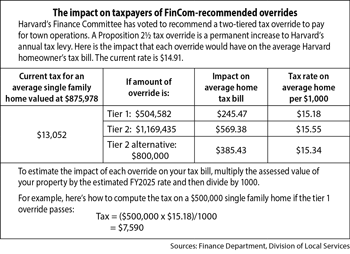
A vote would likely have been unanimous for a tax override that guaranteed departments could deliver the same level of service to residents next year as they deliver today. “The bare minimum,” as FinCom Chair Eric Ward described it. That amount is approximately $504,562, according to Finance Director Jared Mullane, though that number could go up or down, he said.
Select Board members, however, balked at the size of FinCom’s second tier, the estimated $779,853 tax increase that would be needed to pay for all of the requests made by department heads in their fiscal 2025 budget requests. The bulk of that money would be used to hire nine full- or part-time employees with benefits, including two assistant principals for the schools, an additional police officer, a beach director, a grant writer, and an administrative assistant for the Department of Public Works.
In arguing for a second tier, Ward said his committee had carefully vetted every request and that, in its view, none on the list was fluff. “We don’t always want to be doing the bare minimum; we want some opportunity for growth,” he said. “We want the town to do more sometimes and not just always be cutting and scrimping and looking for the least we can do. It’s hard to look at these [requests] and say these aren’t important.”
Summarizing the sentiment of his colleagues, Select Board Chair Rich Maiore said he preferred a more incremental approach, one that would support some but not all requests this year. He suggested $300,000 as a target for the second tier and asked FinCom to meet with town and school administrators to choose which positions to include.
If voters approve both Tier 1 and the $300,000 alternate Tier 2 at Town Meeting and Town Election in April, the tax levy would increase by approximately $800,000.
The problem
According to Finance Director Mullane’s latest forecast, expenses for the coming fiscal year, which begins July 1, will exceed expected revenues by approximately $1.2 million, a deficit that requires severe cuts to next year’s spending, more money from taxpayers, or both. State law requires a municipal budget to balance.
Department heads say the cuts required to balance the fiscal 2025 budget without additional taxpayer dollars would be severe, forcing layoffs, reduced access to the library and Council on Aging services, understaffed police shifts, deferred maintenance of municipal buildings, larger class sizes in the elementary school, and more.
Last week the Finance Committee recommended that taxpayers be asked to make up some or all of the difference with additional real estate taxes. Rather than cut department budgets, FinCom has recommended that a two-tiered tax override be put to the voters this year.
Depending on their fiscal appetite, voters can choose the first tier, but decide not to support the second. A vote for the second tier implies a vote for the first. If neither tier is approved, town departments and the schools will be forced to remove $800,000 from their budgets, assuming the Select Board agrees to set tier 2 at $300,000. (For an estimate of the impact of each override, see table at right.)
Each tier requires a Proposition 2½ override, allowing the town to increase the tax levy on real estate and personal property above the limit set by state law: a 2.5% increase over the previous year’s levy plus the assessed value of new construction. A majority of voters must approve an override first at Town Meeting and then again at the ballot box. Once enacted, an override becomes permanent, the increase embedded in the base amount the town may increase each year. A revised forecast presented by Mullane Tuesday night shows that passage of an override this year lowers the deficit that Harvard will face in future years.
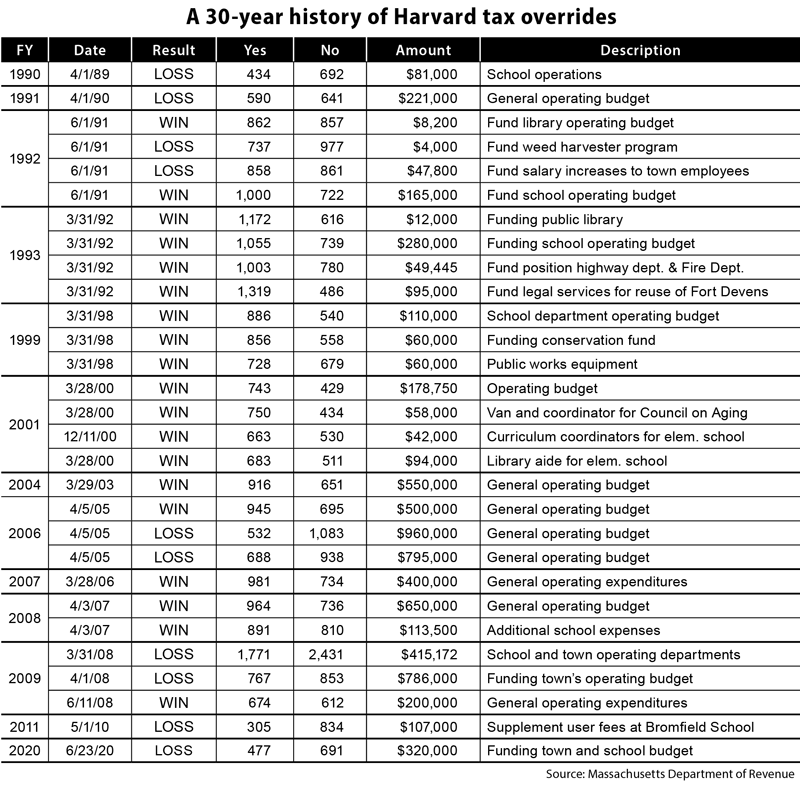
Harvard voters have rejected the last two requests for an override, the first a request by the schools in 2011 for $107,000, and the second by the Select Board in 2020 for $320,000. The last successful override was in 2008 when voters approved a $200,000 increase in the levy. (See table below.)
Tight management of the town’s finances has enabled the town to make do with an annual 2½% increase in the levy plus revenue from new construction, local fees, excise and sales taxes, and state aid. But this year town officials say the growth in the cost of benefits, insurance, wages, and supplies has outpaced growth in revenue and made that amount of growth insufficient.
The Select Board must decide whether to ask for an override by Feb. 23 and is scheduled to meet Feb. 20 to make its final budget recommendation. FinCom is scheduled to meet Tuesday, Feb. 13, but a Press request for when a revised budget would be available was unanswered at press time.