The title of Harvard resident Bob Feldman’s newly released novel, “Deception Downeast,” is written in foreboding red letters on a black background, looming over a fog-shrouded lobster boat. And its billing as “an epic struggle,” a “suspenseful thriller,” a “tale of deceit and blackmail,” left me somewhat disconcerted when I found myself—within a few pages—laughing out loud. So it was a relief when, in meeting with Feldman and confessing my reaction to the book, he assured me that’s what he had hoped. He said he couldn’t help the comic edge. “That’s who I am. I think I’m incapable of writing without being funny.” He admitted that, much to his father’s chagrin, he had wanted to be a stand-up comic.

Bob Feldman. (Courtesy photo)
Dissuaded from that career, Feldman brought his creativity and humor to his profession as a technology executive and startup mentor, where he did a lot of writing, as well as directing and producing. Although he wasn’t always thinking of writing a novel, books were very important in his house growing up; his father, to whom he dedicated this book, was always reading. Feldman said the idea for a novel began floating around in his head about 10 years ago, and finally the time came when he could put other things aside to write.
In defiance of what one might think is a more typical approach to fiction writing, Feldman started to write with no plan at all. “I didn’t have an arc, or a map of the plot,” he said. What he did have were a setting and a cast of characters, both based in his own experience.
With a home on the coast of Maine, Feldman has known many small coastal towns like the Eggemogin of the novel. And some of the most memorable parts of the book are the descriptions of the beauty of these unspoiled coves and inlets on the ocean, the scattering of islands, and picturesque harbors.
He also knows the culture of these towns and is fascinated with their mix of people and homes. There’s a Martha Stewart kind of person alongside a lobsterman who comes from generations of fishermen, retired professionals next to tradesmen. “And they’re all mixed together in this egalitarian kind of way.” He said Maine is “unique in the best possible way.” There’s a “dynamic that functions on different waves,” a coastal beauty that is often breathtaking and also a very practical way of life. With native families at the base, topped with people “from away,” It’s “a layer cake of culture.”
So what if? Feldman wondered what would happen if you threw a game-changing situation into this mix of people. How would this dynamic play out? That situation becomes a proposed gas pipeline and shipping terminal going right through the heart of Eggemogin. This becomes the plot—a greedy, unethical corporation tries to bribe, blackmail, or physically force its way on the townspeople to achieve its goal.
Characters take charge
But the book is unlike a typical “thriller” because it is not the plot but the characters that drive the book. The storyline flowed out when the characters appeared. “These people came out of my head and told me what was happening.”
He said he had started the book with two characters he thought would be the protagonists. One was “Father” John Murphy, an ex-Marine who is constantly quoting from the saints. Feldman said Father grew, in part, out of his childhood. Living in an Irish and Italian neighborhood, he often got rides from his friends’ moms, and he was fascinated by the way they blessed themselves going by a church or sprinkled any conversation with “Saints preserve us.” Father’s friend, Jack, now a professional photographer, is plagued by a missing wife and nightmares of his military service. “And then Sam came out of nowhere and took over;” he and his wife Marilyn becoming the central characters.
The characters are composites of people Feldman has met. “Some less ‘composite’ than others,” he said with a grin. There’s Marilyn Wicker, related to half the town, and an important wheel in the vast local gossip machine. Her mood swings have her ranting, in hyperbolic detail, a saga of worst-case scenarios. There are the Bird Nerds with their chin-strap hats and ever at-the-ready binoculars; the MIT alums, still in competition for staging the most ingenious prank; the fishermen twins, whose conversation is limited to “Yuh”; the chef and sommelier who exists to decant expensive wine and serve the perfect dish. There’s Louise, with her detritus of Marlboros and her mug of coffee brandy, wrapped in a knitted afghan, sitting on her Barcalounger watching TV, with Buttercup, the 100-pound Rottweiler, snoring close by. All these—and so many more— come close to being over-the-top stereotypes, but they remain real people because of their backstories and because of something uniquely endearing about each of them.
All these characters are caught up in mounting tensions.The pipeline is a very real threat to their way of living, and we are reminded of it by scenes in the corporate boardroom where insidious forces are plotting, sending their minions to infiltrate the community. We watch Sam become increasingly squeezed by the Faustian bargain he has made with those people. There is mounting disagreement between different factions in the town and increasing violence. Some cling to the “homespun ethics of the fading world they still represented.”
The writing process
The book is broken into short chapters, each a complete episode in the life of one of the characters. We see Marilyn and Sam planning a real estate deal, then in the next chapter Marvin, the computer genius, and his staff gathering information, then a stealthy revenge attack by the twins, then the Bird Nerds sighting an extinct bird and then, chapters later, back to a new problem for Sam and Marilyn. In this way the book is very fast-paced. It’s complicated but not confusing—and it’s impossible not to keep reading.
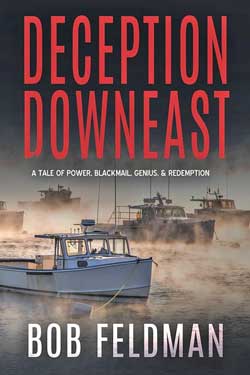
It is hard to believe Feldman didn’t need a giant map or spreadsheet to keep track of it all, including the clues deftly planted throughout. But he didn’t. Nothing was predetermined, said Feldman, including how Sam would get out of his impossible situation.”The complexity is a mystery to me and how it all worked out. It just emerged as I went.”
In addition to his own experience providing the setting and the basis for the characters, Feldman’s own knowledge and business connections gave him many details for the book. The extinct bird that has the Bird Nerds agog was inspired by a feat of mechatronics—a corn-harvesting robot that Feldman was involved in launching. The search engines and databases used to find the identity of the villain are all real technologies with which he is familiar.
Feldman has keen powers of observation, and even his minor characters are perfectly captured through detail and imagery. “Elderly Mrs. Phillips leaned forward, all ten fingertips perched on top of her purse.” Joan, the secretary, slipped through the slightly open door “like a letter going into an envelope.” Linda the journalist with the “reflexive smile young women give older, harmless men.” The professor who laments the lack of a Nobel Prize for ornithology, and the town meeting blowhards.
Feldman spent 18 intensive months on the book, bringing to it a focus and discipline he said he has not brought to any previous project. “Once I sat down and touched the keyboard, I could not be interrupted. It was amazing.” Nothing would please him more than to have people reading “Deception Downeast” and laughing out loud.
The book is available from Amazon in hardcover, paperback, and on Kindle.