Finance Committee and Select Board members had few good options this week as they began to deliberate how to balance a severely unbalanced budget for the coming fiscal year.
The dollars that town departments and the schools have requested for fiscal 2025, which begins July 1, exceed next year’s projected revenues by nearly $1.5 million, the largest deficit in anyone’s memory. FinCom must find a way to balance the budget at its next meeting on Jan. 30 and deliver its recommendations to the Select Board by Feb. 6.
But the committee has a limited number of financial tools available as it considers a range of solutions. Members could vote to cut town and school budgets until they match the available dollars, staying within the bounds of Proposition 2½ and drawing on other sources of money as they have done done before. Or they can ask voters to approve a tax override, an increase in property taxes beyond the 2.5% limit the 1980 law allows. The most likely outcome? A combination of the two.
A tax override allows a town to increase the tax levy on real estate and personal property above the limit set by state law—a 2.5% increase over the previous year’s levy plus the assessed value of new construction. A majority of voters must approve an override at Town Meeting and then again at the ballot box. Once enacted, an override becomes permanent, the increase embedded in the base amount the town may increase each year.
“Most of the conversation today has been about what kind of override, not whether or not we need one,” said FinCom Chair Eric Ward this week. “We’ve fought it for a number of years and have gotten extremely lean in the process. We’ve asked people to make cuts multiple times and to stay with level-service or level-funding, but it’s not practical for where we are.”
The Select Board must decide whether to request an override by Feb. 23, the last day the board can add the question to this year’s ballot for the April 8 Town Election.
In back-to-back meetings of FinCom and the Select Board Tuesday, Jan. 23, the two boards seemed resigned to an override. The reductions that are necessary to stay within the bounds of next fiscal year’s revenue would cut deeply into town and school operations. In a memo released Tuesday afternoon, Town Administrator Tim Bragan and Assistant Town Administrator Marie Sobalvarro wrote that they didn’t believe the reductions would be acceptable to the town. “The only alternative for funding the [fiscal 2025] budget without impacts to existing service and safety, is an operational override,” they advised.
Later, at the Select Board meeting that night, School Committee Chair Abby Besse stated that achieving a level-funded budget would require cutting nine teachers from the Hildreth Elementary and Bromfield School staff. No matter how you look at it, she said, a reduction of the school budget of the magnitude required to level-fund its operations “will lead to significant and negative impacts for our students.”
Level-service versus level-funded
Balancing Harvard’s budget has grown increasingly difficult in recent years as costs over which the town has little control have eaten into available revenue. Harvard’s finance director, Jared Mullane, estimates that Harvard’s tax revenues will increase by $717,549 in fiscal 2025, but dramatic rises in the cost of employee benefits and insurance will consume $377,000 (53%) of that amount. That leaves $340,290 (46%) to be divided between town and schools. Current FinCom policy allocates 66% of available revenue to the schools and the remaining 34% to the town. Neither amount is sufficient to maintain level services, which Mullane told the Select Board Tuesday would require an additional $200,000 for the town and $600,000 for the schools.
In the absence of additional dollars, budget cuts are the only means for balancing income and expenses. In their July fiscal 2025 budget memo, the Select Board and Finance Committee asked department heads and committee chairs to prepare two budgets for the coming year: a level-service budget sufficient to allow the organization to operate at fiscal 2024 levels in fiscal 2025, and a level-funded budget restricted to the same dollar amount as fiscal 2024. Both level-service and level-funded budgets must include cost-of-living increases for employees and the higher cost of materials and services due to last year’s rate of inflation, which at times exceeded 8%.
Maintaining level service
What’s to be done? For starters, the latest budget forecast, with its projected $1.5 million deficit, is not the level-service budget the boards requested. In their July memo, the Select Board and FinCom invited budgeters to submit a prioritized list of “top additional spending opportunities,” with an explanation of how such additional spending would create value for the town. The current budget includes many such requests.
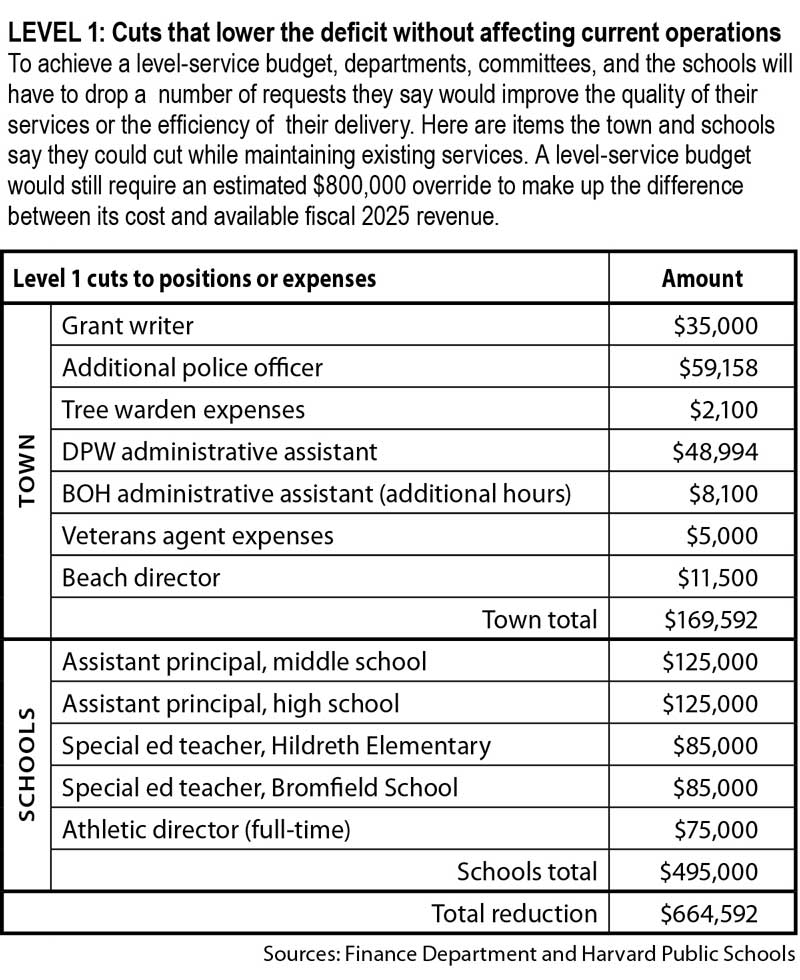
Stripping those add-on expenditures from next year’s budgets immediately lowers fiscal 2025 expenditures by $169,852 for the town and $495,000 for the schools. (For details, see “Level 1: Cuts that lower the FY2025 deficit without affecting current operations” below.) But while those reductions cut the deficit by more than half, they are not sufficient. According to figures published by Mullane last week, a level-service budget for fiscal 2025 would require almost $800,000 more than the amount of revenue anticipated for fiscal 2025.
That number is a forecast, an educated guess. Perhaps state aid will be higher than expected and state assessments lower. Perhaps local receipts from excise taxes and fees will grow and not remain flat as forecast. As this edition of the paper was being prepared, town officials were awaiting the details of Gov. Maura Healey’s fiscal 2025 budget request, which was due to the Legislature by Wednesday, Jan. 24.
Cutting to the bone
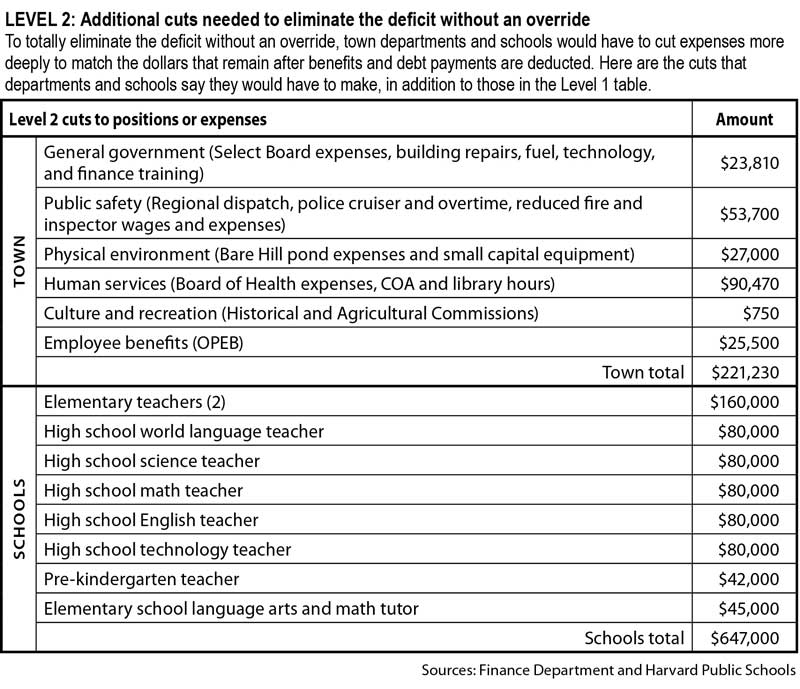
What would be the impact of cutting budgets to match available revenue? FinCom and the Select Board got some answers in a Jan. 12 memo from the school superintendent, Linda Dwight, and assistant superintendent, Ingrid Nilsson, and in the Tuesday memo from Bragan and Sobalvarrro. The memos listed cuts the town and schools would recommend if voters rejected an override. In a word, both town and the schools would likely be forced to cut personnel as well as service hours. (See “Level 2: Additional cuts needed to eliminate the deficit without an override” below.) “These cuts are not acceptable to the administration or staff, and they are not without impact to the taxpayer,” wrote Bragan and Sobalvarro.
Dwight and Nilsson wrote that school cuts would lead to the removal of almost all electives at the Bromfield School and larger class sizes at Hildreth Elementary School. “We are also concerned that this preliminary information will negatively impact the retention of quality staff and create an uncertain school culture. We have agreed to balance these difficulties with the request from the Finance Committee and the need for the community to understand the importance of fully funding the school system.” In an email to the Press, Dwight confirmed that the proposed level-funded cuts have been shared with school staff and teachers.
To override or not?
Harvard voters passed 19 of 25 overrides requested in the years from 1989 to 2008, according to records kept by the Department of Revenue. The last successful override was in 2008, when residents voted, 674-612, to raise an additional $200,000 to balance that year’s budget.
The Select Board has requested overrides twice since 2010, both of which failed. In 2010, the schools asked taxpayers to shoulder an additional $107,000 to supplement the fees students must pay to take part in school athletics and other activities. The measure was defeated 834 to 305 at the polls.
In 2020, at the height of the pandemic, the Select Board asked voters to approve a $320,000 override to defray a deficit in the fiscal 2021 budget. But while the request passed at Town Meeting, it failed at the ballot box by a vote of 691 to 477. The Select Board had to cut money from town and school requests and return with a balanced budget to a special town meeting in October 2021.
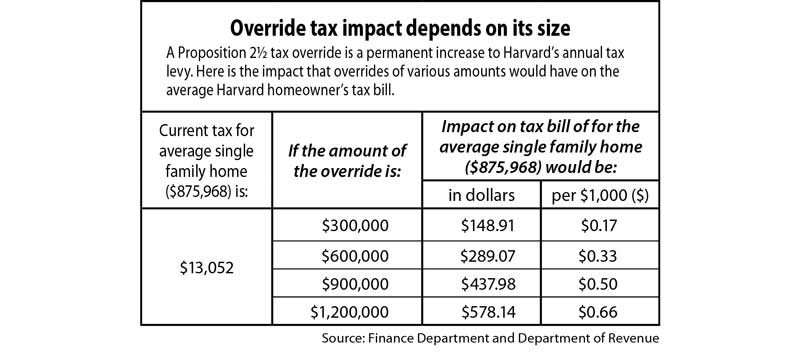
The impact of an override on taxpayers depends on the size of the request. A $900,000 override would increase the tax bill of an average single-family home in Harvard with an assessed value of $875,968 by $437.98 in its first year. The increase would be permanent. For estimates of the impact of higher and lower override amounts, see table above.
As noted earlier in this report, the Select Board must decide whether to press for an override by Feb. 23. FinCom plans to vote its recommendation at its next meeting Tuesday, Jan. 30, at 2 p.m. The committee will present its recommendations to the Select Board Feb. 6.