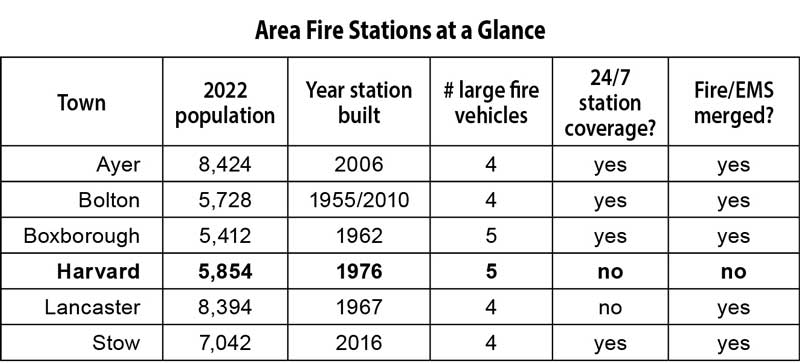
Over the past few weeks, the Press toured the Harvard Fire Station and fire stations in five neighboring towns—Ayer, Bolton, Boxborough, Lancaster, and Stow. Two of those stations, in Boxborough and Lancaster, were built in the same era as Harvard’s and share the Harvard station’s major shortcomings—safety issues and size. Bolton’s station is a mix of old and new, but even the new section lacks enough storage and living space. The newer facilities, in Ayer and Stow, show what an up-to-date fire station provides for its staff and volunteers and the town they serve.

The Boxborough fire station is so tight that vehicles are backed in and have only 10 inches between them. (Photos by Lisa Aciukewicz)
The goal of the tours was to compare the facilities in surrounding towns with a population size about the same as Harvard’s as town officials consider the need for a new fire station. Tours focused on space, both in the apparatus bay and the living and administration areas, safety features, and station staffing.
Space to store apparatus
Four of the stations visited have apparatus bays built before 1980. The oldest is Bolton’s, built in 1955. None of those bays has enough space to house all the vehicles that towns typically own these days. Many of the vehicles had to be custom ordered because standard-size engines were too long to fit, and that cost towns more money.
Some towns have no choice but to store vehicles outside the station. One of Bolton’s tankers and its forestry truck are kept outside. Bolton Fire Chief Jeff Legendre told the Press that when the new part of the station was built in 2010, the 1955 apparatus bay remained as is, with no extra space for vehicles. He said the original construction plan was to have three phases; the third included an additional apparatus bay. The second two phases never materialized. The department was using the old station next door for vehicle storage, but that building was condemned a few years ago. He said he is in preliminary talks with the town to replace the condemned station with a storage building that would hold a few vehicles.

Below: The crowding in the Boxborough Fire Department has resulted in storing items between vehicles.
Lancaster uses an old fire station building to house two of its engines, but its forestry truck is parked outside. Lancaster firefighter Tom Fitzgerald told the Press the truck must be winterized in late fall, and it’s not put back into service until the spring. The town’s rescue boat is stored behind the station in a box similar to a shipping container. Boxborough has two utility vehicles outside. Harvard keeps one of its engines in the Still River Fire Station, and a utility vehicle used to tow the rescue boat is stored in the vault building next to Town Hall. The boat itself is in the Quonset hut behind the station.
Because the bays are so small in the older stations, the vehicles are typically crowded into them. That was most evident in the Boxborough station, where space between engines parked one in front of the other is less than a foot in most cases. Interim Fire Chief Shawn Grey told the Press, “Everyone walks through sideways.” To make matters worse, storage in the station is so limited that a lot of the department’s equipment is stored between the apparatus, and firefighting gear hangs right next to the trucks. Lancaster’s bays are also very tight. One of the engines is only about 6 inches from the garage door in front of it, and about 18 inches from the wall behind it. The town has a ladder truck on order, but it had to be custom-built to fit the garage.
Harvard’s apparatus bay is currently full. As in Boxborough, some firefighting gear is less than 3 feet from an engine, leaving little space for firefighters to maneuver around each other while changing to go out on a call. The old tower truck is parked in front of one of the pumpers, and the new tower truck, which will soon be arriving, is 9 feet longer than the old one, too long to fit. However, the new tower truck has a built-in pumper, so the town will be selling one of its engines, and that will make room for the new forestry truck, which will fit behind the tower truck in the main station.
By comparison, the apparatus bays in the Ayer and Stow fire stations, both less than 20 years old, are spacious and easily hold all the department’s vehicles, with plenty of space between the engines for quick and easy access. And, since there are separate gear rooms and other storage rooms in those stations, the bay floors are uncluttered.
Safety
Harvard Fire Chief Rick Sicard told the Press one of his primary reasons for requesting a new fire station is the protection of his firefighters. According to the International Association of Fire Fighters, toxic chemicals can be brought back into the station on gear; and diesel engine exhaust, considered a carcinogen, can settle on gear stored in apparatus bays. They recommend dividing stations into three zones: hot (contaminated equipment), warm (cleaned equipment), and cold (living quarters and administration areas). Ideally, stations should have a separate space for washing and drying contaminated gear and showering after returning from a call. Clean gear would be stored in a room in the warm zone, and firefighters would not enter the living and office spaces in the station before decontaminating.
The newer stations the Press visited, Ayer, Bolton, and Stow, have the recommended zones, but none of the older stations has a warm zone. Firefighting gear, as well as the washer and dryer are in the apparatus bay, the hot zone, in all the older stations. Gear is removed and decontaminated in the hot zone and stored there. In addition, the only showers in the older stations are in the living area, so firefighters must enter that space to decontaminate themselves, bringing any toxic chemicals they may have been exposed to into the cold zone.
Living space
Ayer, Stow, Bolton, and Boxborough have 24/7 coverage by at least two people per shift. That requires a place to sleep, eat, and relax. The size, usability, and comfort in those spaces varied widely among those four stations. In Boxborough, the main bunk room has three beds separated by partial walls. Sheets are hung from the ceiling and attached with binder clips to provide more privacy between two of the beds, and storage bins sit next to, behind, and on one of the beds.
“Day rooms,” spaces where firefighters can spend time between calls, were as sparse as a small room with a few desks and chairs and as luxurious as a large room with multiple recliners and a large-screen TV. Bolton’s living area is small, even though it’s in the newer part of the facility. Chief Legendre told the Press it’s big enough for two people, but it “gets pretty cozy” with four or five. He said additional living and office space was planned for phase two of construction, but like the additional apparatus bay planned for phase three, it was never built. The station began 24/7 coverage about a year ago, and while there is a plan to convert the EMS director’s office to a multigender bunk room, Legendre currently has a bunk in his office as well as the bed for the station’s comfort dog.
Harvard has no day room, but it is currently staffed only during the day on weekdays. Still, it serves as an emergency operations center, and firefighters spend the night there during emergencies. The only common area is the training room, which also doubles as Lt. Andrew Perry’s office. Sicard joked that having Perry’s desk in the middle of that room “forces him to keep it neat.” The kitchen is small with no dining table. Sicard said when multiple firefighters have a meal there, they bring out folding tables and chairs. The station has a bunk room, although the three bunks in it share space with Department of Public Works equipment and backup radios. There are also no lockers. During the Press’ tour, Sicard pointed to the duffle bag in his office and said, “That’s my locker.”
While Lancaster’s fire station looks very similar to Harvard’s, the living and office space in the rear of the building spans two floors. That allows for a day room and small locker room on the first floor as well as a large kitchen and dining table upstairs, adjacent to the training room. But the only bunks are in a small storage room upstairs. And, “The building is not in good shape,” firefighter Fitzgerald told the Press. He said he sees a lot of things that need to be fixed, but there’s no money to fix them. “We’re putting Band-Aids on bullet wounds,” he said.
Storage is a major problem in the older stations. Bunk rooms and offices double as places to stash bins, boxes, and piles of papers. “We’re bursting at the seams,” Fitzgerald told the Press. At the Boxborough station, Interim Fire Chief Shawn Grey said some of the storage space is in the eaves, where it can only be accessed by ladder. The weight room has extra firefighting gear and equipment sitting on the floor. “We’re beyond max,” he said. In Harvard, Sicard’s office is packed with files and boxes of equipment he’s buying for the new tower and forestry trucks. Even a portion of the shower stall is being used as a storage area.

A new recommendation suggests gear be stored away from the vehicles, but ideally in a room right off the garage area. Towns with volunteer firefighters need larger gear rooms like this one in Stow to accommodate larger rosters.
The newer stations are clearly more livable than the older ones. In Lancaster, the gym consists of a few pieces of equipment against the back wall of the room used for meetings and training. By contrast, a large gym in the Ayer station overlooks the apparatus bay. Ayer and Stow have large kitchens and dining areas, and firefighters were gathered in those spaces on the days the Press visited. Stow also has an outdoor patio (with a grill) that overlooks a large expanse of undeveloped land behind the station. Both stations also have plenty of office space; large, well-equipped training rooms; and spaces for small meetings. Ayer has a three-story training tower attached to the station, and Fire Chief Tim Johnston said his firefighters typically train twice a month, so the tower gets a lot of use. It is also available for other towns to use.
Full-time coverage
Harvard has the least coverage at the fire station—three full-time employees working 8 a.m. to 4:30 p.m. on weekdays only. After that, coverage reverts to the 25 on-call firefighters. Lancaster has four people in the station in the daytime, and two in the evening until 9 p.m. Boxborough and Bolton have at least two people at the station 24 hours a day, seven days a week. Ayer has at least four people in the station 24 hours a day, every day. Chief Johnston said there are typically about seven people there in the daytime.
Because Harvard’s Fire Department is trying hard to keep the on-call model working, Chief Sicard said he doesn’t anticipate needing 24/7 coverage in the next five years. But he wants the new building to be able to accommodate full-time staff. He said fire calls of every type are up statewide. In 2022 Harvard’s firefighters responded to 357 calls; in 2023 it was 500.
Sicard told the Press the department is “very blessed” to have so many dedicated on-call firefighters. He said he was recently at a fire chief luncheon when a call came into Harvard dispatch requesting a horse rescue. He said within minutes, there were eight people responding to the call. When he mentioned it to the other chiefs, they were surprised. One said his town had eight full-time firefighters, and half of them probably wouldn’t have responded to a call like that.
One thing that has been in the new fire station plan from the beginning is space for the town’s ambulance, currently housed at the Public Safety Building on Ayer Road. All five stations that the Press visited were combined fire and EMS stations. Most had one ambulance, some had two. The additional office and storage space for the EMS department was only a small part of each station. The full-time firefighters who staffed the stations were all either EMTs or paramedics as well. The night shift, if there was one, tended to be staffed by EMTs, since those are the calls most likely to come in at night according to several of the chiefs the Press talked to. Both Sicard and Ambulance Co-Director Jason Cotting would like to see Harvard’s fire and ambulance service departments merged, and a new building would have the benefit of shared living, training, and meeting spaces.
Plans for the future
The Harvard, Boxborough, and Lancaster fire departments are all asking for new stations. Boxborough is the closest to achieving that goal. Interim Chief Grey told the Press his department is hoping for a funding article on the warrant for Boxborough’s spring Town Meeting. He said the existing site has wetlands behind it, so the station can’t be expanded. The town has narrowed the location choices down to three; two on Mass. Ave., and one on Stow Road just off Mass. Ave. The new station would have five full-length bays (100 feet as opposed to the 52-foot bays the station currently has), as well as proper living quarters and more storage.
Lancaster’s fire department will have a much longer wait. Firefighter Fitzgerald told the Press that the chief asked for a study to add on to both the fire station and the public safety building next to it. But Stow, Bolton, and Lancaster, the three towns that make up the Nashoba Regional School District, just voted to fund a new high school. And while the Massachusetts School Building Authority will contribute $65 million of the $242 million price tag, taxpayers in those three towns will be responsible for the remaining $177 million. Because of that, Fitzgerald said, town administration told the chief no capital would be available for a new fire station for the next 10 years.
The Harvard Fire Department’s request for a new station is currently mired in confusion over whether a new location is needed, and if it is, how land could be purchased in advance of a town vote to fund a new station. Town-owned land around the current location would require blasting through ledge, which would be costly. A new location would have to be close to the center of town, large enough for the new facility and firefighter parking, and situated so that large engines could easily enter and exit the station. The Capital Planning and Investment Committee rejected the department’s request to fund land acquisition and a schematic design for a new station in fiscal 2025. Sicard was hoping to secure design money this year because of a bill currently in the state Legislature that would provide state funding for a large part of new fire station construction projects. If the bill passes, shovel-ready projects would be funded first. The committee said it would consider putting a funding article on the fall Town Meeting warrant should the bill pass. A new fire station is currently on the capital plan for fiscal 2028, when several existing debt exclusions are scheduled to be paid off.
Advice from other towns
The Press asked the firefighters and chiefs at the various fire stations it visited for advice regarding building a new station. All said there cannot be too much storage space and that towns should build for the future. Boxborough’s Interim Chief Grey recommended not waiting to build, because every year a town waits will add expense since safety requirements are constantly changing. As an example, he mentioned that saunas to sweat out chemicals are currently optional, but they could become a requirement in the future. Stow firefighter Rachel Vroegindewey said she would encourage the town to interview chiefs at stations that were recently built or renovated and ask what went well, what didn’t, and what they would do differently. Chief Johnston said he’s happy with pretty much everything about the Ayer station. But, he said, he would have liked to have had a fire pole, something the town had to cut when it ran short of funds, and, “there’s no place to put the snow.”
Finally, the Press could not help but notice how different it felt to be at the older stations versus the newer ones. Light, bright, spacious, well-appointed stations were comfortable places to be, and firefighters in those stations were spending time together in the common areas. The older stations were the opposite—dilapidated and uninviting, with no one in the common areas. The chiefs at the newer stations were proud to show off their facility, while those at the older stations were focused on the many shortcomings. Vroegindewey said the new Stow fire station has been a huge morale boost. Firefighters felt more valued when the town invested in the station. “I can’t tell you how happy people were to move over here,” she said.