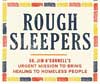
As part of its outreach, Arm in Arm, established in 2016, sponsored a number of townwide book reads and discussions in Volunteers Hall and continued the program over Zoom during one of the pandemic years. The book events were part of the group’s dedication to furthering cultural education and broadening perspectives as it pursues its stated goal “to uphold a safe, inclusive social climate that values diversity and fosters respect for one another.”

The book read and discussion is returning as an in-person event Thursday, Nov. 2, at 7 p.m. at the library. Participants are asked to bring a dessert to share. “Rough Sleepers,” by best-selling and award-winning author Tracy Kidder, is the story of one man’s three-decade commitment to caring for people living on the streets of Boston and of the medical organization he, friends, and colleagues built: “the country’s largest medical system wholly devoted to the care of homeless people.” On and off for five years, starting in 2014, Kidder spent time with Dr. Jim O’Connell as he saw patients in the clinic at Massachusetts General Hospital, in shelters and the McInnis House respite facility, and on the streets at night as he rode in an outreach van, finding people in distress, dispensing blankets, socks, food, and medicine.
Mary Jane Ellison, the event’s organizer, said she will prepare questions to spark discussion of people’s responses to the book and perhaps personal experiences and ideas for action. Harvard resident Hugh Silk, who practices family medicine in Worcester, will talk and answer questions about his work with homelessness and with mental health and addiction care.
“Rough Sleepers” is both depressing and uplifting as it exposes the deep, abiding societal flaws that fail to help the most destitute of people but also shows the unselfish love that O’Connell and others have for those they are trying to help. The efforts often seem futile as resources are limited and so many people choose to remain on the streets instead of accepting shelter. O’Connell likens his work to the efforts of Sisyphus, ceaselessly rolling the boulder up a hill only to have it fall back down. The work in itself is important and rewarding, even with the awareness that it probably won’t have lasting effect. As a mentor told O’Connell, “It’s the right thing to do even if the outcome is out of your hands.”
Keys to success
Kidder shows that O’Connell’s success in treating homeless people lies in his atypical approach to patient care. He meets a patient with no judgment and listens for however long they want to talk. He offers help, but there is no pressure for anyone to accept that help. In the first month of his work in the 1980s, the nurses at the shelter told him to put away his stethoscope and do nothing but soak people’s feet, call them by their name, and listen. It seemed wrong to him as a doctor, when someone clearly had multiple problems, physical and mental, but it turned out to be the best possible advice. He had to get to the patient’s level and offer relief, not a cure, before he could do anything else. “Medicine is not supposed to be efficient,” he said.
In 1985 O’Connell had just completed his residency at Mass General, having graduated from Harvard Medical School after almost a decade of trying different jobs, teaching and bartending among them. He was looking forward to a fellowship at New York’s Sloan Kettering Hospital when Mass General’s chief of staff recruited him to be the doctor for a special project. Because of rising homelessness, a foundation had been established to award grants to cities for Health Care for the Homeless programs. O’Connell had no idea what he was getting into, but he deferred the fellowship, and after a year in the program, he deferred it again.The next year he withdrew from it completely. He felt he was making a difference, especially to the “rough sleepers,” the small population of homeless people who, year-round, refuse housing at night and sleep in doorways, on benches, in subways, or in cardboard boxes under display windows of Brooks Brothers on Newbury Street. His regulars looked for the van he drove three times a week and would usually take his suggestion to show up at the Thursday street clinic at the hospital. “I was drafted into this job. I didn’t pick it, but I lucked into the best job I can imagine,” he told Kidder.
O’Connell emphasizes that the key to the success of the program is the continuity of health care it provides. Each patient has a team of doctors who know them, regular access to a clinic and to a hospital and recovery facility. But over time problems were myriad. Funding was a problem as the grants ran out and the program relied on Medicaid. Housing was scarce and the qualifications for it precluded anyone with a criminal record, no matter how minor the charge or length of years past. Even when more housing became available, there were not the support systems to go with it. Someone might be placed in a room isolated from everyone they knew, and this was sometimes a death sentence.
Real human beings
O’Connell never probed patients for their life stories. He didn’t really want to know what they had done earlier so that he could meet them where they were. But stories leaked out. About 90% of homeless people have been afflicted by substance abuse or mental illness, or both. Sometimes by the time they get help, they have late-stage cancer, rotted teeth, or an infected wound that is disabling. At least 75% suffered from physical or psychological effects of severe childhood trauma.
The rough sleepers, and others who panhandled during the day but entered a shelter at night, formed love-hate relations. Some were like family to one another and protected the ones among them who were the least able. But there were also fights, robberies from one another, and sexual assaults.
It is through Kidder’s vivid characterizations of so many of O’Connell’s patients and his interactions with them that the abstract concept of homelessness is made real. The patients are human beings, in all their complexities. Kidder’s close observations of O’Connell make it clear what an unusual man the doctor is. His unselfishness with his time and own resources, his acceptance of the worst his patients may have done, his willingness to see each for the best version of themselves and to listen to their stories—all are inspiring to the patients and to the reader. When O’Connell despaired of not doing enough, he remembered words of his mentor: “You just need to be there and be present and, if need be, stand with them in the darkness.”
The book shows that the causes of homelessness, which “consigns people to appalling miseries and kills them before their time,” are rooted in society’s weaknesses, and the solutions are like Sisyphus’ boulder. But the work of O’Connell and his colleagues goes on: “This is what we do while we’re waiting for the world to change.”
To join in
To participate, register at tinyurl.com/4jarrw2p. Copies of “Rough Sleepers” and O’Connell’s “Stories From the Darkness” are available at the library.