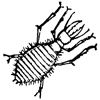
Antlion—the very name conjures up visions of an improbable combination of two distinctly different creatures. In fact, the name is derived from the ferocious (lion-like) nature of a predaceous larva that consumes ants.
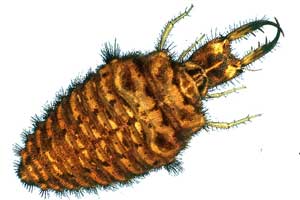
Antlions are motley-looking insects that are gray or brown, have an oversized head, spiny jaws, short legs, and a soft body covered in bristles. (Courtesy photo)
A member of the insect family Myrmeleontidae, the antlion matures into an adult winged insect that closely resembles dragonflies and damselflies but has longer clubbed antennae and a different pattern of veins on its wings. Only the larval stage is referred to as an antlion; its mission is to consume enough food to metamorphose into an adult. While the adult may eat small flies (or pollen and nectar), its month-long life is consumed more with reproduction than feeding.
Aptly named
Antlions are known for the manner in which they capture their prey. They look for a sandy spot, meandering here and there, creating trails and designs in the sand, for which they are nicknamed “doodlebugs.” Once soft sand is located, the larva excavates a pit about 2 inches deep and 3 inches wide at the edges. It goes about this by first making a circular groove in the sand. The antlion larva then starts to crawl backwards, using its abdomen as a plow to shovel up the soil. With one of its front legs, it places a pile of loosened particles on its flat head, and then with a jerk of its head, it throws the pile up and outside of the circle it made. This head-jerking reflex occurs over and over as the larva gradually shovels its way towards the center and deepest part of the pit. After a headful of sand has been flicked out of the pit, the remaining sand then settles at the critical angle of repose—the steepest angle the sand can maintain without collapsing in on itself. At this point, the slightest disturbance will cause the sand to collapse.
It takes an antlion about 15 minutes to excavate a pit, after which it hides at the bottom, with only its pincer-like mandibles exposed, ready to grab unsuspecting prey. When an ant or other small insect or spider accidentally falls into the pit, its weight causes the sand to collapse below it, drawing the victim toward the center where the antlion is lying in wait under a thin layer of loose sand. Climbing back up to the top of the pit is practically impossible, but if the ant attempts to do so, the antlion, with quick jerking movements of its head, showers it with sand. This sand either hits the ant, which then falls down into the pit, or causes the loose, sandy slopes of the pit to collapse, carrying the ant down with them.
Far from ordinary
Once the ant is in the grip of the antlion’s mandibles, the antlion quickly injects venom and digestive fluids into it, through a groove that runs the length of each mandible. The gastric juices digest the softs parts of the ant (inside its exoskeleton) within a few hours. The dissolved nutrients are sucked up through these same grooves, after which the antlion hurls the indigestible ant carcass out of the pit. With a few more head tosses of the loose sand that has accumulated at the bottom of the pit, the antlion is back in business.
From its manner of catching prey to its anatomy (and its copulation process), there is nothing ordinary about antlions. The antlion’s digestive system is unusual, to say the least. For one thing, it has no mouth opening. Secondly, while antlions excrete some fluids, their digestive tract lacks an external opening for solid waste. Feces accumulate within its body for the entire larval stage, which can be as much as three years. Some of the waste is processed into silk for making a pupal case, and the remainder is voided by the adult when it emerges from the case. Because digestion occurs outside of the larva’s body, there is a minimal amount of solid waste, which, given the antlion’s anatomy, is a decidedly good thing.
After about three weeks of pupating inside a hollow, quarter-inch diameter ball of sand and silk that the larva makes, the adult emerges (usually at night) and climbs up a nearby plant or tree where it waits for about 20 minutes while its wings expand and harden so it can fly. For the next month or so, its goal is to mate and lay eggs (if it’s a female).
Mating adults are said to be quite acrobatic, with the male attaching his abdomen to a perched female’s abdomen, and then hanging below her, suspended only by his genital apparatus, while copulation ensues for the next two hours.
Antlions are easier to find in their larval stage than when they’re adults, as adults are nocturnal. Look for antlion sand pits (there are often several clustered together) in soft sand beneath trees or under overhanging rocks—the larvae prefer dry places that are protected from the rain. Their hunting antics are guaranteed to amuse any age for hours at a time.
Naturalist and writer Mary Holland lived in Harvard for many years before moving to Vermont. She can be contacted at mholland@vermontel.net.
Editors Note: This column first appeared in the Sept. 5, 2014, issue of the Harvard Press.